


Tens of thousands of people had been ordered to evacuate their homes by yesterday and many more had been told to prepare to flee as parts of Australia’s southeast coast were inundated by the worst flooding in decades that has claimed at least nine lives.
Scores of residents, some with pets, spent hours trapped on their roofs in the past few days by a fast-rising river in the town of Lismore in northern New South Wales state.
The body of a woman in her 80s was yesterday found by a neighbor in her Lismore home, a police statement said. There were no details of how she died.
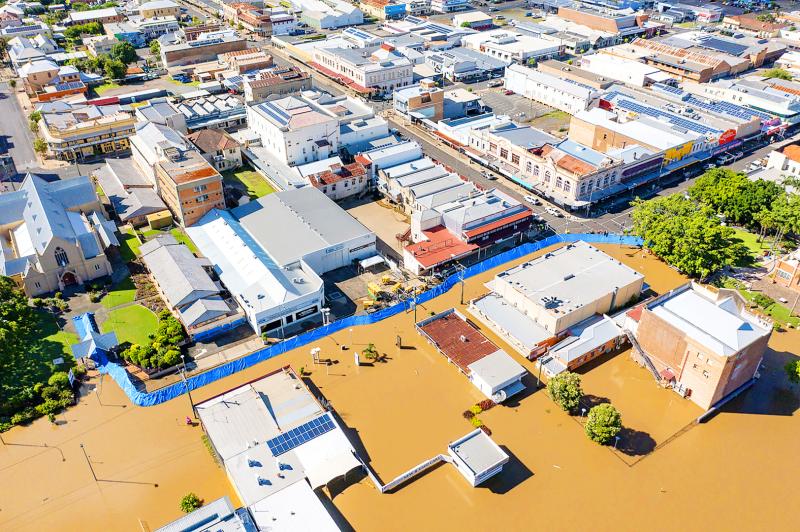
Photo: AP / Queensland Fire and Emergency Services
MANHOLE TRAP
There were concerns that householders who climbed into their roof spaces through ceiling manholes could become trapped by rising waters.
A police rescue officer had saved an elderly woman from such a roof space that was almost filled with water, Lismore State Emergency Service Commander Steve Patterson said.
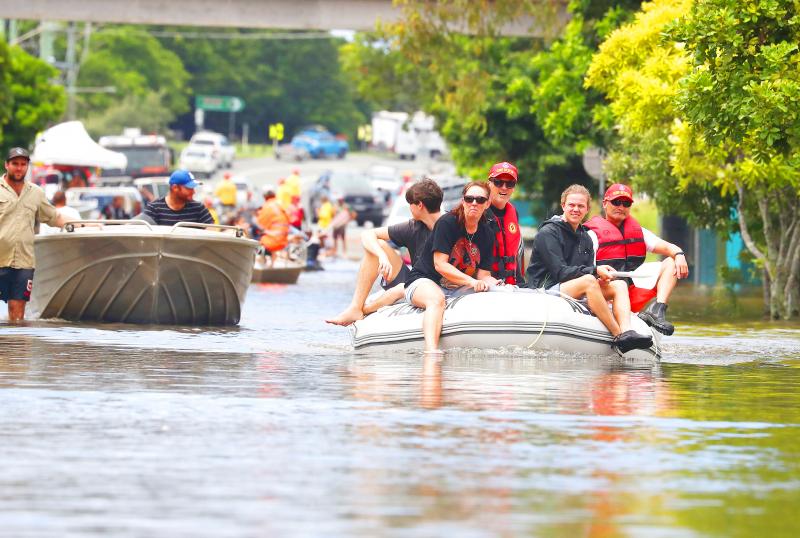
Photo: EPA-EFE
“He dived in through a window, noticed the manhole cover was open, when he checked, found a 93-year-old lady with about 20cm left of space before the water hit the top,” Patterson told Australian Broadcasting Corp.
Dozens of vehicles were trapped on a bridge in the nearby town of Woodburn over Monday night with both the bridge’s approaches submerged.
Up to 50 people were rescued from the bridge early yesterday, officials said.
“We had no capabilities to get them off in the dark so we just had to make sure that they bunkered down, and we went in this morning and got them all out,” Woodburn State Emergency Services Commander Ashley Slapp said.
The flood waters were moving south into New South Wales from Queensland state in the worst disaster in the region since what was described as a once-in-a-century event in 2011.
New South Wales Premier Dominic Perrottet said there had been 1,000 rescues in his state by yesterday and more than 6,000 calls for authorities to help.
Perrottet said 40,000 people had been ordered to evacuate, while 300,000 others had been placed under evacuation warnings.
“We’ll be doing everything ... We can to get everybody to safety and get these communities right across our state back on their feet as quickly as possible,” Perrottet said.
Government meteorologist Jonathan Howe described the amount of recent rainfall in northern New South Wales and southern Queensland as “astronomical.”
Eight of the nine deaths of the current disaster were in Queensland.
Queensland Police Commissioner Katarina Carroll said emergency services held grave concerns for a man aged in his 70s who fell from his moored yacht in the state capital, Brisbane ,into a swollen river on Saturday and for a 76-year-old man who disappeared with his vehicle in flood water northwest of Brisbane on Sunday.
FIRE RISK
The extraordinary rainfall comes as the UN Intergovernmental Panel on Climate Change (IPCC) reported this week that vast swathes of Australia have already lost 20 percent of its rainfall and the country’s fire risk has gone beyond worst-case scenarios developed just a few years ago.
Australia’s hottest and driest year on record was 2019, which ended with devastating wildfires across southeast Australia.
The fires directly killed 33 people and another 400 people were killed by the smoke.
The fires also destroyed more than 3,000 homes and razed 19 million hectares of farmland and forests.
However, two La Nina weather patterns have since brought above-average rainfall to the same regions.
Lesley Hughes, an Australian academic and former lead author of the IPCC assessment reports in 2007 and 2015, said climate change was expected to overwhelm government systems such as flood responses.
“We can see that our emergency services are struggling already to cope with the floods in northern New South Wales with people stranded on roofs without food for more than 24 hours,” Hughes said.

‘CROSSING THE LINE’: China’s embassy in Seoul criticized US Forces Korea Commander General Xavier Brunson, asking if his ‘hostile’ remarks were authorized by Washington South Korea and the US are in talks over recent public remarks by the commander of US Forces Korea, Seoul’s presidential office said yesterday, after the comments drew sharp criticism from China. In a recent podcast interview, US Forces Korea Commander General Xavier Brunson described South Korea as “the dagger in the heart of Asia” from China’s east coast, prompting the Chinese embassy in Seoul to say that he had “truly crossed the line.” The interview came amid growing speculation that Washington might seek to expand the role of US Forces Korea in countering the growing regional influence of China, a key

SEEKING ORDER: Rodrigo Paz said that ‘anyone who wants to destroy the nation will have to deal with this president and the full force of the constitution’ Bolivian President Rodrigo Paz on Wednesday said that the nation was at a “breaking point” after nearly a month of protests that have caused shortages of food, fuel and medicine. Paz, who took office six months ago amid the worst economic crisis there in four decades, is battling a groundswell of fury over his policies. The political capital, La Paz, has been besieged by low-income workers and members of the indigenous majority calling for his resignation. “The country needs order and is reaching breaking point,” the 58-year-old said at a public event in La Paz, renewing his appeal for dialogue. On Tuesday, the Bolivian

Australian researchers have trained lab-grown brain cells on a silicon computer chip to play the 1990s shooter game Doom and said they are just scratching the surface of what the neurons could be capable of doing. It is the science-fiction work of biotech boffins at Cortical Labs, who researched and developed the technology that harnesses the workings of the brain’s networking system. Each so-called “biological computer” contains about 200,000 living human brain cells, grown from stem cells that were harvested from blood donations. Having mastered the simple computer game Pong, where a paddle is moved up and down to send a ball

Through the noise of rushing papers and whirring belts at a print factory in Kyoto, two creators watch their photo essay come to life in broadsheet form — part of an effort to win new audiences in the age of artificial intelligence (AI). Despite the decline of the publishing industry, self-publication and handmade “zine” magazines are growing in popularity in Japan, reflecting the nation’s enduring love of paper in the digital era. While speaking to Agence France-Presse at the plant, his hands black with ink, one of the creators, Kazuma Obara, said: “I think [paper] is a medium that engages all five


 RSS
RSS