


The Dominican government on Sunday began building a wall that is to cover almost half of the 392km border with Haiti, its only land neighbor, to stop irregular migration and the smuggling of goods, weapons and drugs.
While the two countries share the island of Hispaniola, they are worlds apart in terms of development. Crime-plagued Haiti is one of the poorest nations in the Americas, while the Dominican Republic, a popular Caribbean tourist destination, has prospered in the past few decades amid marked political stability.
Many Haitians cross the border clandestinely in search of work in the fields or in the construction industry in the Dominican Republic.
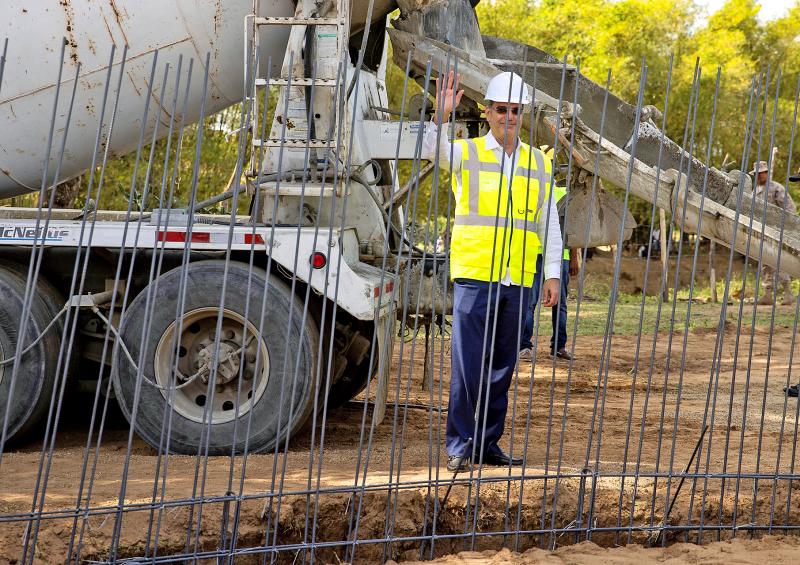
Photo: EPA-EFE
“The benefit for both nations will be of great importance,” Dominican President Luis Abinader said shortly before pushing the button to begin pouring concrete into the foundations of what is to be the wall in Dajabon Province, about 230km northwest of the capital.
About 500,000 Haitians and tens of thousands of their descendents live in the Dominican Republic, a Spanish-speaking nation of about 11 million people, the most recent immigration survey conducted in 2018 showed.
Abinader predicted that the border wall would reduce the smuggling of commercial goods, weapons and help fight organized crime in both nations.
He started the project to build a 164km wall ahead of the anniversary of the Dominican Republic’s independence from Haiti on Feb. 27, 1844.
Abinader said the first phase of the project would be completed within nine months at the latest.
The 20cm-thick concrete wall topped by a metal mesh is to be 3.9m-high and have fiber optics for communications, movement sensors, cameras, radars and drones.
The project also includes the construction of 70 watchtowers and 41 access gates for patrolling.

When a hiker fell from a 55m waterfall in wild New Zealand bush, rescuers were forced to evacuate the badly hurt woman without her dog, which could not be found. After strangers raised thousands of dollars for a search, border collie Molly was flown to safety by a helicopter pilot who was determined to reunite the pet and the owner. A week earlier, an emergency rescue helicopter found the woman with bruises and lacerations after a fall at a rocky spot at the waterfall on the South Island’s West Coast. She was airlifted on March 24, but they were forced to

CONFIDENCE BOOSTER: ’After parkour ... you dare to do a lot of things that you think only young people can do,’ a 67-year-old parkour enthusiast said In a corner of suburban Singapore, Betty Boon vaults a guardrail, crawls underneath a slide, executes forward shoulder rolls and scales a steep slope, finishing the course to applause. “Good job,” the 69-year-old’s coach cheers. This is “geriatric parkour,” where about 20 retirees learned to tackle a series of relatively demanding exercises, building their agility and enjoying a sense of camaraderie. Boon, an upbeat grandmother, said learning parkour has aided her confidence and independence as she ages. “When you’re weak, you will be dependent on someone,” she said after sweating it out with her parkour classmates in suburban Toa Payoh,

HIGH HOPES: The power source is expected to have a future, as it is not dependent on the weather or light, and could be useful for places with large desalination facilities A Japanese water plant is harnessing the natural process of osmosis to generate renewable energy that could one day become a common power source. The possibility of generating power from osmosis — when water molecules pass from a less salty solution to a more salty one — has long been known. However, actually generating energy from that has proved more complicated, in part due the difficulty of designing the membrane through which the molecules pass. Engineers in Fukuoka, Japan, and their private partners think they might have cracked it, and have opened what is only the world’s second osmotic power plant. It generates

Chinese dissident artist Gao Zhen (高兟), famous for making provocative satirical sculptures of former Chinese leader Mao Zedong (毛澤東), was tried on Monday over accusations of “defaming national heroes and martyrs,” his wife and a rights group said. Gao, 69, who was detained in 2024 during a visit from the US, faces a maximum three-year prison sentence, said his wife, Zhao Yaliang (趙雅良), and Shane Yi, a researcher at the Chinese Human Rights Defenders group which operates outside the nation. The closed-door, one-day trial took place at Sanhe City People’s Court in Hebei Province neighboring the capital, Beijing, and ended without a


 RSS
RSS