


The highly anticipated return of Friends to Chinese streaming platforms soured quickly after fans noticed that a LGBTQ plotline was cut from the US sitcom — and their complaints were censored, too.
China’s top platforms started streaming the series on Friday, but the back story of a lesbian character was absent from the first season’s second episode.
Fans flooded social media with complaints about the removal, with the top-trending hashtag “Friends censored” racking up tens of millions of views on the Sina Weibo microblog.
“I compared this episode and found that all the lines referring to Ross’ ex-wife Carol being a lesbian were deleted. It’s very clearly disjointed,” wrote one user, whose post gained more than 177,000 likes.
Foreign films and television programs that include content authorities consider “sensitive,” such as LGBTQ themes, sex, politics and violence, are routinely censored in China.
“Why would there be a need to mention it? Homosexuality doesn’t exist here, so it’s perfect forever. Everyone’s happy living under this government,” read another seemingly sarcastic comment.
The criticism was also censored on the weekend, and the protest hashtag was replaced by “Why is friends so popular” on Sunday.
Friends, which follows a group of six young people in New York, originally ran from 1994 to 2004 in the US.
It also became an international phenomenon, including in China, where it is hugely popular among millennials. Many young Chinese learned English by watching it on DVDs.
The series first ran in China — uncensored — on the streaming platform Sohu between 2012 and 2013.
Following the popularity of last year’s reunion show, the country’s streaming giants, including Bilibili, Tencent, iQiyi and Youku, decided to relaunch a censored version.
In addition to omitting the LGBTQ plotline in season one, sexually suggestive lines have been translated differently in the Chinese subtitles of the relaunched version to remove the innuendo.
The fan furore over Friends was just the latest such wave of complaints from Chinese fans.
In 2019, multiple scenes in the film Bohemian Rhapsody referencing queer music superstar Freddie Mercury’s sexuality were dropped in its China release.
Under Chinese President Xi Jinping (習近平), authorities have pushed to purge society and culture of elements they deem unhealthy.
Guidelines released by the top media regulator in 2016 prohibited “vulgar, immoral and unhealthy content” in TV shows, such as homosexuality, smoking, extramarital affairs and underage relationships.

Crowds in Bangladesh are flocking to snap photographs with an unlikely social media star — an albino buffalo with flowing blond hair nicknamed “Donald Trump” that is due to be sacrificed within days. Owner Zia Uddin Mridha, 38, said his brother named the 700kg bull over its flowing helmet of hair resembling the signature look of the US president. “My younger brother picked this name because of the buffalo’s extraordinary hair,” he said at his farm in Narayanganj, just outside the capital, Dhaka. Mridha said that a constant stream of curious visitors — social media fans, onlookers and children — have come throughout

It began as a satirical online project. Now millions of young people in India are flocking to it as an outlet for their frustration. A parody political party called the Cockroach Janta Party, with the insect as its symbol, has exploded across India’s social media by turning absurdist humor into protest. Memes and short videos mocking corruption, joblessness and political dysfunction have flooded social media sites, where millions of users are embracing the cockroach — known for its ability to survive harsh conditions — as a tongue-in-cheek symbol of endurance. The online movement’s rise has been unusually rapid. The Cockroach Janta Party (CJP)
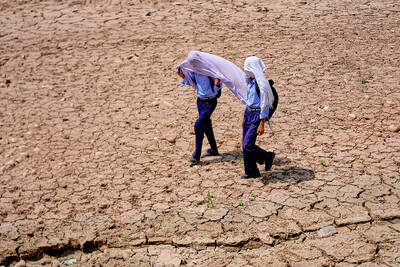
HOTTER: While Indians are accustomed to summer heat, climate change has caused northwestern India to warm faster than other parts of the country, an academic said Roads and markets have emptied during afternoons and some farmers have switched to nighttime work to avoid scorching temperatures as a heat wave grips large parts of India. The India Meteorological Department forecast maximum temperatures for yesterday of about 45°C in the capital, New Delhi, where authorities have opened temporary “cooling zones” to help people cope. The weather department warned that conditions would likely persist across several northern regions in the coming days, with temperatures staying well above seasonal averages. Authorities urged people to stay indoors during the hottest hours and take precautions against heat-related illnesses. India declares a heat wave whenever maximum temperatures

BIGGER ROLE: Beijing has said it maintains an impartial stance on the war in Ukraine, but by training Russian troops, China is far more involved than previously known China’s armed forces secretly trained about 200 Russian military personnel in China late last year, and some have since returned to fight in Ukraine, according to three European intelligence agencies and documents seen by Reuters. While China and Russia have held a number of joint military exercises since Moscow’s full-scale invasion of Ukraine in 2022, Beijing has repeatedly said that it is neutral in the conflict and presents itself as a peace mediator. The covert training sessions, which predominantly focused on the use of drones, were outlined in a dual-language Russian-Chinese agreement signed by senior Russian and Chinese officers in Beijing on


 RSS
RSS