


A huge designer property in Beijing and millions of dollars hidden in seafood boxes — a state television series on China’s anti-graft campaign is captivating viewers and lifting the lid on officials brought down on graft charges.
A staggering number of Chinese Communist Party cadres have been caught up in Chinese President Xi Jinping’s (習近平) anti-corruption drive in the past few years, which critics say has also served as a way to remove political enemies since he came to power in 2013.
The ongoing five-part series aired by state broadcaster China Central Television (CCTV) shows televised confessions by officials accused of corruption, including former Chinese deputy minister of public security Sun Lijun (孫力軍).
Sun — who oversaw security in Hong Kong during months of unrest — is facing allegations that include taking bribes, manipulating the stock market, illegally possessing firearms and paying for sex.
The TV series claimed Sun received regular bribes worth US$14 million disguised as “small seafood boxes” from a man he later appointed as police chief in Jiangsu Province.
“I helped him all this way,” Sun said on the program.
It is common practice for CCTV to air “confessions” by criminal suspects, including former officials, before they have even appeared in court — something widely condemned by rights groups.
Another episode featured imprisoned Chen Gang (陳剛) of the China Association for Science and Technology — who was said to have built a 72,000m2 private compound complete with a Chinese-style residence, swimming pool and artificial beach with illicit funds.
Others featured were accused of taking millions in bribes.
Those convicted of corruption can be stripped of their wealth, party membership and face a lifetime behind bars or even death.
More than 1 million officials have been punished under the anti-corruption campaign so far, which has been a cornerstone of Xi’s tenure.
Wang Fuyu (王富玉), who featured in the second episode of the series, was given a death sentence with a two-year reprieve on Monday — a day after his confession was aired.
Hundreds of millions took to social media in China to dissect the series, most angered by the luxuries the officials had enjoyed.
One user said that the men did not seem to be remorseful and had, on the contrary, “lived a wonderful life” and were “unable to hide their pride.”
Some feared the display of excessive wealth was more likely to be appealing.
“Is this a damned civil servant recruitment advertisement?” one skeptic wrote.

ACTIONABLE ADVICE: The majority of chatbots tested provided guidance on weapons, tactics and target selections, with Perplexity and Meta AI deemed to be the least safe From school shootings to synagogue bombings, leading artificial intelligence (AI) chatbots helped researchers plot violent attacks, according to a study published on Wednesday that highlighted the technology’s potential for real-world harm. Researchers from the nonprofit watchdog Center for Countering Digital Hate and CNN posed as 13-year-old boys in the US and Ireland to test 10 chatbots, including ChatGPT, Google Gemini, Perplexity, Deepseek and Meta AI. Eight of the chatbots assisted the make-believe attackers in more than half the responses, providing advice on “locations to target” and “weapons to use” in an attack, the study said. The chatbots had become a “powerful accelerant for
Australians were downloading virtual private networks (VPNs) in droves, while one of the world’s largest porn distributors said it was blocking users from its platforms as the country yesterday rolled out sweeping online age restriction. Australia in December became the first country to impose a nationwide ban on teenagers using social media. A separate law now requires artificial intelligence (AI)-powered chatbot services to keep certain content — including pornography, extreme violence and self-harm and eating disorder material — from minors or face fines of up to A$49.5 million (US$34.6 million). The country also joined Britain, France and dozens of US states requiring
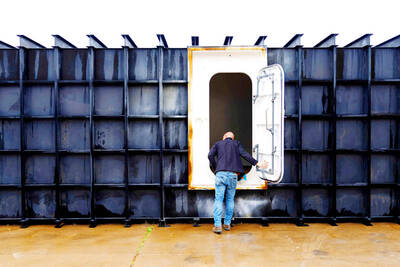
Since the war in the Middle East began nearly two weeks ago, the telephone at Ron Hubbard’s bomb shelter company in Texas has not stopped ringing. Foreign and US clients are rushing to buy his bunkers, seeking refuge in case of air raids, nuclear fallout or apocalypse. With the US and Israel pounding Iran, and Tehran retaliating with strikes across the region, Hubbard has seen demand for his product soar, mostly from Gulf nation customers in Bahrain, Qatar, Kuwait and the United Arab Emirates. “You can imagine how many people are thinking: ‘I wish I had a bomb shelter,’” Hubbard, 63, said in

STILL IN POWER: US intelligence reports showed that the Iranian regime is not in danger of collapse and retains control of the public, casting doubt on Trump’s exit Nearly every US Senate Democrat on Wednesday signed a letter sent to US Secretary of Defense Pete Hegseth requesting a “swift investigation” of airstrikes on a girls’ school in Iran that killed scores of children and any other potential US military actions causing civilian harm. Reuters reported on Thursday last week that US military investigators believe it is likely that US forces were responsible for the Feb. 28 strike on the school, as US and Israeli forces launched attacks on Iran. “The results of this school attack are horrific. The majority of those killed in the strikes were girls between the ages


 RSS
RSS