


In Papua New Guinea’s isolated Star Mountains, indigenous people say that the tree kangaroo is king and the bird of paradise is queen. Both have a price on their heads.
These extraordinary species have long been prized by traditional hunters, but conservationists now fear that the forests they live in, one of Earth’s last great wilderness areas, could soon fall to axe and bulldozer.
“Old people say tree kangaroo is the king,” said Lloyd Leo, a young resident of Golgubip, a mountain community where most people are still subsistence farmers whose ancestors lived a neolithic lifestyle until only decades ago.
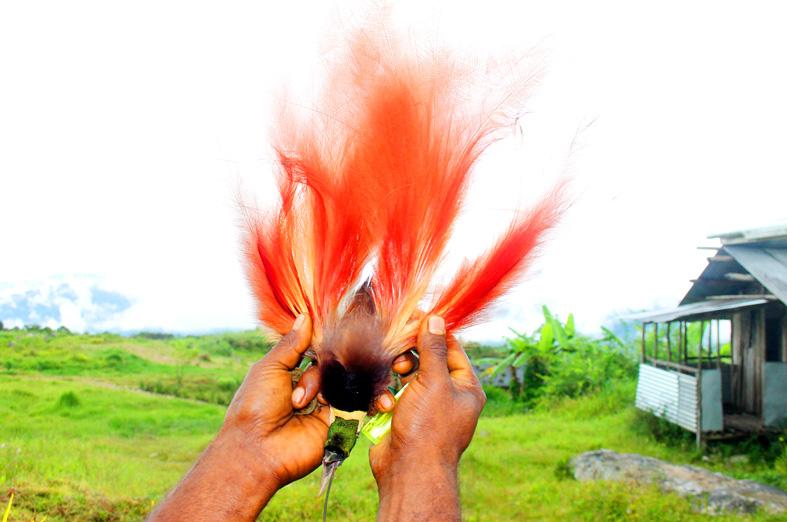
Photo: AFP
“He lives high in the forest. Certain fruits he doesn’t eat. He only takes the fresh ones,” he said.
The marsupial, which looks like a mix of a kangaroo and a lemur, was once a form of currency, used to pay bride prices. Its tail is still worn as an emblem.
The creature is listed among the planet’s most threatened species, deemed critically endangered on the International Union for Conservation of Nature’s (IUCN) Red List.
Two species of birds of paradise also live in the area, and one, called “karom” in the local Faiwol language, is considered the queen of birds by locals.
People hunt them on a small scale, despite it being illegal. The feathers and stuffed birds are prized, kept in homes and brought out for festivals.
However, the trees around Golgubip are also valuable, as are others like them across Papua New Guinea — and the dual threat of deforestation and hunting might seal the fate of the nation’s unique creatures.
“In the villages, there is a general expectation of economic development, which is by and large not happening,” said Vojtech Novotny, a biologist at the New Guinea Binatang Research Center. “People will become desperate and go for development at any cost.”
The country’s population has about tripled since independence in 1975, and now stands at more than 9 million.
With fewer forests left in Southeast Asia, and much of the land converted to palm oil plantations, some logging firms are turning attention to Papua New Guinea, said Novotny, who has worked in the country for 25 years.
In the past, authorities mainly allowed “selective” logging, which enables forests to quickly recover. That might be changing, he said.
“There is now pressure for large agriculture projects. The big issue here is oil palm. Once you have the first cut, you come for the second and third. Very soon you destroy the forest structure. That happened basically in Borneo,” Novotny said.
The monitoring Web site Global Forest Watch says that forests in 2010 covered 93 percent of Papua New Guinea’s land surface.
However, the country has seen a 3.7 percent decrease in tree cover since 2000, it said.
At this year’s COP 26 climate summit, Papua New Guinea was among about 100 countries to pledge to end deforestation by 2030.
However, illegal logging has become such a problem that non-governmental organizations and some local politicians have demanded authorities take urgent action now.
The Raggiana bird of paradise is featured on the country’s flag and although officially only one related species, the blue bird of paradise, is listed as “vulnerable” by the IUCN, biologists say that no one really knows their status for sure.
There are also concerns about another bird, Pesquet’s parrot, which has distinctive red and black feathers that are worn in traditional dress for indigenous ceremonies.
“These bright red feathers are very highly prized for headdresses,” said Brett Smith, a curator at the Port Moresby Nature Park, adding that it appeared there were more Pesquet’s parrot feathers now in tribal dress than on living birds.
Biologists say that they want to involve more Papua New Guineans in conservation, although it has proved hard, in the face of poverty, a lack of education and low awareness of the effects humans can have on the environment.
However, there have been success stories.
As headhunting declined in the pig-nosed turtles’ habitat, more people moved in and the rare creature became part of the local diet, Piku Biodiversity Network director Yolarnie Amepou said.
However, by involving local children in the preservation of key species, the network created a generation — now adults — invested in the pig-nosed turtles’ survival, Amepou said, adding that hunting has now eased off.
“This environment is what they depend on every day. If we want to save the turtle we have to fix the people,” she said.

Through the noise of rushing papers and whirring belts at a print factory in Kyoto, two creators watch their photo essay come to life in broadsheet form — part of an effort to win new audiences in the age of artificial intelligence (AI). Despite the decline of the publishing industry, self-publication and handmade “zine” magazines are growing in popularity in Japan, reflecting the nation’s enduring love of paper in the digital era. While speaking to Agence France-Presse at the plant, his hands black with ink, one of the creators, Kazuma Obara, said: “I think [paper] is a medium that engages all five

‘ABSURD MISTAKE’: The election commission said that there had been a failure to anticipate turnout after 14 polling stations ran short of ballot papers South Korean riot police yesterday cleared protesters from a Seoul polling station after a 35-hour blockade sparked by a shortage of ballot papers during local elections earlier this week. Wednesday’s election was the first nationwide vote since South Korean President Lee Jae-myung took office following the ouster of Yoon Suk-yeol over his short-lived martial law declaration. Lee’s ruling Democratic Party swept most races, but failed to flip the crucial Seoul mayoral seat. The South Korean National Election Commission apologized, blaming a failure to anticipate turnout after 14 polling stations in Seoul ran short of ballot papers. Some polling stations stayed open until 10pm to

Australian researchers have trained lab-grown brain cells on a silicon computer chip to play the 1990s shooter game Doom and said they are just scratching the surface of what the neurons could be capable of doing. It is the science-fiction work of biotech boffins at Cortical Labs, who researched and developed the technology that harnesses the workings of the brain’s networking system. Each so-called “biological computer” contains about 200,000 living human brain cells, grown from stem cells that were harvested from blood donations. Having mastered the simple computer game Pong, where a paddle is moved up and down to send a ball

France experienced its hottest spring on record, the French weather service said on Tuesday, after an exceptional early heat wave that also broke highs for the season in England and Wales. Meteo-France said the average nationwide temperature over March to May was 13.8°C — about 1.7°C above the norm, and surpassing records set in 2011 and 2020. “The warmest spring since records began in 1900,” it said in a bulletin. All three months were warmer than average, but the onset of an “unprecedented heatwave” late last month pushed the mercury to highs typically seen at the height of the summer. “Our country had never


 RSS
RSS