


The Taliban on Tuesday announced a ban on the use of foreign currency in Afghanistan, a move sure to cause further disruption to an economy pushed to the brink of collapset.
The surprise move came hours after at least 25 people were killed and more than 50 wounded when gunmen attacked Afghanistan’s biggest military hospital after two heavy explosions at the site in central Kabul.
“The economic situation and national interests in the country require that all Afghans use Afghan currency in their every trade,” the Taliban said in a statement.
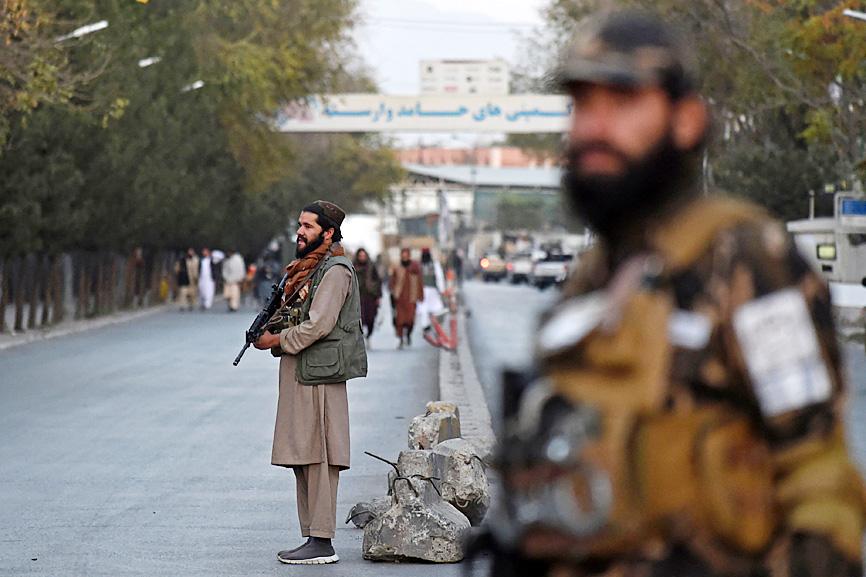
Photo: AFP
The use of US dollars is widespread at Afghanistan’s markets, while border areas use the currency of neighboring countries, such as Pakistan, for trade.
The Taliban government is pressing for the release of billions of US dollars of central bank reserves as the drought-stricken nation faces a cash crunch, mass starvation and a new migration crisis.
Afghanistan had parked billions of US dollars in assets overseas with the US Federal Reserve and other central banks in Europe, but that money has been frozen since the Taliban ousted the Western-backed government in August.
US-led forces and many international donors departed, leaving the country without grants that financed three-quarters of public spending.
The Afghan Ministry of Finance said that it had a daily tax take of about 400 million Afghanis (US$4.4 million).
Yesterday, officials said that a Taliban commander was among the fighters killed when his men responded to an Islamic State attack on Sardar Daud Khan Hospital.
Hamdullah Mokhlis, a member of the Haqqani network and an officer in the Badri Corps special forces, is the most senior figure to have been killed since the Taliban seized the capital.
“When he got the information that Sardar Daud Khan Hospital was under attack, Maulvi Hamdullah [Mokhlis], the commander of the Kabul corps, immediately rushed to the scene,” a Taliban media official said.
“We tried to stop him, but he laughed. Later we found out that he was martyred in the face-to-face fight at the hospital,” he added.
The attack — claimed by the Taliban’s hardline rivals, the Islamic State-Khorasan (IS-K) — began with a suicide bomber detonating his explosives near the hospital’s entrance.
The Taliban deployed special forces to the roof of the building in a helicopter.
In a statement released on its Telegram channels, IS-K said: “Five Islamic State group fighters carried out simultaneous coordinated attacks.”
Taliban spokesman Zabiullah Mujahid played down the death toll, saying that the attack was put down within 15 minutes thanks to the rapid intervention.
Additional reporting by AFP

Kouri Richins, a Utah mother who published a children’s book about grief after the death of her husband is to serve a life sentence for his murder without the possibility of parole, a judge ruled on Wednesday. Richins was convicted in March of aggravated murder for lacing a cocktail given to her husband, Eric Richins, with five times the lethal dose of fentanyl at their home near Park City in 2022. A jury also found her guilty of four other felonies, including insurance fraud, forgery and attempted murder for trying to poison her husband weeks earlier on Feb. 14, 2022, with a

‘PERSONAL MISTAKES’: Eileen Wang has agreed to plead guilty to the felony, which comes with a maximum sentence of 10 years in federal prison A southern California mayor has agreed to plead guilty to acting as an illegal agent for the Chinese government and has resigned from her city position, officials said on Monday. Eileen Wang (王愛琳), mayor of Arcadia, was charged last month with one count of acting in the US as an illegal agent of a foreign government. She was accused of doing the bidding of Chinese officials, such as sharing articles favorable to Beijing, without prior notification to the US government as required by law. The 58-year-old was elected in November 2022 to a five-person city council, from which the mayor is selected

DELA ROSA CASE: The whereabouts of the senator, who is wanted by the ICC, was unclear, while President Marcos faces a political test over the senate situation Philippine authorities yesterday were seeking confirmation of reports that a top politician wanted by the International Criminal Court (ICC) had fled, a day after gunfire rang out at the Philippine Senate where he had taken refuge fearing his arrest. Senator Ronald “Bato” dela Rosa, the former national police chief and top enforcer of former Philippine president Rodrigo Duterte’s “war on drugs,” has been under Senate protection and is wanted for crimes against humanity, the same charges Duterte is accused of. “Several sources confirmed that the senator, Senator Bato, is no longer in the Senate premises, but we are still getting confirmation,” Presidential

HELP DENIED? The US Department of State said that the Cuban leadership refuses to allow the US to provide aid to Cubans, ‘who are in desperate need of assistance’ US Secretary of State Marco Rubio on Wednesday said that Cuba’s leadership must change, as Washington renewed an offer of US$100 million in aid if the communist nation agrees to cooperate. Cuba has been suffering severe economic tumult led by an energy shortage that plunged 65 percent of the country into darkness on Tuesday. Cuba’s leaders have blamed US sanctions, but Rubio, a Cuban American and critic of the government established by Fidel Castro, said the system was to blame, including corruption by the military. “It’s a broken, nonfunctional economy, and it’s impossible to change it. I wish it were different,” he told


 RSS
RSS