


Jeff Bezos’ Blue Origin on Monday announced that it wants to launch a space station that would house up to 10 people in the second half of this decade, as the race to commercialize the cosmos heats up.
“Orbital Reef,” described in a statement as a mixed-use business park in space that would support microgravity research and manufacturing, is a joint venture with commercial space company Sierra Space, and has the support of Boeing and Arizona State University.
“For over 60 years, NASA and other space agencies have developed orbital space flight and space habitation, setting us up for commercial business to take off in this decade,” Blue Origin executive Brent Sherwood said. “We will expand access, lower the cost, and provide all the services and amenities needed to normalize space flight.”

Photo: AFP / Blue Origin
The private outpost is one of several planned as NASA considers the future of the International Space Station (ISS) after the 2020s.
The space agency holds a contract with a company called Axiom to develop a space station that would initially dock with the ISS and later become free-flying.
Space services company Nanoracks, in collaboration with Voyager Space and Lockheed Martin, last week announced a planned space station that would be operational by 2027 and be known as Starlab.
Orbital Reef would fly at an altitude of 500km, slightly above the ISS, with inhabitants experiencing 32 sunrises and sunsets a day, a fact sheet released by Blue Origin says.
It would support 10 people in a volume of 830m3, which is slightly smaller than the ISS, in futuristic modules with huge windows.
The ISS was completed in 2011 and has long been a symbol of US-Russia space cooperation, though Moscow has equivocated on the future of the partnership.
It is rated as safe until 2028 and NASA administrator Bill Nelson has said he hopes it would last until 2030, by which time NASA wants the commercial sector to step up and replace it.
Blue Origin is currently only able to fly to suborbital space with its New Shepard rocket, which blasted Star Trek actor William Shatner beyond the atmosphere earlier this month.
Its other planned projects include New Glenn, a rocket that could fly cargo and people into orbit, and a lunar lander — though it lost the moon contract to rival SpaceX and is suing NASA.
Bezos founded Blue Origin in 2000 with the goal of one day building floating space colonies with artificial gravity where millions of people would work and live, freeing the Earth from pollution.
The colonies would be based on a design by Gerard O’Neill, Bezos’ physics professor at Princeton University, and would consist of counter-rotating cylinders providing artificial gravity.


Showcasing phallus-shaped portable shrines and pink penis candies, Japan’s annual fertility festival yesterday teemed with tourists, couples and families elated by its open display of sex. The spring Kanamara Matsuri near Tokyo features colorfully dressed worshipers carrying a trio of giant phallic-shaped objects as they parade through the street with glee. The festival, as legend has it, honors a local blacksmith in the Edo Period (1603-1868) who forged an iron dildo to break the teeth of a sharp-toothed demon inhabiting a woman’s vagina that had been castrating young men on their wedding nights. A 1m black steel phallus sits in the courtyard of

JAN. 1 CLAUSE: As military service is voluntary, applications for permission to stay abroad for over three months for men up to age 45 must, in principle, be granted A little-noticed clause in sweeping changes to Germany’s military service policy has triggered an uproar after it emerged that the law requires men aged up to 45 to get permission from the armed forces before any significant stay abroad, even in peacetime. The legislation, which went into effect on Jan. 1 aims to bolster the military and demands all 18-year-old men fill out a questionnaire to gauge their suitability to serve in the armed forces, but stops short of conscription. If the “modernized” model fails to pull in enough recruits, parliament will be compelled to discuss the reintroduction of compulsory service, German
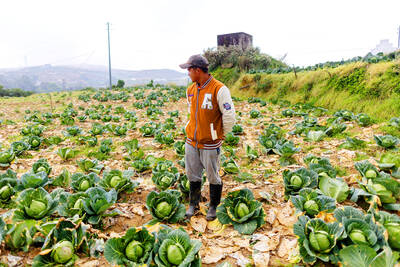
Filipino farmers like Romeo Wagayan have been left with little choice but to let their vegetables rot in the field rather than sell them at a loss, as rising oil prices linked to the Iran war drive up the cost of harvesting, labor and transport. “There’s nothing we can do,” said Wagayan, a 57-year old vegetable farmer in the northern Philippine province of Benguet. “If we harvest it, our losses only increase because of labor, transportation and packing costs. We don’t earn anything from it. That’s why we decided not to harvest at all,” he said. Soaring costs caused by the Middle East

Hungarian Prime Minister Viktor Orban’s officially declared wealth is fairly modest: some savings and a jointly owned villa in Budapest. However, voters in what Transparency International deems the EU’s most corrupt country believe otherwise — and they might make Orban pay in a general election this Sunday that could spell an end to his 16-year rule. The wealth amassed by Orban’s inner circle is fueling the increasingly palpable frustration of a population grappling with sluggish growth, high inflation and worsening public services. “The government’s communication machine worked well as long as our economic situation remained relatively good,” said Zoltan Ranschburg, a political analyst


 RSS
RSS