


In Hollywood’s latest attempt to score in the huge — but highly restrictive — Chinese market, an Asian actor has been cast as a leading Marvel superhero for the first time.
Shang-Chi and the Legend of the Ten Rings, out tomorrow, takes the 25th installment in the wildly popular Marvel film series into mythical China, where enormous beasts, mysticism and kung fu collide for a tale about the difficult relationship between a son and his father.
The titular son — played by relatively unknown Chinese Canadian actor Simu Liu (劉思慕) — fled his controlling dad as a teenager, after being sculpted into a deadly assassin, and washes up in the US.
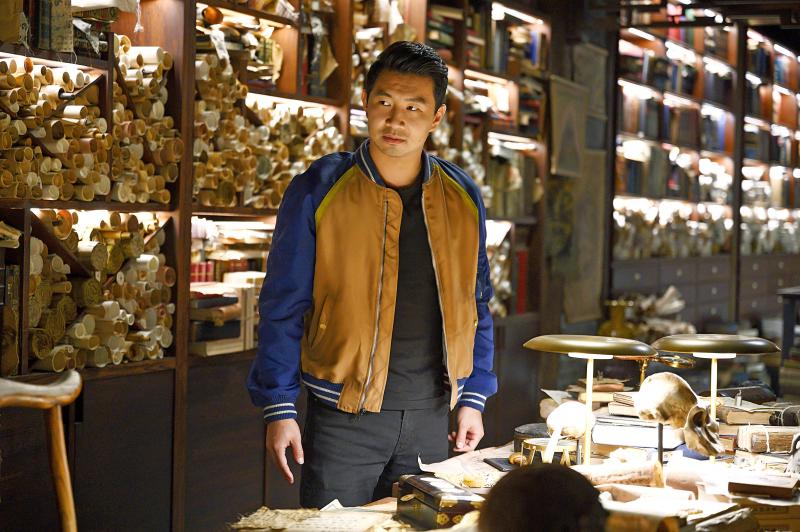
Photo: AP
There he lives anonymously, palling around with the underachieving Katy — played by Awkwafina, known from her role in Crazy Rich Asians — until his father — Hong Kong superstar Tony Leung (梁朝偉) — sends a sinister gang to chase him home.
Shang-Chi locates itself firmly in the record-grossing Marvel Cinematic Universe series of movies, with an amusing reprisal of Ben Kingsley’s washed-up actor Trevor Slattery from Iron Man 3.
However, its value for Marvel Studios, and owner Disney, was expected to be as a vehicle for expanding into the Chinese market.
“It’s very moving because it’s been a long time coming to have an Asian superhero, and a movie that celebrates not only our culture, but our humanity,” Asian-American actress Jodi Long told reporters at the film’s world premiere in Los Angeles. “And I think that’s really important in this time of COVID and xenophobia.”
Yet despite a predominantly Asian cast, and huge swathes of dialogue in Mandarin — both predicted to be popular among China’s cinemagoers — success for Shang-Chi is far from guaranteed.
Like the previous Marvel film Black Widow, the film has no release date in China, where movie theaters reopening this summer are stocked largely with domestic, patriotic features.
As well as protecting Chinese filmmaking, this could reflect growing discontent with Disney-owned Marvel, whose next big superhero outing Eternals is being directed by Beijing-born Chloe Zhao (趙婷).
Zhao this year won two Oscars including an historic best director statuette for Nomadland, but her success has been censored in China after a nationalist backlash over years-old interviews in which she appeared to criticize her country of birth.
Excitement in China for Shang-Chi also appears to be lukewarm among some social media users.
“This movie will only deepen the world’s stereotype of us,” one user of a microblogging site wrote. “Marvel may not want to insult China, but it is a fact that in terms of casting, it has to cater to the American social aesthetic of humiliating China.”
Another user called it “a poor attempt to mint money from Chinese audiences.”
On popular review site Duoban — similar to Rotten Tomatoes — one user bemoaned the notion of an Americanized Chinese man returning to his homeland to do battle with his traditionally minded father.
“Marvel, do you really want to enter China with such a plot?” the user wrote.
Marvel Studios president Kevin Feige sought to tamp down that criticism in an interview with a Chinese film journalist last month, insisting that the narrative is one of the hero returning to his roots.
“That sense of running away ... is presented as one of his flaws,” Variety quoted him as saying during the interview.
Director Destin Daniel Cretton told reporters that filmmakers had worked hard to overcome “some very clear stereotypes that were created in life and society, and that were also part of the original comics.”
“So for me the most important thing to get right in this movie were the characters — that they are relatable, that they are multidimensional, whether they are the hero Shang-Chi or whether they are the quote-unquote villain,” he said

When a hiker fell from a 55m waterfall in wild New Zealand bush, rescuers were forced to evacuate the badly hurt woman without her dog, which could not be found. After strangers raised thousands of dollars for a search, border collie Molly was flown to safety by a helicopter pilot who was determined to reunite the pet and the owner. A week earlier, an emergency rescue helicopter found the woman with bruises and lacerations after a fall at a rocky spot at the waterfall on the South Island’s West Coast. She was airlifted on March 24, but they were forced to
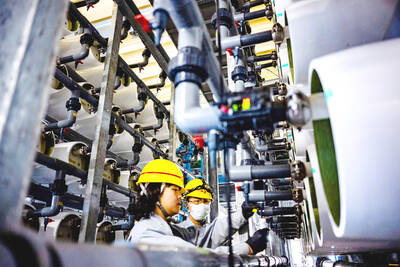
HIGH HOPES: The power source is expected to have a future, as it is not dependent on the weather or light, and could be useful for places with large desalination facilities A Japanese water plant is harnessing the natural process of osmosis to generate renewable energy that could one day become a common power source. The possibility of generating power from osmosis — when water molecules pass from a less salty solution to a more salty one — has long been known. However, actually generating energy from that has proved more complicated, in part due the difficulty of designing the membrane through which the molecules pass. Engineers in Fukuoka, Japan, and their private partners think they might have cracked it, and have opened what is only the world’s second osmotic power plant. It generates

Hundreds of Filipinos and tourists flocked to a sun-bleached field north of Manila yesterday, on Good Friday, to witness one of the country’s most blood-soaked displays of religious fervor, undeterred by rising fuel prices. Scores of bare-chested flagellants with covered faces walked barefoot through the dusty streets of Pampanga Province’s San Fernando as they flogged their backs with bamboo whips in the scorching heat. Agence France-Presse (AFP) journalists said they saw devotees deliberately puncturing their skin with glass shards attached to a small wooden paddle to ensure their bleeding during the ritual, a way to atone for sins and seek miracles from
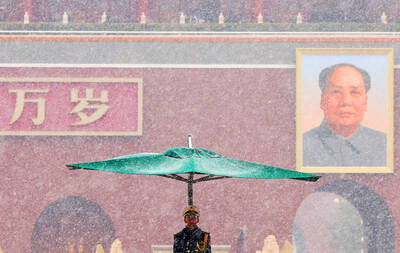
Chinese dissident artist Gao Zhen (高兟), famous for making provocative satirical sculptures of former Chinese leader Mao Zedong (毛澤東), was tried on Monday over accusations of “defaming national heroes and martyrs,” his wife and a rights group said. Gao, 69, who was detained in 2024 during a visit from the US, faces a maximum three-year prison sentence, said his wife, Zhao Yaliang (趙雅良), and Shane Yi, a researcher at the Chinese Human Rights Defenders group which operates outside the nation. The closed-door, one-day trial took place at Sanhe City People’s Court in Hebei Province neighboring the capital, Beijing, and ended without a


 RSS
RSS