


Athletes should not make “political demonstrations” or express their private views on the medal podium at the Tokyo Olympic Games, International Olympic Committee (IOC) president Thomas Bach said yesterday.
The IOC this month relaxed its Rule 50, which had previously forbidden athletes from any protests, but now allows them to make gestures on the field, provided they do so without disruption and with respect for fellow competitors.
However, there is still a threat of sanctions if any protests are made on the medal podium during the Games, which are to be held from Friday next week to Aug. 8.
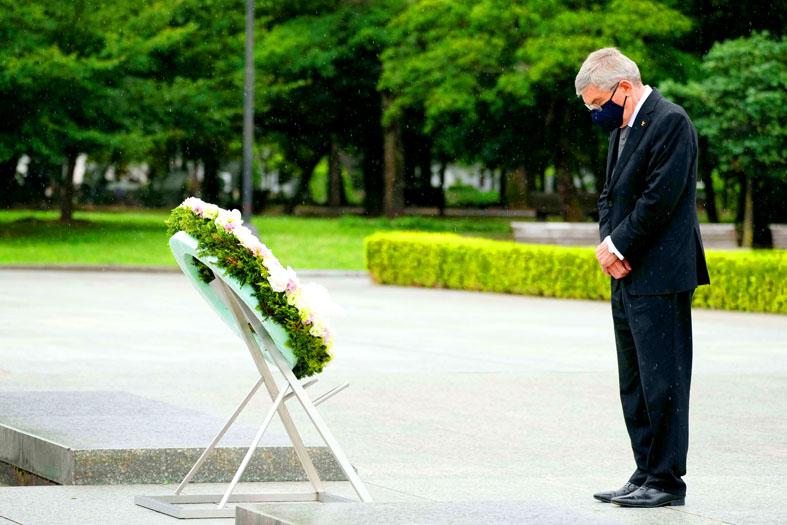
Photo: AFP
“The podium and the medal ceremonies are not made ... for a political or other demonstration,” Bach told the Financial Times.
“They are made to honor the athletes and the medal winners for sporting achievement, and not for their private,” he said. “The mission is to have the entire world together at one place and competing peacefully with each other. This you would never manage if the Games [became] divisive.”
While athlete protests at the Olympics are rare, at the 1968 Mexico City Olympic Games, African American sprinters Tommie Smith and John Carlos were expelled after they bowed their heads and raised black-gloved fists on the podium to protest racial inequality.
At the 2016 Rio Olympic Games, Ethiopian marathon runner Feyisa Lilesa raised his arms and crossed his wrists when crossing the finish line to show support for his Oromo tribe’s protests over Ethiopian government plans to reallocate farmland.
The UK’s women’s soccer coach Hege Riise on Thursday said that her players would take the knee before matches at the Tokyo Games to raise awareness about racism and all forms of discrimination.

PHISHING: The con might appear convincing, as the scam e-mails can coincide with genuine messages from Apple saying you have run out of storage For a while you have been getting messages from Apple saying “your iCloud storage is full.” They say you have exceeded your storage plan, so documents are no longer being backed up, and photos you take are not being uploaded. You have been resisting Apple’s efforts to get you to pay a minimum of £0.99 (US$1.33) a month for more storage, but it seems that you cannot keep putting off the inevitable: You have received an e-mail which says your iCloud account has been blocked, and your photos and videos would be deleted very soon. To keep them you need

For two decades, researchers observed members of the Ngogo chimpanzee group of Kibale National Park in Uganda spend their days eating fruits and leaves, resting, traveling and grooming in their tropical rainforest abode, but this stable community then fractured and descended into years of deadly violence. The researchers are now describing the first clearly documented example of a group of wild chimpanzees splitting into two separate factions, with one launching a series of coordinated attacks against the other. Adult males and infants were targeted, with 28 deaths. “Biting, pounding the victim with their hands, dragging them, kicking them — mostly adult males,

The Israeli military has demolished entire villages as part of its invasion of south Lebanon, rigging homes with explosives and razing them to the ground in massive remote detonations. The Guardian reviewed three videos posted by the Israeli military and on social media, which showed Israel carrying out mass detonations in the villages of Taybeh, Naqoura and Deir Seryan along the Israel-Lebanon border. Lebanese media has reported more mass detonations in other border villages, but satellite imagery was not readily available to verify these claims. The demolitions came after Israeli Minister of Defense Israel Katz called for the destruction of

SUPERFAN: The Japanese PM played keyboard in a Deep Purple tribute band in middle school and then switched to drums at university, she told the British rock band Legendary British rock band Deep Purple yesterday made Japanese Prime Minister Sanae Takaichi’s day with a brief visit to their high-profile superfan as they returned to the nation they first toured more than half a century ago. Takaichi’s reputation as an amateur drummer, and a fan of hard rock and heavy metal has been well documented, and she has referred to Deep Purple as one of her favorite bands along with the likes of Black Sabbath and Iron Maiden. “You are my god,” a giddy Takaichi said in English to Deep Purple drummer Ian Paice, presenting him with a set of made-in-Japan


 RSS
RSS