


With a spiked drink, a puff of dust, missing memories and an empty bank account, several men in Hong Kong’s Wanchai District, an entertainment hotspot, have seen their night out turn into a nightmare as a collapse in tourism brings desperate times.
It took days for Stuart to recall a crucial memory, but after speaking with another victim, it suddenly came flooding back.
A woman had tried to spark a conversation with him outside a bar, and then a man had approached him with a determined look in his eye.
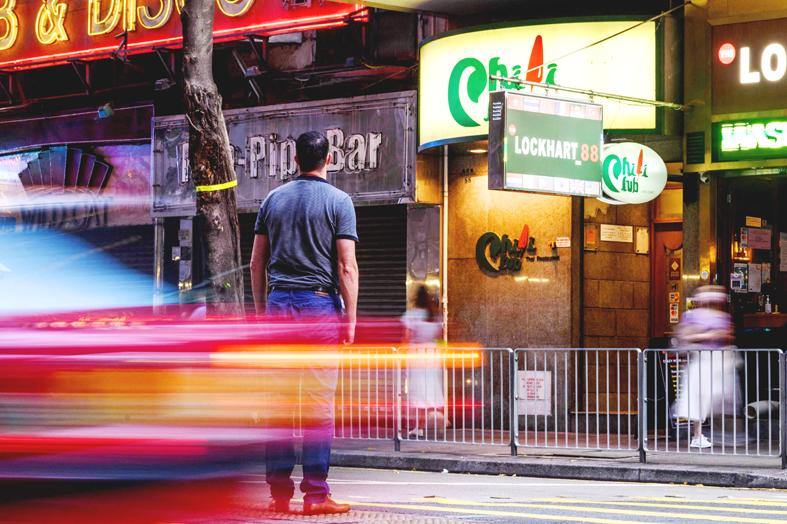
Photo: AFP
“I thought he was going to punch me, but he just blew something in my face,” he said. “I laughed, but that was it — no memories after that.”
It was a breakthrough for Stuart who, like the other victims interviewed for this piece, asked to use a pseudonym.
He had been trying to figure out why post-match drinks with his cricket buddies in Wanchai, a popular hangout for white-collar foreign workers, had turned into one big blackout following his encounter outside the bar.
Hours were missing alongside HK$80,000 (US$10,304) — taken in six separate transactions from nearby ATMs.
“It was a joint account with my missus and we have a baby on the way,” said the 36-year-old Briton, who moved to Hong Kong 18 months ago. “Police said maybe I was just drunk, but why would I empty that account? It wouldn’t be worth my life doing that.”
WhatsApp groups used by Wanchai bar owners and regulars have lit up in recent months with similar stories.
Most targets have no memory and awake to find accounts emptied by scammers who have drugged their unwitting victims — largely by tampering with their drinks — to keep them pliable and obtain their account PINs.
Victims have dubbed the scam “devil’s breath” attacks — technically the nickname for the powerful anti-nausea drug scopolamine, but in this case used more as a catch-all descriptor.
Spiked drinks have previously posed a small risk in Hong Kong, a largely safe territory, but a recession has exacerbated the issue.
“It’s become a huge problem,” said one bar owner, who declined to be named, adding that multiple regulars had become victims.
“The police are up and down here all night, checking our licenses, making sure we abide by COVID-19 pandemic restrictions. But this seems to be something they just don’t, or won’t, tackle,” he added.
The jump in cases tracks with a general rise in opportunistic crime as Hong Kong experiences its worst recession in decades.
Crime figures from last year showed a 26 percent increase in robberies, a 237 percent jump in blackmail and an 89 percent rise in deception. Cybercrime was up 55 percent last year.
In a series of pandemic-themed reports the Global Initiative Against Transnational Organized Crime detailed how the virus has transformed crime trends.
For example, widespread lockdowns and travel restrictions have made break-ins and international drug smuggling harder, but the pandemic has been a boon for human trafficking, extortion, counterfeiting and cybercrime.
Police and bar owners said that most robberies are carried out by teams of sex workers, an already vulnerable group, sometimes with the help of male accomplices.
“We’ve all struggled during the pandemic and that includes the girls,” another bar owner said. “That doesn’t excuse the crime, but it helps explain why.”

When a hiker fell from a 55m waterfall in wild New Zealand bush, rescuers were forced to evacuate the badly hurt woman without her dog, which could not be found. After strangers raised thousands of dollars for a search, border collie Molly was flown to safety by a helicopter pilot who was determined to reunite the pet and the owner. A week earlier, an emergency rescue helicopter found the woman with bruises and lacerations after a fall at a rocky spot at the waterfall on the South Island’s West Coast. She was airlifted on March 24, but they were forced to
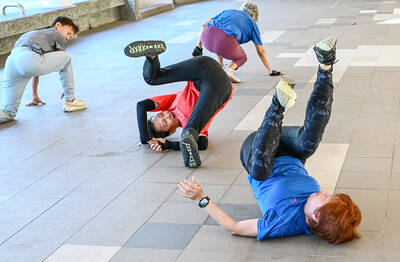
CONFIDENCE BOOSTER: ’After parkour ... you dare to do a lot of things that you think only young people can do,’ a 67-year-old parkour enthusiast said In a corner of suburban Singapore, Betty Boon vaults a guardrail, crawls underneath a slide, executes forward shoulder rolls and scales a steep slope, finishing the course to applause. “Good job,” the 69-year-old’s coach cheers. This is “geriatric parkour,” where about 20 retirees learned to tackle a series of relatively demanding exercises, building their agility and enjoying a sense of camaraderie. Boon, an upbeat grandmother, said learning parkour has aided her confidence and independence as she ages. “When you’re weak, you will be dependent on someone,” she said after sweating it out with her parkour classmates in suburban Toa Payoh,

Chinese dissident artist Gao Zhen (高兟), famous for making provocative satirical sculptures of former Chinese leader Mao Zedong (毛澤東), was tried on Monday over accusations of “defaming national heroes and martyrs,” his wife and a rights group said. Gao, 69, who was detained in 2024 during a visit from the US, faces a maximum three-year prison sentence, said his wife, Zhao Yaliang (趙雅良), and Shane Yi, a researcher at the Chinese Human Rights Defenders group which operates outside the nation. The closed-door, one-day trial took place at Sanhe City People’s Court in Hebei Province neighboring the capital, Beijing, and ended without a

‘TOXIC CLIMATE’: ‘I don’t really recognize Labour anymore... The idea that you can implement far-right ideas in order to stop the far right is nonsense,’ a protester said Tens of thousands of people on Saturday marched through central London to protest against the far right, weeks ahead of local elections and six months after Britain saw one of its largest far-right demonstrations. Organized by hundreds of civic groups, including trade unions, anti-racism campaigners and Muslim representative bodies, Saturday’s Together Alliance event was billed as the biggest in UK history to counter right-wing extremism. A separate pro-Palestinian march had also converged with the main rally. While organizers claimed 500,000 had turned out in total, the police gave a figure of about 50,000. Protesters carrying placards with slogans such as


 RSS
RSS