


Hong Kong democracy campaigner Figo Chan (陳皓桓) yesterday wore an Avengers hoodie into court for his jail sentence in a nod to his love of the comic series and its tale of heroic redemption. Prison will make him a “better man,” he said.
Chan, 25, was one of eight activists jailed for taking part in 2019’s pro-democracy protests, the latest in a long line of democracy figures behind bars.
It was a prospect Chan was sanguine about.
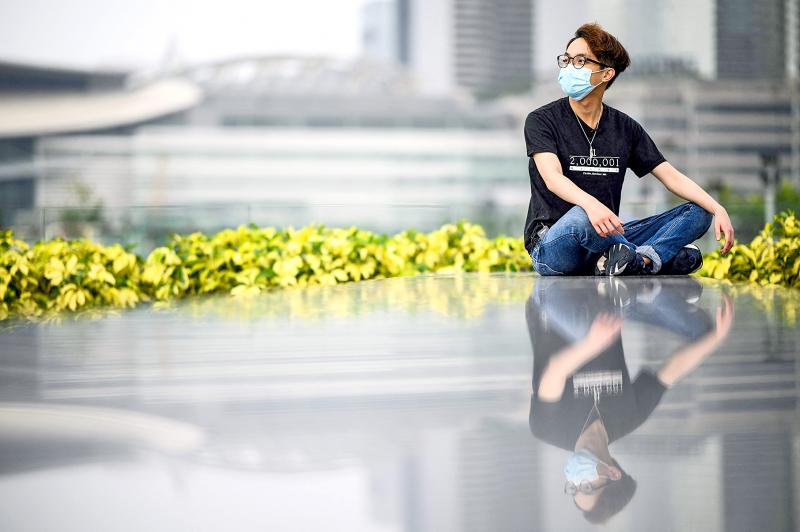
Photo: AFP
“It’s better for me to be jailed when I am still young,” he said ahead of his sentencing.
“I can do sports and train my muscles. Isn’t that great? I will work out and read in jail then I will be a better man when I am out,” he said.
Few would have been surprised to see Chan chose to wear his beloved Avengers hoodie to court.
It was what he wore a few weeks ago when he went into detention ahead of his sentencing.
The movie franchise’s story of superheroes battling seemingly insurmountable odds has always been popular in Hong Kong, but it has taken on extra significance in the past few years, especially among younger generations, as Beijing cracks down on freedoms.
Hong Kong’s democracy movement is on its knees. Most of its leaders are under arrest, jailed or have fled overseas.
“I think we are at a low point,” Chan said.
He is adamant Hong Kongers still want the right to choose their leaders and would one day hit the streets again.
“I look forward to one day reading while I am in jail that 2 million Hong Kongers marched,” he said.
Like so many of Hong Kong’s young pro-democracy figures, Chan became an activist as a teenager.
He recalled beaming with patriotic fervor as a child when Beijing hosted the 2008 Olympics.
“I really wanted to travel in mainland China, and I believed I was a proud Chinese person,” but that patriotism dissipated as he went through adulthood, he said.
“Nothing can give me that recognition of [Chinese] identity anymore,” he said.
Chan became a key figure within — and later led — the Civil Human Rights Front (CHRF), the group that organized some of the massive rallies that took place in 2019, during which hundreds of thousands of Hong Kongers attended.
The CHRF was not a radical organization and was far removed from the masked people on the front lines who routinely battled police. It espoused nonviolence and always sought permission for its marches.
When that permission became routinely refused, the group held rallies anyway, arguing that Hong Kongers had a right to be heard.
Hong Kong’s courts have consistently ruled that attending unlawful rallies, even peaceful ones, is a crime and that the right to expression has firm limits.
Yesterday, Chan was sentenced to 18 months in jail.
Police have also begun a separate investigation into the CHRF, saying it has failed to adhere to regulations governing local societies.
Since 2019’s huge rallies, protest has become impossible in Hong Kong, with authorities using the pandemic and security concerns to deny permission.
On Thursday, the June 4 Tiananmen vigil — an annual event usually attended by tens of thousands — was banned for the second year in a row, with authorities citing the COVID-19 pandemic.
Since 2019’s protests, China has imposed the sweeping Hong Kong National Security Law to criminalize dissent.
Chan is adamant that while short-term stability has been returned by force to Hong Kong, Beijing is setting itself up for more unrest in the longer term.
“When even the CHRF — which advocates peaceful, rational, lawful and nonviolent expression — is not allowed, how can you convince people to remain peaceful?” he asked.
“My dream is when I am released, all my friends will be back in Hong Kong, including those who are now in exile or behind bars,” he added. “Then many of us will gather here, right outside the government headquarters, for a grand celebration.”

‘CROSSING THE LINE’: China’s embassy in Seoul criticized US Forces Korea Commander General Xavier Brunson, asking if his ‘hostile’ remarks were authorized by Washington South Korea and the US are in talks over recent public remarks by the commander of US Forces Korea, Seoul’s presidential office said yesterday, after the comments drew sharp criticism from China. In a recent podcast interview, US Forces Korea Commander General Xavier Brunson described South Korea as “the dagger in the heart of Asia” from China’s east coast, prompting the Chinese embassy in Seoul to say that he had “truly crossed the line.” The interview came amid growing speculation that Washington might seek to expand the role of US Forces Korea in countering the growing regional influence of China, a key

SEEKING ORDER: Rodrigo Paz said that ‘anyone who wants to destroy the nation will have to deal with this president and the full force of the constitution’ Bolivian President Rodrigo Paz on Wednesday said that the nation was at a “breaking point” after nearly a month of protests that have caused shortages of food, fuel and medicine. Paz, who took office six months ago amid the worst economic crisis there in four decades, is battling a groundswell of fury over his policies. The political capital, La Paz, has been besieged by low-income workers and members of the indigenous majority calling for his resignation. “The country needs order and is reaching breaking point,” the 58-year-old said at a public event in La Paz, renewing his appeal for dialogue. On Tuesday, the Bolivian

Through the noise of rushing papers and whirring belts at a print factory in Kyoto, two creators watch their photo essay come to life in broadsheet form — part of an effort to win new audiences in the age of artificial intelligence (AI). Despite the decline of the publishing industry, self-publication and handmade “zine” magazines are growing in popularity in Japan, reflecting the nation’s enduring love of paper in the digital era. While speaking to Agence France-Presse at the plant, his hands black with ink, one of the creators, Kazuma Obara, said: “I think [paper] is a medium that engages all five

Australian researchers have trained lab-grown brain cells on a silicon computer chip to play the 1990s shooter game Doom and said they are just scratching the surface of what the neurons could be capable of doing. It is the science-fiction work of biotech boffins at Cortical Labs, who researched and developed the technology that harnesses the workings of the brain’s networking system. Each so-called “biological computer” contains about 200,000 living human brain cells, grown from stem cells that were harvested from blood donations. Having mastered the simple computer game Pong, where a paddle is moved up and down to send a ball


 RSS
RSS