


The driver of a speeding Japanese bullet train handed over the controls to an unqualified conductor so he could answer an urgent call ... of nature, a rail operator has revealed.
The unfortunate driver’s toilet trip might have gone unnoticed, except for the fact that his train was subsequently one minute late, which prompted an investigation in a nation famous for punctuality.
The driver confessed that he had left his post after experiencing abdominal pain and turned over controls of the train with l60 passengers on board to a conductor so he could run to the toilet.
He was away for three minutes as the train ran at 150kph.
Bullet trains are tightly controlled by computerized central command systems, but human drivers are required to stay in place to deal with any unexpected situation, a spokesman for the rail operator said.
They also need to manually brake or accelerate as necessary to ensure safety and keep trains on schedule, the spokesman added.
The driver’s brief absence apparently resulted in the one minute delay that flagged his secret to superiors.
Drivers who experience an emergency while operating a train are supposed to coordinate with the command center to turn over the controls to a qualified conductor, or stop on the tracks or at the nearest station.
At a news conference on Thursday, company executives apologized for the incident and said the embarrassed driver would be dealt with “appropriately.”
The driver said that he “didn’t want to cause a delay by stopping the train.”
“I didn’t report it because it was embarrassing,” the driver added.
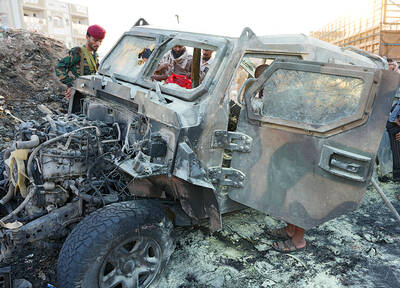
‘TERRORIST ATTACK’: The convoy of Brigadier General Hamdi Shukri resulted in the ‘martyrdom of five of our armed forces,’ the Presidential Leadership Council said A blast targeting the convoy of a Saudi Arabian-backed armed group killed five in Yemen’s southern city of Aden and injured the commander of the government-allied unit, officials said on Wednesday. “The treacherous terrorist attack targeting the convoy of Brigadier General Hamdi Shukri, commander of the Second Giants Brigade, resulted in the martyrdom of five of our armed forces heroes and the injury of three others,” Yemen’s Saudi Arabia-backed Presidential Leadership Council said in a statement published by Yemeni news agency Saba. A security source told reporters that a car bomb on the side of the road in the Ja’awla area in

PRECARIOUS RELATIONS: Commentators in Saudi Arabia accuse the UAE of growing too bold, backing forces at odds with Saudi interests in various conflicts A Saudi Arabian media campaign targeting the United Arab Emirates (UAE) has deepened the Gulf’s worst row in years, stoking fears of a damaging fall-out in the financial heart of the Middle East. Fiery accusations of rights abuses and betrayal have circulated for weeks in state-run and social media after a brief conflict in Yemen, where Saudi airstrikes quelled an offensive by UAE-backed separatists. The United Arab Emirates is “investing in chaos and supporting secessionists” from Libya to Yemen and the Horn of Africa, Saudi Arabia’s al-Ekhbariya TV charged in a report this week. Such invective has been unheard of
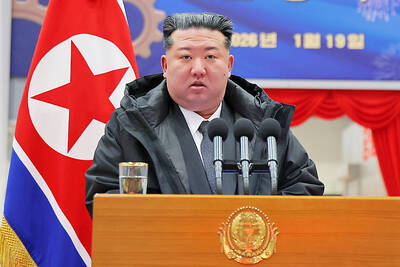
‘SHOCK TACTIC’: The dismissal of Yang mirrors past cases such as Jang Song-thaek, Kim’s uncle, who was executed after being accused of plotting to overthrow his nephew North Korean leader Kim Jong-un has fired his vice premier, compared him to a goat and railed against “incompetent” officials, state media reported yesterday, in a rare and very public broadside against apparatchiks at the opening of a critical factory. Vice Premier Yang Sung-ho was sacked “on the spot,” the state-run Korean Central News Agency said, in a speech in which Kim attacked “irresponsible, rude and incompetent leading officials.” “Please, comrade vice premier, resign by yourself when you can do it on your own before it is too late,” Kim reportedly said. “He is ineligible for an important duty. Put simply, it was
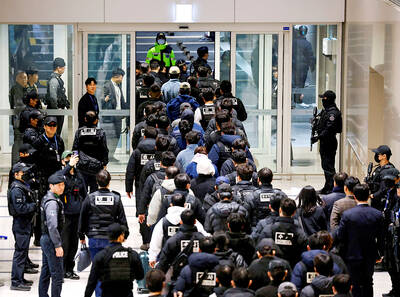
SCAM CLAMPDOWN: About 130 South Korean scam suspects have been sent home since October last year, and 60 more are still waiting for repatriation Dozens of South Koreans allegedly involved in online scams in Cambodia were yesterday returned to South Korea to face investigations in what was the largest group repatriation of Korean criminal suspects from abroad. The 73 South Korean suspects allegedly scammed fellow Koreans out of 48.6 billion won (US$33 million), South Korea said. Upon arrival in South Korea’s Incheon International Airport aboard a chartered plane, the suspects — 65 men and eight women — were sent to police stations. Local TV footage showed the suspects, in handcuffs and wearing masks, being escorted by police officers and boarding buses. They were among about 260 South


 RSS
RSS