


Some of the world’s biggest fossil fuel companies have used advertising to “greenwash” their contribution to the climate crisis, according to files published by environmental lawyers ClientEarth.
They describe the practice as “a great deception.”
The files compare the adverts produced by ExxonMobil, Aramco, Chevron, Shell, Equinor and others with the companies’ operations and products, overall climate impact and progress toward climate-safe business models.
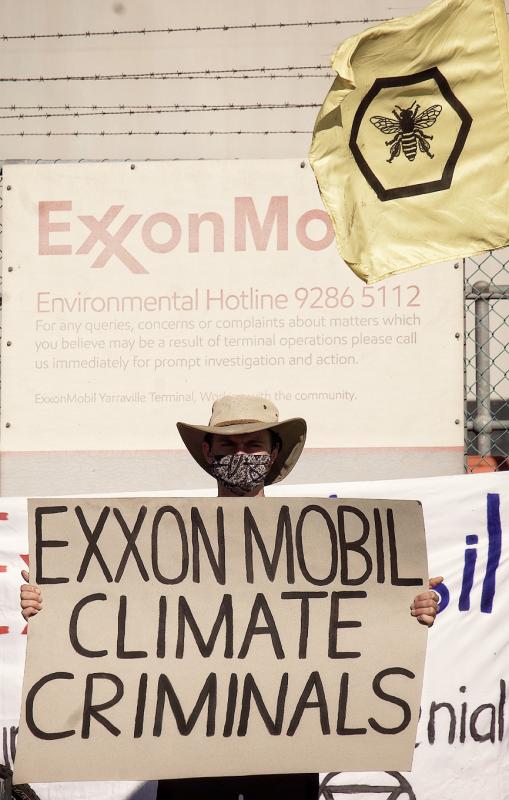
Photo: EPA-EFE
ClientEarth is calling on policymakers to ban all fossil fuel company ads unless they come with tobacco-style health warnings about the risks of global heating to people and the planet.
Its lawyers lodged a complaint in 2019 alleging that BP’s advertising campaigns misled the public by focusing on the company’s low-carbon energy products, when more than 96 percent of its annual spend was on oil and gas.
BP withdrew the ads before the complaint was assessed.
ClientEarth said it is now putting other fossil fuel companies on notice over greenwashing adverts.
“We’re currently witnessing a great deception, where the companies most responsible for catastrophically heating the planet are spending millions on advertising campaigns about how their business plans are focused on sustainability,” ClientEarth lawyer Johnny White said.
“We need to reduce reliance on fossil fuels, but instead of leading a low-carbon transition these companies are putting out advertising which distracts the public and launders their image,” White said. “Our research shows these adverts are misrepresenting the true nature of companies’ businesses, of their contribution to climate change, and of their transition plans.”
ClientEarth’s analysis includes claims that ExxonMobil advertising suggested its experimental algae biofuels could one day reduce transport emissions, while it has no company-wide net zero target and its 2025 emission reduction targets do not include the vast majority of emissions resulting from its products.
Saudi Arabia’s Aramco said it conducted business “in a way that addresses the climate challenge,” yet it is the world’s largest corporate greenhouse gas emitter and plans to continue exploring for more oil and gas, despite having reserves greater than those of Exxon, Chevron, Shell, BP and Total combined.
Chevron said it is “ part of the solution “ to climate change, but does not have a net zero commitment or a strategy aligned with the Paris climate agreement, and its plans for carbon capture and storage cover less than 1 percent of its 2019 carbon emissions .
Shell said it is investing in “lower-carbon biofuels and hydrogen, electric vehicle charging, solar and wind power,” but in last year it earmarked between US$2 billion and US$3 billion a year for low-carbon businesses, compared with US$17 billion on fossil fuels operations.
Norway’s Equinor has talked of growing renewable capacity tenfold by 2026 , but renewables are only planned to be 4 percent of its energy by that date.
ClientEarth said warnings on oil company adverts should state that fossil fuel products are the main cause of global heating and that companies must divulge how much they are spending on fossil fuels compared with their low-carbon businesses.

SPEAKING OUT: After Siranudh Scott’s allegations surfaced, celebrities and public figures took to social media to share their own experiences of sexual misconduct and abuse A high-profile alleged sexual abuse case within a wealthy Thai beer brewing family has prompted a wave of painful accounts from survivors of unconnected abuse in the conservative nation. Siranudh Scott, a member of the billionaire Thai family that founded the ubiquitous Singha beer brand, posted an emotional video this month accusing his elder brother Sunit of repeatedly abusing him when he was a teenager. Sunit, who is in his 30s, later denied the allegations in a video posted online, but Singha parent Boonrawd dismissed him from his executive role with the company on Tuesday last week. “I felt I needed to speak

SEEKING ORDER: Rodrigo Paz said that ‘anyone who wants to destroy the nation will have to deal with this president and the full force of the constitution’ Bolivian President Rodrigo Paz on Wednesday said that the nation was at a “breaking point” after nearly a month of protests that have caused shortages of food, fuel and medicine. Paz, who took office six months ago amid the worst economic crisis there in four decades, is battling a groundswell of fury over his policies. The political capital, La Paz, has been besieged by low-income workers and members of the indigenous majority calling for his resignation. “The country needs order and is reaching breaking point,” the 58-year-old said at a public event in La Paz, renewing his appeal for dialogue. On Tuesday, the Bolivian

COMMUNITY CONFLICT: Concerns about disease spread from corpses has run up against friends and families’ desire to bury their dead as infection spreads in the area Angry residents of a town at the epicenter of the Ebola outbreak in the Democratic Republic of the Congo (DR Congo) attacked and burned a tent that was part of a health center where people are being treated for the virus, the staff there said Saturday. It was the second such attack in the region in a week. No one was hurt in the attack, according to reports but as patients ran out to escape the fire, 18 people with suspected Ebola infections fled the facility and are unaccounted for, a hospital director said. Angry residents arrived at the clinic in the

Forecasters in Europe yesterday warned of exceptional heat as record temperatures driven by a “heat dome” push temperatures well above seasonal norms across the continent. The surge follows a record-breaking Monday, with France logging its hottest day in the month of May on record, its weather agency said, and the UK also posting unprecedented highs. A so-called “heat dome” of warm air from northern Africa trapped under a high-pressure system over western Europe is behind the high temperatures not usually seen until high summer. Restrictions on outdoor work were imposed in parts of Italy, beaches in southwest France filled earlier than usual and


 RSS
RSS