


Calling yourself “The Dying Town” might not sound like the best way of attracting visitors, but Civita di Bagnoregio has learned to make a living out of dying.
It has resisted definitive death for so long that Italy has nominated it and the surrounding area of stark cliffs and valleys known as “badlands” to be a UNESCO World Heritage Site.
Centuries ago, the town was much larger and connected by road to other settlements, but landslides, earthquakes, cracks and erosion have reduced its size dramatically and left it sitting spectacularly alone at the top of a spur.
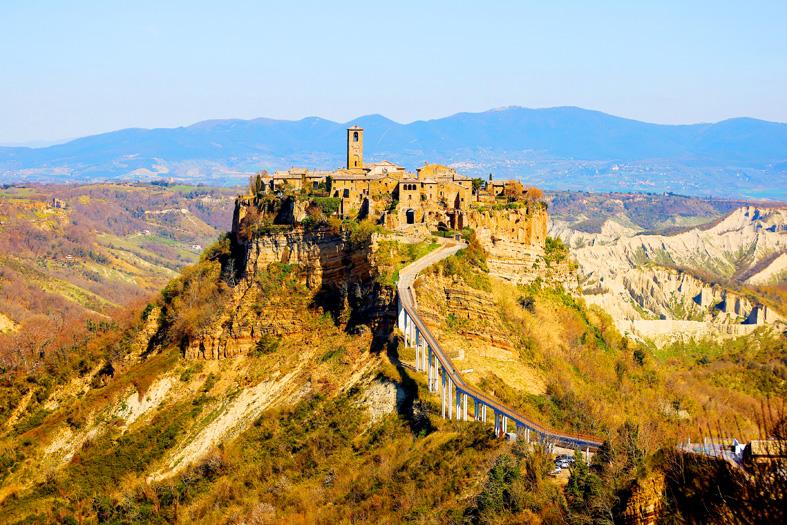
Photo: Reuters
When winter clouds are low, Civita looks like a floating castle in the air. On a clear day, the rock on which it rests looks like a slice of a multilayered cake.
Clay from an inland sea 1 million years ago supports strata of compacted ash and magma from subsequent volcanic eruptions.
Civita’s past, present and future are the stuff of a geologist’s dream, with a major landslide that occurred in 1114 still under study today.
“During three millennia, regressive erosion has practically reduced Civita to a nucleus, leaving the square and a few streets around it,” said Luca Costantini, 49, a geologist who is part of project to monitor and slow down the erosion.
In underground caverns cut out of soft volcanic rock known as tufo, steel bars hold walls together.
“Our motto is ‘resilience,’ because Civita was founded by the Etruscans, passed through the Roman era and the entire medieval period to reach the present day,” said Luca Profili, 32, the mayor of Bagnoregio, of which Civita is a part.
“This place is so fragile,” he said.
That fragility is measured in part by an “extensometer,” an external telescopic rod that detects movement.
The Civita that remains today is mostly from the medieval period and measures about 152m by 91m, less than two soccer pitches. Its main square is about the size of a basketball court.
Once spread out on a hill about three times its current size, over the centuries entire neighborhoods collapsed in landslides. Today it is accessible via a long and steep ramp for pedestrians or golf carts.
The number of permanent residents fluctuates between 10 and 14 depending on the season.
Before the COVID-19 pandemic Civita was a draw for tourists traveling between Rome and Florence.
Road signs direct visitors to “Civita — The Dying Town.”
Stefano Lucarini, 29, bought a restaurant in Civita in March last year, just days before the first COVID-19 lockdown.
“The timing was not great,” he joked.
However, he is optimistic that after the pandemic, the town can get back on its feet.
“The environmental risk is worrying [but] we hope that for many years everyone will be able to enjoy the town,” he said.
The mayor’s spokesman, Roberto Pomi, said Italy submitted the heritage site proposal in January and expects UNESCO to decide in June next year.

PARLIAMENT CHAOS: Police forcibly removed Brazilian Deputy Glauber Braga after he called the legislation part of a ‘coup offensive’ and occupied the speaker’s chair Brazil’s lower house of Congress early yesterday approved a bill that could slash former Brazilian president Jair Bolsonaro’s prison sentence for plotting a coup, after efforts by a lawmaker to disrupt the proceedings sparked chaos in parliament. Bolsonaro has been serving a 27-year term since last month after his conviction for a scheme to stop Brazilian President Luiz Inacio Lula da Silva from taking office after the 2022 election. Lawmakers had been discussing a bill that would significantly reduce sentences for several crimes, including attempting a coup d’etat — opening up the prospect that Bolsonaro, 70, could have his sentence cut to

A powerful magnitude 7.6 earthquake shook Japan’s northeast region late on Monday, prompting tsunami warnings and orders for residents to evacuate. A tsunami as high as three metres (10 feet) could hit Japan’s northeastern coast after an earthquake with an estimated magnitude of 7.6 occurred offshore at 11:15 p.m. (1415 GMT), the Japan Meteorological Agency (JMA) said. Tsunami warnings were issued for the prefectures of Hokkaido, Aomori and Iwate, and a tsunami of 40cm had been observed at Aomori’s Mutsu Ogawara and Hokkaido’s Urakawa ports before midnight, JMA said. The epicentre of the quake was 80 km (50 miles) off the coast of
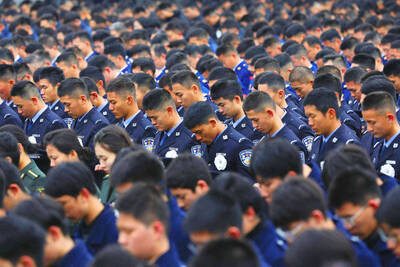
China yesterday held a low-key memorial ceremony for the 1937 Nanjing Massacre, with Chinese President Xi Jinping (習近平) not attending, despite a diplomatic crisis between Beijing and Tokyo over Taiwan. Beijing has raged at Tokyo since Japanese Prime Minister Sanae Takaichi last month said that a hypothetical Chinese attack on Taiwan could trigger a military response from Japan. China and Japan have long sparred over their painful history. China consistently reminds its people of the 1937 Nanjing Massacre, in which it says Japanese troops killed 300,000 people in what was then its capital. A post-World War II Allied tribunal put the death toll

A passerby could hear the cacophony from miles away in the Argentine capital, the unmistakable sound of 2,397 dogs barking — and breaking the unofficial world record for the largest-ever gathering of golden retrievers. Excitement pulsed through Bosques de Palermo, a sprawling park in Buenos Aires, as golden retriever-owners from all over Argentina transformed the park’s grassy expanse into a sea of bright yellow fur. Dog owners of all ages, their clothes covered in dog hair and stained with slobber, plopped down on picnic blankets with their beloved goldens to take in the surreal sight of so many other, exceptionally similar-looking ones.


 RSS
RSS