


Ten trailblazing Yemeni women have overcome skepticism and ridicule to bring electricity to their villages, illuminating lives with a micro-grid solar business that they hope to expand across the region.
In a conservative country wracked by hunger and poverty amid a devastating war that has destroyed most infrastructure, 36-year-old Iman Hadi and her female colleagues are achieving what many would have thought unthinkable.
Hadi has been managing the all-female Friends of the Environment Station in the rebel-held area of Abs, northwest of the capital Sana’a, since 2019.
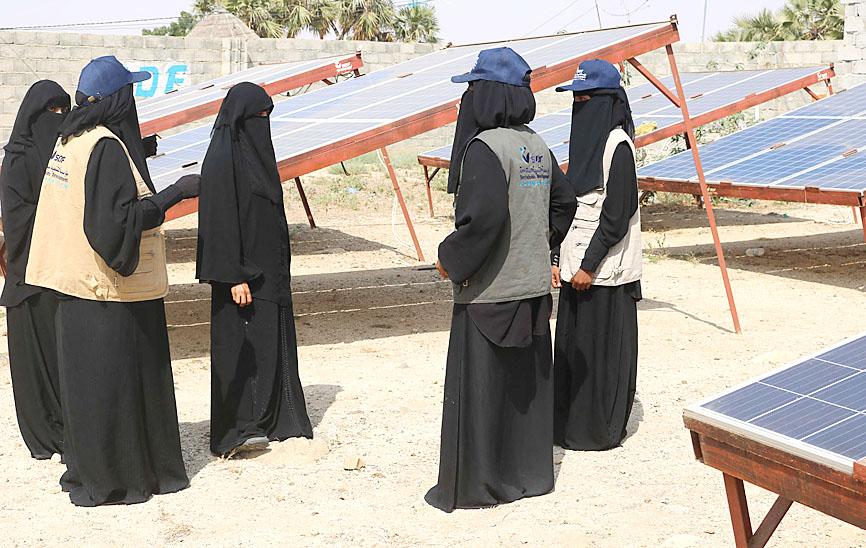
Photo: AFP
Equipped with six solar power grids, the station is the only source of electricity for dozens of houses in several villages.
Hadi said that the idea started when the women imagined what they could do to help ease the impact of war.
“We were able to make many people happy by connecting their houses to electricity,” Hadi said, as she sat behind her desk in a makeshift structure at the station.
The station — one of three in the country, but the only one run by an all-female crew — started with 20 houses. Today, it powers twice that number.
Tens of thousands have been killed since 2014 in the conflict, which pits the Iran-backed Houthi rebels against a government supported by a Saudi Arabia-led military coalition.
Hospitals, businesses and electricity plants have been destroyed or shuttered, amid severe fuel shortages that force many to work by candlelight.
Before the conflict, only about two-thirds of Yemenis had access to the public electricity grid.
However, amid the despair, one silver lining is emerging: solar panels that started appearing on the roofs of houses in cities and villages.
“In Yemen, where people cannot afford to purchase food, access healthcare or other fundamental needs, providing the option of solar energy for remote areas empowers communities, and builds hope and resilience in an otherwise often hopeless situation,” UN Development Programme (UNDP) Resident Representative to Yemen Auke Lootsma said.
Projects like Hadi’s station, which received UN and EU funding and training, have helped Yemenis regain a semblance of normal living.
“Praise be to God, from morning and until evening, fans and washing machines and refrigerators and sewing machines are working in our house,” said Faeiqa Najjar, one of Hadi’s customers.
The power grid is helping others to earn money as well.
Hadi gives micro-loans from the monthly net profits of about US$2,000, allowing people to open small businesses, such as grocery stores and bakeries.
However, Hadi’s journey was anything but easy.
The small station surrounded by drab concrete walls is in a front-line region that often witnesses fighting between the rebels and government forces.
On top of that, rural society rejects the idea of women working outside the home.
“We have faced many difficulties, including ridicule and rejection from our families and society, who believed that this sort of project is only for men,” Hadi said. “But we have handled these difficulties with persistence. Today, their mockery has changed to appreciation and respect for women.”
In scenes that are novel for Yemen, the women mop and clean the blue solar grids daily, tighten the screws that hold them in place, check the battery life and calculate consumption through meters hung on the walls.
The project has won the Ashden Awards for Humanitarian Energy that celebrates climate champions, and the UNDP is working to scale up the community business from three to 100 sites across the country.
Last year, Hadi was chosen as one of the BBC’s 100 most inspiring and influential women from around the world.
The power grid has turned her into a local business icon, with men asking for advice and loans.
Her long-term plan is to extend solar services to all 3,060 households in her area.
“My message to all women here is to rise up and go out to fulfill their ambitions,” she said.


Through the noise of rushing papers and whirring belts at a print factory in Kyoto, two creators watch their photo essay come to life in broadsheet form — part of an effort to win new audiences in the age of artificial intelligence (AI). Despite the decline of the publishing industry, self-publication and handmade “zine” magazines are growing in popularity in Japan, reflecting the nation’s enduring love of paper in the digital era. While speaking to Agence France-Presse at the plant, his hands black with ink, one of the creators, Kazuma Obara, said: “I think [paper] is a medium that engages all five

‘ABSURD MISTAKE’: The election commission said that there had been a failure to anticipate turnout after 14 polling stations ran short of ballot papers South Korean riot police yesterday cleared protesters from a Seoul polling station after a 35-hour blockade sparked by a shortage of ballot papers during local elections earlier this week. Wednesday’s election was the first nationwide vote since South Korean President Lee Jae-myung took office following the ouster of Yoon Suk-yeol over his short-lived martial law declaration. Lee’s ruling Democratic Party swept most races, but failed to flip the crucial Seoul mayoral seat. The South Korean National Election Commission apologized, blaming a failure to anticipate turnout after 14 polling stations in Seoul ran short of ballot papers. Some polling stations stayed open until 10pm to

France experienced its hottest spring on record, the French weather service said on Tuesday, after an exceptional early heat wave that also broke highs for the season in England and Wales. Meteo-France said the average nationwide temperature over March to May was 13.8°C — about 1.7°C above the norm, and surpassing records set in 2011 and 2020. “The warmest spring since records began in 1900,” it said in a bulletin. All three months were warmer than average, but the onset of an “unprecedented heatwave” late last month pushed the mercury to highs typically seen at the height of the summer. “Our country had never

A Sherpa guide was found crawling to base camp on Mount Everest a week after he went missing and was reunited with his family, who had given up hope he would return. Dawa Sherpa was last seen on Friday last week descending the mountain, but he did not reach base camp even though his client did. The pair were among the last climbers on the mountain as the climbing season came to an end and the route was dismantled. Dawa was located by a cleaning crew on Thursday morning as he was crawling down the snowy slopes around the Khumbu Icefall, just above


 RSS
RSS