


The court hearing for a Canadian man detained in China for more than two years on espionage charges finished after less than three hours yesterday, a Canadian diplomat said.
Michael Spavor is one of two Canadians detained, in apparent retaliation for Canada’s arrest on a US extradition warrant of Huawei Technologies Co chief financial officer Meng Wanzhou (孟晚舟), and formally charged in June last year with spying.
Canada has called the charges against the men as “trumped-up,” and the three cases have sent relations between Ottawa and Beijing to their lowest point in decades.
Spavor’s family have called for his unconditional release, insisting that he was innocent of the accusations and had done much as a businessman to “build constructive ties” between Canada, China and North Korea.
Jim Nickel, the deputy head of mission at the Canadian embassy in Beijing, told reporters outside the courtroom that the hearing had finished, and officials were awaiting the verdict.
Nickel earlier told reporters outside the court in the city of Dandong near China’s border with North Korea that Canada was “disappointed by the lack of transparency and the lack of access” to the proceedings, from which Canadian officials were barred.
The trial of Michael Kovrig, a former Canadian diplomat, is scheduled to start on Monday next week in Beijing.
The two men were detained in China just days after Meng was arrested in Canada, drawing accusations from Ottawa that they were taken as virtual hostages to apply pressure in the case of the Huawei executive.
The timing of the trials against the men — revealed by the Canadian government only on Wednesday — after a two-year wait also appears linked to proceedings in the Meng’s case.
Meng, whose father is Huawei founder and chief executive officer Ren Zhengfei (任正非), has been fighting extradition to the US on charges that she and the company contravened US sanctions against Iran and other laws.
Her court case in Vancouver entered its final phase two weeks ago, with hearings expected to end in mid-May, barring appeals.
The “two Michaels,” as they have become known, have had almost no contact with the outside world since their detention.
Virtual consular visits only resumed in October last year after a nine-month hiatus that Chinese authorities said was due to the COVID-19 pandemic.
China’s judicial system convicts most people who stand trial, and the two men face up to life in prison if found guilty of “espionage” and “providing state secrets.”
Nickel said that Canada hopes to obtain their immediate release.
“We are working closely with the United States as well to secure the immediate release of Michael Spavor and Michael Kovrig, so we are hopeful that in some measure this trial may lead to [that],” Nickel said.
Beijing has insisted that the detention of the two Canadians is lawful, while calling Meng’s case “a purely political incident.”
Agence France-Presse saw a police van with tinted windows arriving at the court in Dandong earlier yesterday morning, surrounded by about a dozen police officers as it drove past reporters waiting outside.
A group of 10 diplomats from eight other countries including the UK, the US, France and Australia had also traveled to Dandong, in what Nickel described as a gesture of solidarity for Spavor and to “register their opposition to arbitrary detention.”
“We appreciate the international support,” he told reporters.

Crowds in Bangladesh are flocking to snap photographs with an unlikely social media star — an albino buffalo with flowing blond hair nicknamed “Donald Trump” that is due to be sacrificed within days. Owner Zia Uddin Mridha, 38, said his brother named the 700kg bull over its flowing helmet of hair resembling the signature look of the US president. “My younger brother picked this name because of the buffalo’s extraordinary hair,” he said at his farm in Narayanganj, just outside the capital, Dhaka. Mridha said that a constant stream of curious visitors — social media fans, onlookers and children — have come throughout
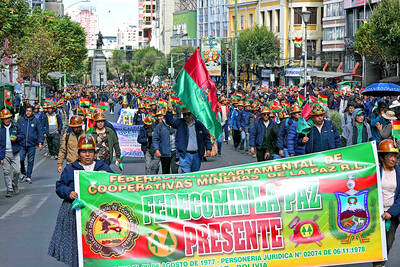
The Bolivian government on Friday struck a deal with protesting miners, but was still grappling with blockades and demonstrations by other workers across La Paz. Other groups are still blocking access roads into the city, which is also the seat of the government. Police on Thursday prevented the miners from entering the main square by using tear gas, while the demonstrators hurled stones and explosives with slingshots. Protests against the policies of Bolivian President Rodrigo Paz have convulsed the Andean nation since early this month, and roadblocks were choking routes into La Paz throughout Friday, the national road authority said. Miners demanded that Paz
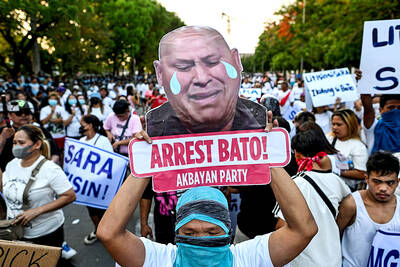
The Philippines said it has asked the country’s Supreme Court to allow it to arrest former Philippine president Rodrigo Duterte’s chief drug war enforcer to stand trial in an international tribunal. The International Criminal Court (ICC) last week unsealed an arrest warrant against Philippine Senator Ronald dela Rosa, accusing him along with Duterte and other “coperpetrators” of the “crime against humanity of murder.” Dela Rosa briefly sought refuge in the Philippine Senate last week while asking the Philippine Supreme Court to stop an ongoing attempt by government agents to arrest him. “By his own conduct, he has placed himself outside the protection of
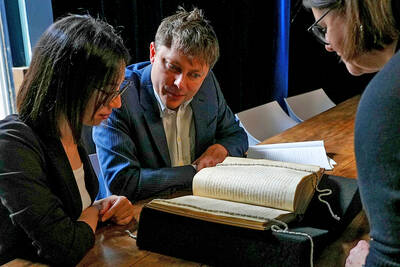
The researchers in Ireland looked at their computer screen, marveling at a medieval book tracked down in a Roman library. They flipped through its digitized pages and found their sought-after treasure: the oldest surviving English poem. “We were extremely surprised. We were speechless. We couldn’t believe our eyes when we first saw that,” said Elisabetta Magnanti, a visiting research fellow at Trinity College Dublin’s school of English. The poem was also within the main body of Latin text, she said, calling it “extraordinary.” Composed in Old English by a Northumbrian agricultural worker in the 7th century, Caedmon’s Hymn appears within some copies of


 RSS
RSS