


Bruce Meyers was hanging out at Pismo Beach on California’s Central Coast one afternoon in 1963 when he saw something that both blew his mind and changed his life: a handful of old, stripped-down cars bouncing across the sand.
It sure would be fun to get behind the wheel of one of those, Meyers thought, if only they were not so ugly and did not appear so uncomfortable.
He built his own solution: A “dune buggy” fashioned out of lightweight fiberglass mounted on four oversized tires with two bug-eyed-looking headlights and a blindingly bright paint job.
The result would become both an overnight automotive sensation and one of the talismans of California surf culture, especially when he created a space in the back to accommodate a surfboard.
He called the vehicle the Meyers Manx and it turned the friendly, soft-spoken Meyers into a revered figure among off-roaders, surfers and car enthusiasts of all types.
Meyers died on Friday last week at his San Diego-area home, his wife, Winnie Meyers, told reporters on Friday. He was 94.
Bruce Meyers built thousands of dune buggies in his lifetime, but he did far more. He designed boats and surfboards, worked as a commercial artist and a lifeguard, traveled the world surfing and sailing, built a trading post in Tahiti and even survived a World War II Japanese kamikaze attack on his navy aircraft carrier the USS Bunker Hill.
“He had a life that nobody else has ever lived,” his wife said with a chuckle.
Bruce Franklin Meyers was born on March 12, 1926, in Los Angeles, the son of a businessman and mechanic who set up automobile dealerships for his friend Henry Ford.
Growing up near such popular Southern California surfing spots as Newport, Hermosa and Manhattan beaches, it was wave riding, not cars, that initially captivated Bruce Meyers, who liked to refer to himself as an original beach bum.
He dropped out of high school and enlisted in the US Navy and was aboard the Bunker Hill when it was attacked near Okinawa, Japan, on May 11, 1945. As fire raged aboard the ship, he jumped overboard, at one point handed his life preserver to someone who needed it more, and helped rescue others.
Later, he returned to the ship and helped remove the bodies of the nearly 400 sailors killed, his wife said.
After the war he served in the Merchant Marine and attended the Chouinard Art Institute, now part of the California Institute of the Arts.
He also designed and built boats, learning to shape lightweight, but sturdy fiberglass.
That experience gave him skills he would put to use in building the first dune buggies.
He built his first 12 mainly for himself and friends, and decades later was still driving No. 1, which he named Old Red.
In all, B.F. Meyers & Co built more than 6,000 Meyers Manx dune buggies.
Although he trademarked the design, it was easy to borrow from it, and deep-pocketed competitors sold more than 250,000 copycats.

Four people jailed in the landmark Hong Kong national security trial of "47 democrats" accused of conspiracy to commit subversion were freed today after more than four years behind bars, the second group to be released in a month. Among those freed was long-time political and LGBTQ activist Jimmy Sham (岑子杰), who also led one of Hong Kong’s largest pro-democracy groups, the Civil Human Rights Front, which disbanded in 2021. "Let me spend some time with my family," Sham said after arriving at his home in the Kowloon district of Jordan. "I don’t know how to plan ahead because, to me, it feels
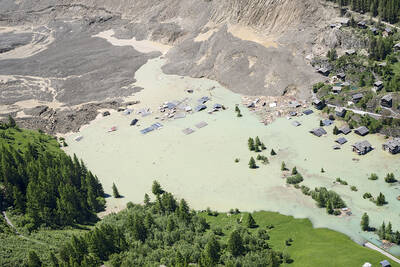
The collapse of the Swiss Birch glacier serves as a chilling warning of the escalating dangers faced by communities worldwide living under the shadow of fragile ice, particularly in Asia, experts said. Footage of the collapse on Wednesday showed a huge cloud of ice and rubble hurtling down the mountainside into the hamlet of Blatten. Swiss Development Cooperation disaster risk reduction adviser Ali Neumann said that while the role of climate change in the case of Blatten “still needs to be investigated,” the wider impacts were clear on the cryosphere — the part of the world covered by frozen water. “Climate change and

Poland is set to hold a presidential runoff election today between two candidates offering starkly different visions for the country’s future. The winner would succeed Polish President Andrzej Duda, a conservative who is finishing his second and final term. The outcome would determine whether Poland embraces a nationalist populist trajectory or pivots more fully toward liberal, pro-European policies. An exit poll by Ipsos would be released when polls close today at 9pm local time, with a margin of error of plus or minus 2 percentage points. Final results are expected tomorrow. Whoever wins can be expected to either help or hinder the
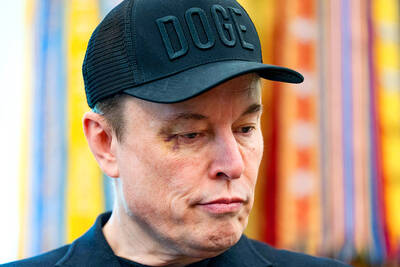
DENIAL: Musk said that the ‘New York Times was lying their ass off,’ after it reported he used so much drugs that he developed bladder problems Elon Musk on Saturday denied a report that he used ketamine and other drugs extensively last year on the US presidential campaign trail. The New York Times on Friday reported that the billionaire adviser to US President Donald Trump used so much ketamine, a powerful anesthetic, that he developed bladder problems. The newspaper said the world’s richest person also took ecstasy and mushrooms, and traveled with a pill box last year, adding that it was not known whether Musk also took drugs while heading the so-called US Department of Government Efficiency (DOGE) after Trump took power in January. In a


 RSS
RSS