


Junta supporters wielding knives and slingshots yesterday clashed with residents in Myanmar’s largest city, as tensions rose after weeks of nationwide protests against the military coup that ousted Burmese state counselor Aung San Suu Kyi.
The country has been gripped by a torrent of anger among hundreds of thousands of people who have taken to the streets to call for the release of the civilian leader and a return to democracy.
Yesterday, hundreds of supporters of the military marched through Myanmar’s capital, Naypyidaw, carrying signs that said: “We stand with the defense services,” referring to the junta.
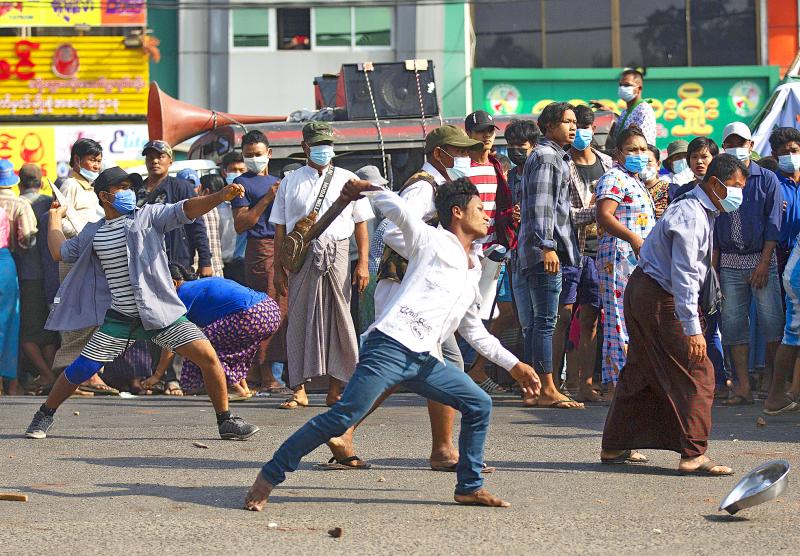
Photo: EPA-EFE
Authorities granted them access to Naypyidaw’s Sule Pagoda, a local landmark at a key junction that was barricaded to prevent protesters of the coup from amassing.
Residents living in the area banged pots and pans in protest at the pro-junta demonstration — a common practice among protesters since the putsch.
By noon, clashes were breaking out near the city’s central railway station compound.
Military supporters — some carrying pipes, knives and slingshots — turned on the booing residents, witnesses said.
“They shot at us with slingshots from the car ... about 10 people were injured in the head,” said Aung Zin Lin, 38, who lives nearby.
Junta supporters brought batons, pocket knives and catapults, he added, but local residents fought back, detaining a number of people until police appeared.
Security forces eventually arrived to find women and children linking arms in front of the railway compound in an effort to prevent them from arresting any protesters.
After a tense standoff, officers took away alleged attackers from the pro-junta group.
“I believe they have the right to protest, but they should not have used weapons,” said Zaw Oo, who was bruised on a rib after he was held down by a group of assailants.
“They are the bullies,” he added.
Unverified surveillance camera footage circulating on social media appeared to show a man armed with a knife chasing people downtown.
Alongside busy roads, Naypyidaw locals shook fists of money at military supporters in cars, accusing them of being paid by the junta.
In the leafy University of Yangon campus, students marched peacefully, carrying the red flags of Aung San Suu Kyi’s National League for Democracy party.
Since the start of this month, police have deployed water cannons, tear gas and rubber bullets against protesters in several cities — with isolated use of live rounds.
Protests in Naypyidaw have remained largely peaceful, despite the presence of troops and security forces barricading key junctions.
Four coup protesters have been killed in crackdowns, while a man patrolling a Yangon neighborhood against night arrests was shot dead at the weekend.
The military has also reported the death of at least one police officer.

Through the noise of rushing papers and whirring belts at a print factory in Kyoto, two creators watch their photo essay come to life in broadsheet form — part of an effort to win new audiences in the age of artificial intelligence (AI). Despite the decline of the publishing industry, self-publication and handmade “zine” magazines are growing in popularity in Japan, reflecting the nation’s enduring love of paper in the digital era. While speaking to Agence France-Presse at the plant, his hands black with ink, one of the creators, Kazuma Obara, said: “I think [paper] is a medium that engages all five

‘CROSSING THE LINE’: China’s embassy in Seoul criticized US Forces Korea Commander General Xavier Brunson, asking if his ‘hostile’ remarks were authorized by Washington South Korea and the US are in talks over recent public remarks by the commander of US Forces Korea, Seoul’s presidential office said yesterday, after the comments drew sharp criticism from China. In a recent podcast interview, US Forces Korea Commander General Xavier Brunson described South Korea as “the dagger in the heart of Asia” from China’s east coast, prompting the Chinese embassy in Seoul to say that he had “truly crossed the line.” The interview came amid growing speculation that Washington might seek to expand the role of US Forces Korea in countering the growing regional influence of China, a key
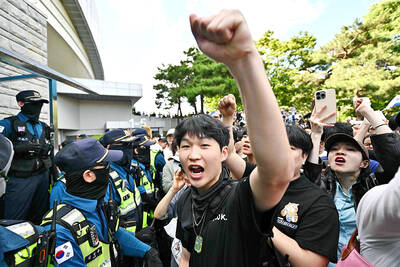
‘ABSURD MISTAKE’: The election commission said that there had been a failure to anticipate turnout after 14 polling stations ran short of ballot papers South Korean riot police yesterday cleared protesters from a Seoul polling station after a 35-hour blockade sparked by a shortage of ballot papers during local elections earlier this week. Wednesday’s election was the first nationwide vote since South Korean President Lee Jae-myung took office following the ouster of Yoon Suk-yeol over his short-lived martial law declaration. Lee’s ruling Democratic Party swept most races, but failed to flip the crucial Seoul mayoral seat. The South Korean National Election Commission apologized, blaming a failure to anticipate turnout after 14 polling stations in Seoul ran short of ballot papers. Some polling stations stayed open until 10pm to

Australian researchers have trained lab-grown brain cells on a silicon computer chip to play the 1990s shooter game Doom and said they are just scratching the surface of what the neurons could be capable of doing. It is the science-fiction work of biotech boffins at Cortical Labs, who researched and developed the technology that harnesses the workings of the brain’s networking system. Each so-called “biological computer” contains about 200,000 living human brain cells, grown from stem cells that were harvested from blood donations. Having mastered the simple computer game Pong, where a paddle is moved up and down to send a ball


 RSS
RSS