


It is dusk beside a creek and we are instructed to look for a trail of bubbles, under which could be one of the world’s weirdest mammals.
When you are desperate to see a platypus in the fading light, everything looks like one.
Floating logs from bank-side paperbark trees, gyrating leaves caught in a dance with the wind, and what was probably a water rat dashing from the rocks — they all make the heart skip briefly.
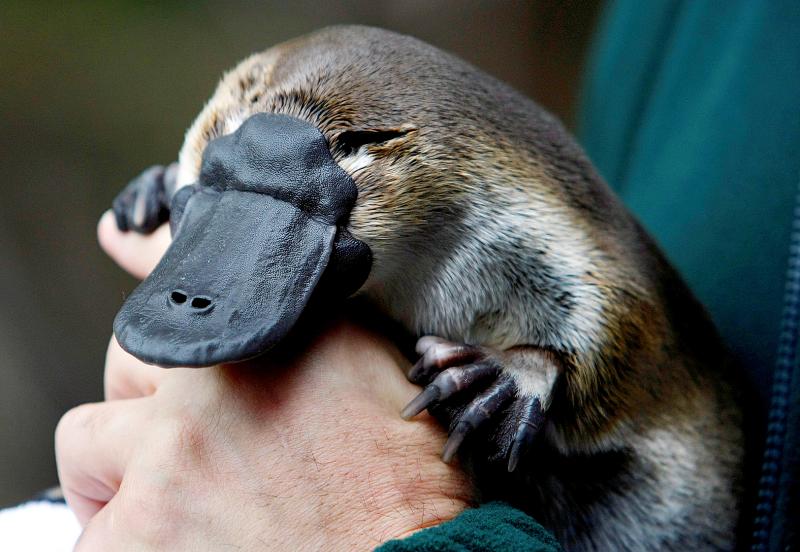
Photo: Reuters
Yet there is no sign of the egg-laying, duck-billed, flat-tailed venomous monotreme.
We did not hack through tropical undergrowth or trek for hours to get here. We turned left at a tile shop and pub in the suburbs of northern Brisbane and parked 40m away from Kedron Brook on a side road.
There are joggers and cyclists everywhere.
Like many of Brisbane’s waterways, platypuses were once regularly seen here, but new research has found platypuses have likely left Kedron Brook and four other greater Brisbane waterways: the Bremer River, Scrubby Creek, Slacks Creek and Enoggera Creek.
The last confirmed sighting at this exact spot was in 2002.
A new study, in the journal Australian Mammalogy, is further evidence the once widespread mammal is in trouble in Australia — its only home on the planet.
“It’s scary to think that we have already had these populations disappear under our noses,” said Tamielle Brunt, lead author and a researcher at the University of Queensland.
Brunt runs the Wildlife Preservation Society of Queensland’s PlatypusWatch network.
In November, researchers at the University of New South Wales found the habitat for platypuses had shrunk by almost one-quarter in the past 30 years.
The researchers joined conservationists to nominate the platypus for threatened species status.
Platypuses are elusive. They are nocturnal, skittish and tend not to make a literal splash. That makes them not only hard to see, but difficult to monitor.
Brunt and her colleagues used a new environmental DNA sampling technique to check 28 rivers and creeks for platypuses. In 21 of the waterways, they had records of platypus sightings between 1990 and 2016.
By analyzing water samples for the DNA of platypuses, excreted mainly in faeces and urine, researchers can tell if the animal is in the water without having to see them.
“Because of how elusive they are, we could be losing them without knowing because we’re just not regularly monitoring them,” Brunt said.
A lack of long-term platypus monitoring means that as land clearing and regulation of rivers has altered their habitat, any decline could be going unnoticed.
Australian coastal cities have grown relatively rapidly and in places such as Brisbane, platypus habitats such as creek banks and waterways are now surrounded by busy suburbs.
“Historically there [are] articles describing [the] platypus as being quite prolific in some waterways [in greater Brisbane],” Brunt said. “The fact that in a 10 or 20-year time frame they’ve gone out of some of these systems and that we’re seeing things only get worse with urbanization and climate change — with all these impacts getting worse, it’s a glum future for the platypus.”
Gilad Bino, a platypus researcher at the University of New South Wales Centre for Ecosystem Science, helped compile research that went to the Australian federal government to ask that the platypus be listed as a vulnerable species.
He said that there are historic newspaper reports of people describing seeing “platypus migrations,” with dozens seen at once.
“These days you’ll see one or two. Most Australians have never seen one,” he said.
Gilad said that its modern-day threats are compounding. Water extraction from rivers and creeks, the building of dams and weirs that create obstacles, and river bank erosion from land clearing all have an effect.

HISTORIC: After the arrest of Kim Keon-hee on financial and political funding charges, the country has for the first time a former president and former first lady behind bars South Korean prosecutors yesterday raided the headquarters of the former party of jailed former South Korean president Yoon Suk-yeol to gather evidence in an election meddling case against his wife, a day after she was arrested on corruption and other charges. Former first lady Kim Keon-hee was arrested late on Tuesday on a range of charges including stock manipulation and corruption, prosecutors said. Her arrest came hours after the Seoul Central District Court reviewed prosecutors’ request for an arrest warrant against the 52-year-old. The court granted the warrant, citing the risk of tampering with evidence, after prosecutors submitted an 848-page opinion laying out
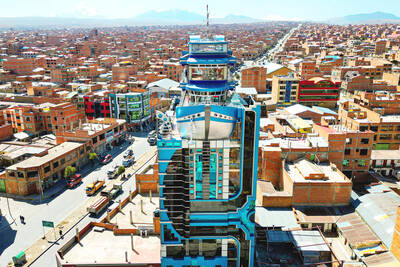
STAGNATION: Once a bastion of leftist politics, the Aymara stronghold of El Alto is showing signs of shifting right ahead of the presidential election A giant cruise ship dominates the skyline in the city of El Alto in landlocked Bolivia, a symbol of the transformation of an indigenous bastion keenly fought over in tomorrow’s presidential election. The “Titanic,” as the tallest building in the city is known, serves as the latest in a collection of uber-flamboyant neo-Andean “cholets” — a mix of chalet and “chola” or Indigenous woman — built by Bolivia’s Aymara bourgeoisie over the past two decades. Victor Choque Flores, a self-made 46-year-old businessman, forked out millions of US dollars for his “ship in a sea of bricks,” as he calls his futuristic 12-story
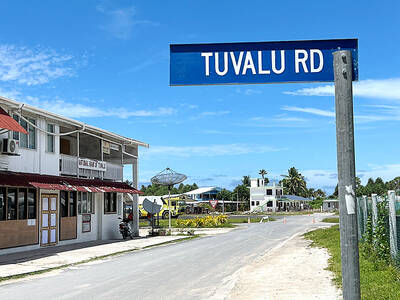
FORUM: The Solomon Islands’ move to bar Taiwan, the US and others from the Pacific Islands Forum has sparked criticism that Beijing’s influence was behind the decision Tuvaluan Prime Minister Feletei Teo said his country might pull out of the region’s top political meeting next month, after host nation Solomon Islands moved to block all external partners — including China, the US and Taiwan — from attending. The Pacific Islands Forum (PIF) leaders’ meeting is to be held in Honiara in September. On Thursday last week, Solomon Islands Prime Minister Jeremiah Manele told parliament that no dialogue partners would be invited to the annual gathering. Countries outside the Pacific, known as “dialogue partners,” have attended the forum since 1989, to work with Pacific leaders and contribute to discussions around

END OF AN ERA: The vote brings the curtain down on 20 years of socialist rule, which began in 2005 when Evo Morales, an indigenous coca farmer, was elected president A center-right senator and a right-wing former president are to advance to a run-off for Bolivia’s presidency after the first round of elections on Sunday, marking the end of two decades of leftist rule, preliminary official results showed. Bolivian Senator Rodrigo Paz was the surprise front-runner, with 32.15 percent of the vote cast in an election dominated by a deep economic crisis, results published by the electoral commission showed. He was followed by former Bolivian president Jorge “Tuto” Quiroga in second with 26.87 percent, according to results based on 92 percent of votes cast. Millionaire businessman Samuel Doria Medina, who had been tipped


 RSS
RSS