


Boko Haram recruited three local gangs in northwest Nigeria to kidnap hundreds of schoolboys on its behalf, security and local sources said on Wednesday.
The militant group has claimed responsibility for the attack on Friday last week that targeted a secondary school in the town of Kankara, in Katsina state.
However, sources said that the operation was carried out on Boko Haram’s orders by a notorious local gangster called Awwalun Daudawa.
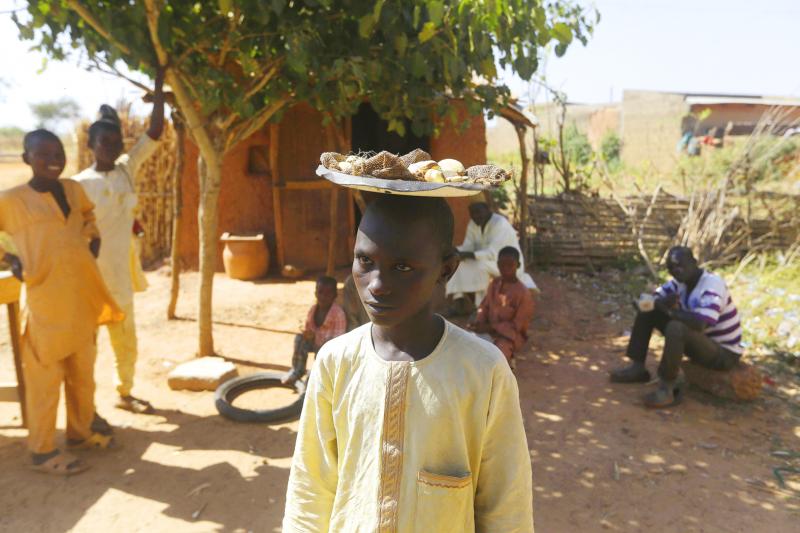
Photo: AP
The 43-year-old worked in collaboration with Idi Minorti and Dankarami, two other crime chiefs with strong local followings, they said.
Criminal gangs, known locally as “bandits,” have terrorized communities in northwest Nigeria for years and experts have said that militants would attempt to forge an alliance with them.
Daudawa “was an armed robber and a cattle rustler before he turned to gunrunning, bringing in weapons from Libya, where he had received training, and selling them to bandits,” a security source said.
“Over time, he forged an alliance with Boko Haram and became their gunrunner, taking weapons the group seizes from the Nigerian security forces in raids and ambushes, and selling them to bandits for a cut,” the source said.
“Awwalun Daudawa was spotted in the forest in the Kankara area, where he recently relocated and there were reports that he was planning something, but it was not clear what it was,” the source added.
Another source with intimate knowledge of “bandit” activities in Katsina and Zamfara states said: “From available information, Awwalun Daudawa was ordered by Abubakar Shekau to kidnap the schoolboys, and he enlisted the help of Idi Minorti and Dankarami.”
“After the children were taken, they went across the border into Zamfara state and split them among different gangs ‘for safekeeping,’” the source said. “Some of the gangs have been in touch with the authorities for the release of the boys.”
The attack occurred hundreds of kilometers from Boko Haram’s stronghold in northeast Nigeria, where it launched a brutal insurgency a decade ago.
The militants made a claim of responsibility in a four-minute audio, sent to Agence France-Presse through the same channel as previous messages from the group.
“I am Abubakar Shekau and our brothers are behind the kidnapping in Katsina,” said the voice in the recording, resembling that of the elusive Boko Haram leader.
Shekau was behind the 2014 abduction of 276 schoolgirls in Chibok that sparked global outrage.
However, another source said that there is an ongoing peace pact between bandits and the Zamfara state government, which the bandits do not want to breach.
“They have been under intense pressure to release the boys,” the source added.
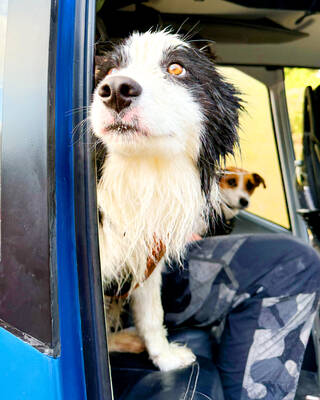
When a hiker fell from a 55m waterfall in wild New Zealand bush, rescuers were forced to evacuate the badly hurt woman without her dog, which could not be found. After strangers raised thousands of dollars for a search, border collie Molly was flown to safety by a helicopter pilot who was determined to reunite the pet and the owner. A week earlier, an emergency rescue helicopter found the woman with bruises and lacerations after a fall at a rocky spot at the waterfall on the South Island’s West Coast. She was airlifted on March 24, but they were forced to

HIGH HOPES: The power source is expected to have a future, as it is not dependent on the weather or light, and could be useful for places with large desalination facilities A Japanese water plant is harnessing the natural process of osmosis to generate renewable energy that could one day become a common power source. The possibility of generating power from osmosis — when water molecules pass from a less salty solution to a more salty one — has long been known. However, actually generating energy from that has proved more complicated, in part due the difficulty of designing the membrane through which the molecules pass. Engineers in Fukuoka, Japan, and their private partners think they might have cracked it, and have opened what is only the world’s second osmotic power plant. It generates
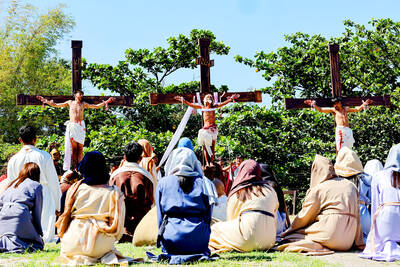
Hundreds of Filipinos and tourists flocked to a sun-bleached field north of Manila yesterday, on Good Friday, to witness one of the country’s most blood-soaked displays of religious fervor, undeterred by rising fuel prices. Scores of bare-chested flagellants with covered faces walked barefoot through the dusty streets of Pampanga Province’s San Fernando as they flogged their backs with bamboo whips in the scorching heat. Agence France-Presse (AFP) journalists said they saw devotees deliberately puncturing their skin with glass shards attached to a small wooden paddle to ensure their bleeding during the ritual, a way to atone for sins and seek miracles from
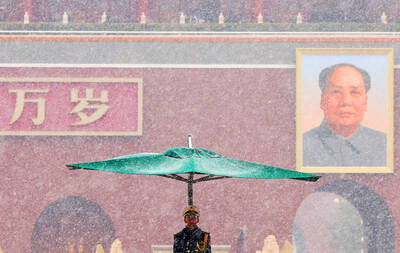
Chinese dissident artist Gao Zhen (高兟), famous for making provocative satirical sculptures of former Chinese leader Mao Zedong (毛澤東), was tried on Monday over accusations of “defaming national heroes and martyrs,” his wife and a rights group said. Gao, 69, who was detained in 2024 during a visit from the US, faces a maximum three-year prison sentence, said his wife, Zhao Yaliang (趙雅良), and Shane Yi, a researcher at the Chinese Human Rights Defenders group which operates outside the nation. The closed-door, one-day trial took place at Sanhe City People’s Court in Hebei Province neighboring the capital, Beijing, and ended without a


 RSS
RSS