


With multiple vaccines close to becoming available in a world gripped by the COVID-19 pandemic, manufacturers have become the target of hackers trying to steal trade secrets or disrupt supply chains.
IBM on Thursday said that it had uncovered a series of cyberattacks, potentially carried out by state actors, against companies involved in the effort to distribute vaccine doses, which must be kept cold.
The EU’s Directorate-General for Taxation and Customs Union was one target of the attacks, as well as European and Asian companies involved in the supply chain, IBM said.
“Our team recently uncovered a global phishing campaign targeting organizations associated with a COVID-19 cold chain,” Claire Zaboeva and Melissa Frydrych, analysts for IBM X-Force, a cybersecurity working group, wrote in a blog post.
The purpose “may have been to harvest credentials, possibly to gain future unauthorized access to corporate networks and sensitive information relating to the COVID-19 vaccine distribution,” they said.
It was unclear if the attacks were successful, IBM said, and while it could not identify those behind the attacks, the precision of the operation signals “the potential hallmarks of nation-state tradecraft.”
The vaccine developed by Pfizer and BioNTech, which on Wednesday was granted approval in the UK, must be stored at minus-70°C to ensure its effectiveness.
That means that it would require specialized logistics companies such as Haier Biomedical, a Chinese-owned cold-chain supply company working with the WHO and the UN.
Hackers impersonated an Haier Biomedical executive and “disguised as this employee, the adversary sent phishing e-mails to organizations believed to be providers of material support to meet transportation needs within the COVID-19 cold chain,” Zaboeva and Frydrych said.
Moderna also has developed a vaccine that must be stored at minus-20°C, while AstraZeneca’s version can be stored in a normal freezer.
Cybercriminals have also tried to attack several pharmaceutical companies developing vaccines, including Johnson & Johnson, Novavax, AstraZeneca and South Korean laboratories, the Wall Street Journal reported.
Spanish daily El Pais in September reported that laboratories in the country have been attacked by Chinese cybercriminals.
Cold storage company Americold last month reported a hack into its computer systems to the US Securities and Exchange Commission, without specifying whether the attack was related to the group’s role in vaccine storage.
“The intellectual property relating to mass market pharmaceuticals has tremendous value and so is a significant prize for a cybercriminal,” said Mark Kedgley, chief technology officer at New Net Technologies, a Florida-based provider of cybersecurity and compliance software.
The countries experts most often linked to cyberattacks are Russia, China and North Korea, although there is no formal proof of their involvement in the incidents in the past few months.
However, cybersecurity firm Kapersky noted the use of “false flags” including Russian-linked e-mail addresses, in a possible move to deflect blame for the attacks.

Le Tuan Binh keeps his Moroccan soldier father’s tombstone at his village home north of Hanoi, a treasured reminder of a man whose community in Vietnam has been largely forgotten. Mzid Ben Ali, or “Mohammed” as Binh calls him, was one of tens of thousands of North Africans who served in the French army as it battled to maintain its colonial rule of Indochina. He fought for France against the Viet Minh independence movement in the 1950s, before leaving the military — as either a defector or a captive — and making a life for himself in Vietnam. “It’s very emotional for me,”

The Chinese Communist Party’s (CCP) Central Committee is to gather in July for a key meeting known as a plenum, the third since the body of elite decisionmakers was elected in 2022, focusing on reforms amid “challenges” at home and complexities broad. Plenums are important events on China’s political calendar that require the attendance of all of the Central Committee, comprising 205 members and 171 alternate members with Chinese President Xi Jinping (習近平) at the helm. The Central Committee typically holds seven plenums between party congresses, which are held once every five years. The current central committee members were elected at the
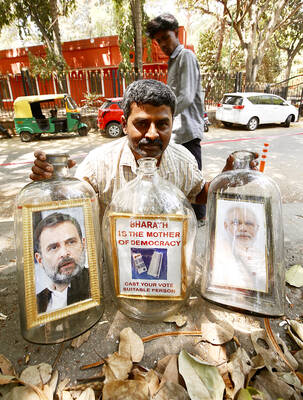
Indian Prime Minister Narendra Modi reaffirmed his pledge to replace India’s religion-based marriage and inheritance laws with a uniform civil code if he returns to office for a third term, a move that some minority groups have opposed. In an interview with the Times of India listing his agenda, Modi said his government would push for making the code a reality. “It is clear that separate laws for communities are detrimental to the health of society,” he said in the interview published yesterday. “We cannot be a nation where one community is progressing with the support of the Constitution while the other

CODIFYING DISCRIMINATION: Transgender people would be sentenced to three years in prison, while same-sex relations could land a person in jail for more than a decade Iraq’s parliament on Saturday passed a bill criminalizing same-sex relations, which would receive a sentence of up to 15 years in prison, in a move rights groups condemned as an “attack on human rights.” Transgender people would be sentenced to three years’ jail under the amendments to a 1988 anti-prostitution law, which were adopted during a session attended by 170 of 329 lawmakers. A previous draft had proposed capital punishment for same-sex relations, in what campaigners had called a “dangerous” escalation. The new amendments enable courts to sentence people engaging in same-sex relations to 10 to 15 years in prison, according to the


 RSS
RSS