

The Iraqi military is training a former member of an Iran-backed militia, who is under US sanctions for killing protesters, to become a high-ranking officer in the army, six government, security and militia officials said.
Hussein Falih Aziz, known as Abu Zainab al-Lami, was sent to Egypt with Iraqi officers for a year-long training normally reserved for the country’s military personnel, they said.
His name, with the rank of major general, appeared on an Iraqi Ministry of Defense list of officers attending the training until next summer.
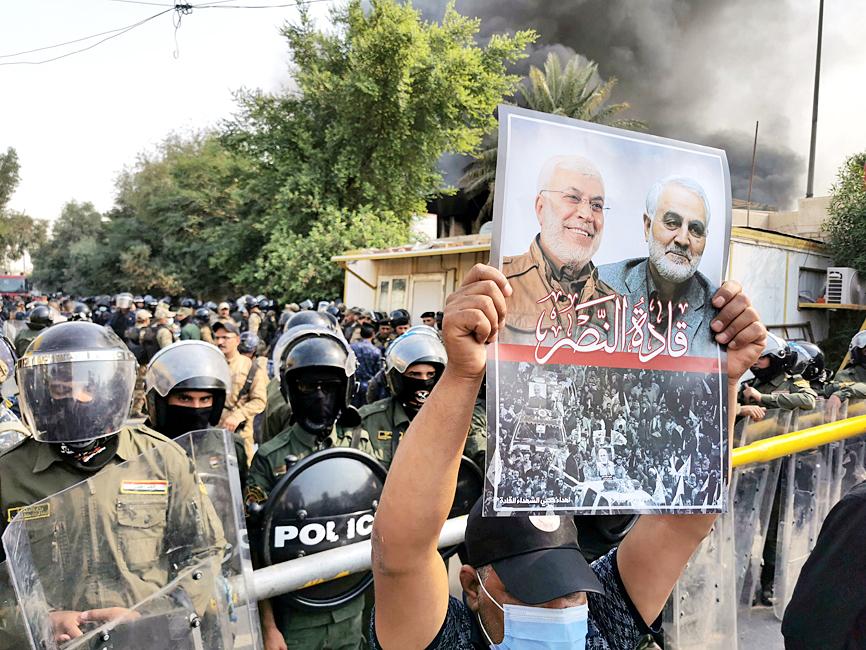
Photo: Reuters
Making al-Lami a senior officer in the army is one of the boldest moves yet by Iraqi Prime Minister Mustafa al-Kadhimi, a US ally, to dilute the power of Iran-backed militias in Iraq, the officials said, adding that it aligns with Washington’s stated desire to curtail Tehran’s influence across the Middle East.
An Iraqi government spokesman and Iranian officials could not immediately be reached for comment.
A source close to al-Lami confirmed his deployment to Egypt for training.
Supporters of the plan see it as a way of weakening militias that boast tens of thousands of fighters and who hold considerable sway over Iraq’s security and economy.
They have said that it would hasten the fracturing of some groups belonging to the Hashed al-Shaabi (Popular Mobilisation Forces; PMF), the state paramilitary umbrella organization whose security branch al-Lami has directed for years.
An Iraqi official declined to comment on al-Lami, but said that there was a plan to restructure the PMF, including providing military training to its leaders.
However, some critics have said that the move is a risky gamble that puts someone with a questionable human rights record and close ties with Iran at the heart of the Iraqi military.
They see it as another sign that the prime minister is giving concessions even to some of the most hardline, Iran-aligned officials to secure support for his government.
“The plan is to bring onside PMF leaders who are not seen as totally loyal to Iran and to ready them through this military training for positions inside the military,” a security official said.
“Al-Lami will be given a senior position when training is completed,” added the official, who spoke on condition of anonymity.
He did not specify what post al-Lami would take up.
Egyptian military officials denied that al-Lami was among a batch of Iraqi officers undergoing training in Egypt, but one Egyptian security source said that al-Lami was in Egypt last month, without elaborating.
Al-Lami is the head of security for Iraq’s state paramilitary grouping and a one-time member of the Iran-backed Kataib Hezbollah militia.
The source close to him denied he had any formal ties to Iran or the militias it supports.
Last year, he was put under US sanctions for his alleged role in ordering the use of lethal force against anti-government protesters.
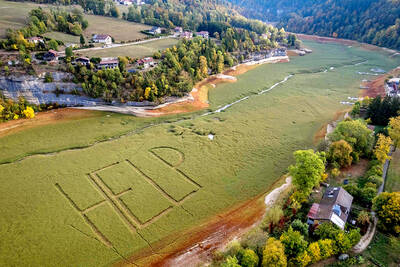
The picturesque Lac des Brenets between France and Switzerland has dried up after a record-breaking hot summer, leaving locals crying out for help to save the lake. Indeed, the words “HELP” and “SOS” have been scratched out in the weeds now flourishing on the exposed lake bed. The drought has ruined pleasure boat tourism, while some question whether the lake will ever return to enduring full health. “It’s absolutely heartbreaking,” said historian David Favre, who lives in Les Brenets. “As children, we used to spend all our summers swimming at the beach, having fun by the water, diving, jumping in and sometimes even

STRAIN ON TIES: The police arrested a 20-year-old man who matched the description of a suspect caught on CCTV leaving a hotel in Naha with the victim’s belongings A US Marine stationed on Japan’s southern island of Okinawa was arrested on suspicion of the murder of a Japanese woman, police said yesterday. The suspect “killed the 39-year-old woman at a hotel in Naha and stole her wallet on Saturday,” a local police spokesman said. US Ambassador George Glass posted on social media that he had spoken with Japan’s foreign ministry and Okinawa’s governor to offer “our sincere condolences and pledging full cooperation as the investigation continues.” Japanese Prime Minister Sanae Takaichi called the crime “exceptionally brutal and vicious” on X. The government has urged the US “to provide maximum cooperation

A US lawmaker has called on Starbucks to close its first stores in Xinjiang, China, calling it a “morally bankrupt decision” to do business in a region where Uighurs face repression. China denies widespread accusations about abuses of the Uighurs, a mainly Muslim people, saying its policies there were aimed at combating terrorism, separatism and religious extremism. Starbucks opened its first two stores this week in Xinjiang’s capital, Urumqi, including one at the city centre’s grand bazaar and a second at its international airport. John Moolenaar, chairman of the Select Committee on China of the House of Representatives, called on Starbucks to “immediately

The winner of this year’s Fat Bear Week has been crowned after a nail-biting final — and it’s the son of a former champion. Backpack, a 20-year-old male beloved by rangers in Alaska for his quiet determination, edged out female fellow finalist Dancing Queen in the annual ursine eating competition at Katmai National Park. More than 2.3 million people voted in the week-long competition that sees bears unwittingly jostle in a series of head-to-head contests to decide which one of them has most impressively piled on the pounds ahead of hibernation. Viewers watch a livestream of the enormous animals as they scoop salmon


 RSS
RSS