


Deadly windblown wildfires raging across the Pacific northwest destroyed hundreds of homes in Oregon, a top official said on Wednesday, warning it could be the greatest loss of life and property from wildfire in state history.
The blazes from the top of the state to the California border caused highway closures and smoky skies and had firefighers struggling to contain and douse flames fanned by 80kph wind gusts.
Officials in some western Oregon communities gave residents “go now” orders to evacuate, meaning they had minutes to flee their homes.
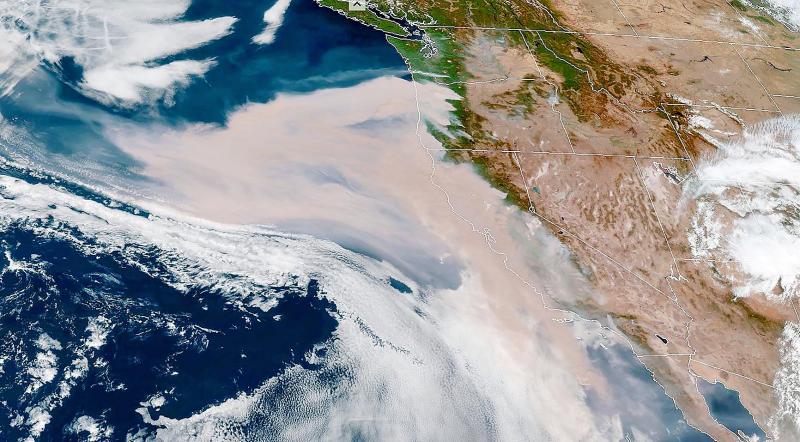
Photo: AFP / RAMMB / NOAA
Fires were burning in a large swath of Washington state and Oregon that rarely experiences such intense wildfire activity because of the Pacific northwest’s cool and wet climate.
Flames trapped firefighters and civilians behind fire lines in Oregon and leveled an entire small town in eastern Washington.
Oregon Governor Kate Brown said the devastation could be overwhelming from the fires that exploded on Monday during a late-summer wind storm.
“Everyone must be on high alert,” Brown said.
The blazes were thought to be extremely destructive around Medford, in southern Oregon, and near the state capital of Salem.
“This could be the greatest loss of human life and property due to wildfire in our state’s history,” Brown said.
At least three people were killed in Oregon fires and a small child died in blazes in Washington state.
Brown said some communities were substantially damaged, with “hundreds of homes lost.”
The precise extent of damage was unclear because so many of the fire zones were too dangerous to survey, Oregon Deputy State Fire Marshal Mariana Ruiz-Temple said.
“Quite frankly, we are not even able to get into these areas,” she said.
In Washington, a one-year-old boy died after his family was apparently overrun by flames while trying to flee a wildfire in the northeastern part of the state, Okanogan County Sheriff Tony Hawley said.
The child’s injured parents were discovered in the area of the Cold Springs Fire, which is burning in Okanogan and Douglas counties, Hawley said.
They were transported to a Seattle hospital with third-degree burns.

An American scientist convicted of lying to US authorities about payments from China while he was at Harvard University has rebuilt his research lab in Shenzhen, China, to pursue technology the Chinese government has identified as a national priority: embedding electronics into the human brain. Charles Lieber, 67, is among the world’s leading researchers in brain-computer interfaces. The technology has shown promise in treating conditions such as amyotrophic lateral sclerosis and restoring movement in paralyzed people. It also has potential military applications: Scientists at the Chinese People’s Liberation Army have investigated brain interfaces as a way to engineer super soldiers by boosting

Indonesian police have arrested 13 people after shocking images of alleged abuse against small children at a daycare center went viral, sparking outrage across the nation, officials said on Monday. Police on Friday last week raided Little Aresha, a daycare center in Yogyakarta on Java island, following a report from a former employee. CCTV footage circulating on social media showed children, most younger than two, lying on the floor wearing only diapers, their hands and feet bound with rags. The police have confirmed that the footage is authentic. Police said they also found 20 children crammed into a room just 3m by 3m. “So

A grieving mother has ended her life at a clinic in Switzerland four years after the death of her only child. Wendy Duffy, 56, a physically healthy woman, died at the Pegasos clinic in Basel after struggling to cope with the death of her 23-year-old son, Marcus. The former care worker, from the West Midlands, England, had previously attempted to take her own life. The case comes as assisted dying would not become law in England and Wales after proposed legislation, branded “hopelessly flawed” by opponents, ran out of time. Ruedi Habegger, the founder of Pegasos, described Duffy’s death as
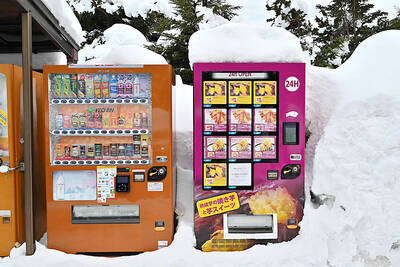
From post offices and parks to stations and even the summit of Mount Fuji, Japan’s vending machines are ubiquitous, but with the rapid pace of inflation cooling demand for their drinks, operators are being forced to rethink the business. Last month beverage giant DyDo Group Holdings announced it would remove about 20,000 vending machines — about 7 percent of their stock nationwide — by January next year, to “reconstruct a profitable network.” Pokka Sapporo Food & Beverage, based in Nagoya, also said last month it would sell its 40,000-machine operation to Osaka-based Lifedrink Co. “The strength of the vending machine


 RSS
RSS