


Major tourist sites in Rio de Janeiro, including the iconic Christ the Redeemer statue overlooking the Brazilian city, reopened to the public on Saturday after being closed for five months due to the COVID-19 pandemic.
“The reopening of the Christ [monument] symbolizes the reopening of Brazil to tourism,” Brazilian Minister of Environment Ricardo Salles said at a ceremony at the base of the statue.
Visitors would be required to wear masks and maintain social distancing, and would not be allowed to lie on the ground — as many do in attempting to get the best angle for photos at the feet of the huge Art Deco statue with its arms outstretched.
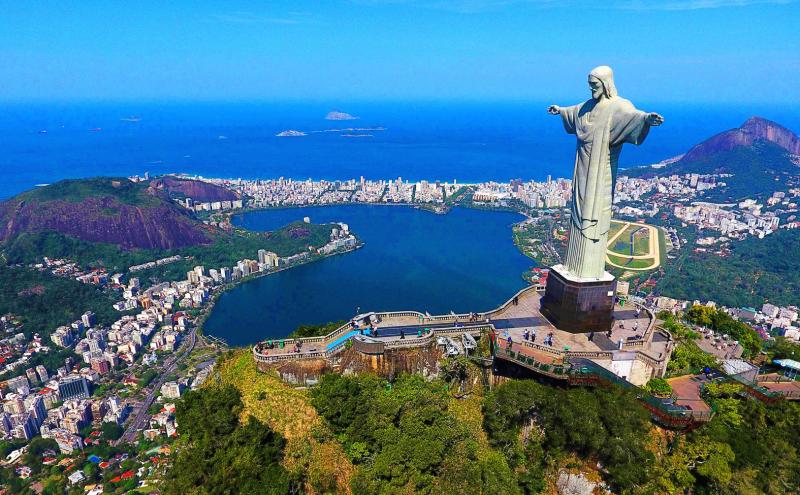
Photo: AFP
Located atop the 710m Corcovado hill in the center of Rio in Tijuca national park, the monument offers a spectacular panoramic view of the city. Since social-distancing measures forced its closure in March, Christ the Redeemer has continued to function as a religious sanctuary, offering public masses and holding vigils.
Also reopening to the public on Saturday were the Pao de Acucar cable car, which offers its own panoramic view of the city, the AquaRio aquarium and the gigantic Rio Star, Latin America’s largest Ferris wheel.
Brazil’s National Confederation of Goods, Services and Tourism has estimated that the country’s tourism sector has lost 154 billion reals (US$28.4 billion) over the past five months, operating at only 14 percent of its capacity.
The state of Rio de Janeiro, with 17 million inhabitants, has registered more than 14,500 deaths and nearly 190,000 cases of the novel coronavirus, according to official statistics.
The state capital, which in June began a gradual economic reopening, has seen 33 deaths and 1,365 new cases in just the past 24 hours.
Brazil, with 107,232 deaths and more than 3.3 million cases to date, is the second-hardest-hit country in the world, after the US.
Brazilian President Jair Bolsonaro has dismissed the disease as a “little flu” and railed against lockdown measures imposed by state governors.
He has been slammed by experts for his stance — but nearly half of Brazilians believe he is not responsible for the death toll, according to a survey published by the Folha de S. Paulo newspaper on Saturday.
Forty-seven percent of those surveyed by the Datafolha Institute answered that Bolsonaro “is not to blame” for the high number of deaths, compared with 41 percent who consider him “one of the culprits (but not the main culprit),” and 11 percent who see him as the “main culprit.”
The survey also showed that Bolsonaro remains more popular than ever.
With no certainty about when a vaccine might be available, Rio authorities have announced a new format for the year-end celebrations that traditionally bring millions of people to Copacabana Beach for a huge fireworks display.
This year, the authorities are working to organize a series of smaller celebrations around the city and are urging people to watch the events online.
Rio’s world-famous carnival, with its huge street parties, also risks being canceled by the pandemic.
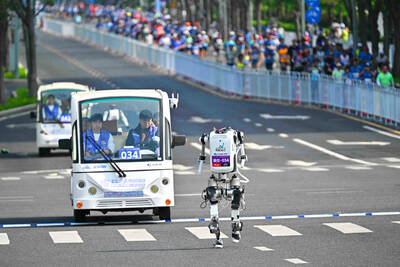
A humanoid robot that won a half-marathon race for robots in Beijing on Sunday ran faster than the human world record in a show of China’s technological leaps. The winner from Honor, a Chinese smartphone maker, completed the 21km race in 50 minutes and 26 seconds, said a WeChat post by the Beijing Economic-Technological Development Area, also known as Beijing E-Town, where the race began. That was faster than the human world record holder, Ugandan Jacob Kiplimo, who finished the same distance in about 57 minutes in March at the Lisbon road race. The performance by the robot marked a significant step forward
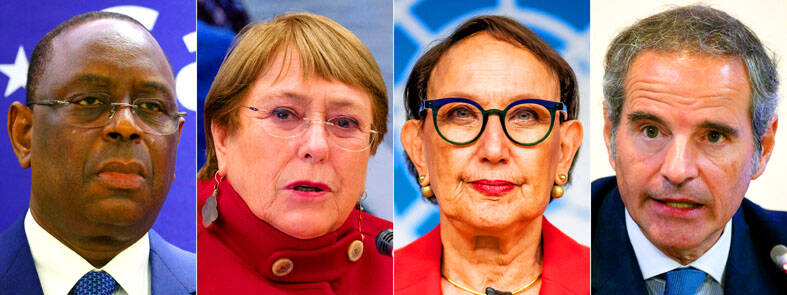
Four contenders are squaring up to succeed Antonio Guterres as secretary-general of the UN, which faces unprecedented global instability, wars and its own crushing budget crisis. Chile’s Michelle Bachelet, Argentina’s Rafael Grossi, Costa Rica’s Rebeca Grynspan and Senegal’s Macky Sall are each to face grillings by 193 member states and non-governmental organizations for three hours today and tomorrow. It is only the second time the UN has held a public question-and-answer, a format created in 2016 to boost transparency. Ultimately the five permanent members of the UN’s top body, the Security Council, hold the power, wielding vetoes over who leads the
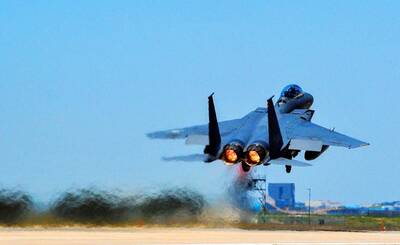
South Korea’s air force yesterday apologized for a 2021 midair collision involving two fighter jets, a day after auditors said the pilots were taking selfies and filming during the flight and held them responsible for the accident. “We sincerely apologize to the public for the concern caused by the accident that occurred in 2021,” an air force spokesman told a news conference, adding that one of the pilots involved had been suspended from flying duties, received severe disciplinary action and has since left the military. The apology followed a report released on Wednesday by the South Korean Board of Audit and Inspection,
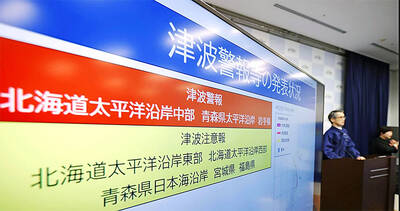
An earthquake registering a preliminary magnitude of 7.7 off northern Japan on Monday prompted a short-lived tsunami alert and the advisory of a higher risk of a possible mega-quake for coastal areas there. The Cabinet Office and the Japan Meteorological Agency said there was a 1% chance for a mega-quake, compared to a 0.1% chance during normal times, in the next week or so following the powerful quake near the Chishima and Japan trenches. Officials said the advisory was not a quake prediction but urged residents in 182 towns along the northeastern coasts to raise their preparedness while continuing their daily lives. Prime


 RSS
RSS