


China’s Sinovac Biotech Ltd yesterday began a late-stage human trial that would involve as many as 1,620 patients in Indonesia for a COVID-19 vaccine candidate, which it is developing with Indonesian state-owned peer Bio Farma.
Separately on Monday, Sinovac released details from a mid-stage, or Phase 2, study in which it said the vaccine candidate appeared to be safe and induced detectable antibody-based immune responses in subjects.
CORONAVAC

Photo: Reuters
The vaccine candidate, known as CoronaVac, is among a few potential vaccines that have entered late-stage trials for a large-scale study to gather proof of efficacy for regulatory approval.
CoronaVac is already undergoing a late-stage trial in Brazil and Sinovac expects to also test it in Bangladesh.
Sinovac’s Indonesia trial comes as Southeast Asia’s most populous country grapples with spiking infection numbers, with more than 127,000 cases recorded as of yesterday. The trial has so far recruited 1,215 people and would last six months.
“The threat of COVID-19 will not subside until a vaccine is given to all the people,” Indonesian President Joko Widodo said at a ceremony to begin the trial in Bandung, West Java. “Hopefully in January, we can produce and vaccinate everyone in the country.”
In addition to Bio Farma and Sinovac, private Indonesian firm Kalbe Farma and South Korea’s Genexine are cooperating to produce a separate vaccine. It is yet unclear how many doses these partnerships will produce and by when.
FEVER RATE
In Sinovac’s mid-stage trial involving 600 participants in China, the rate of fever in patients was lower than other COVID-19 candidates, including one from AstraZeneca, the study showed ahead of peer review.
Mid-stage trials usually test a candidate’s safety and ability to trigger an immune response in a relatively small number of people before it enters late-stage tests.
The study noted that the process to make the vaccines used in the Phase 2 trial was more optimized than in Phase 1, which produced more immunogens and triggered better immune responses.
Vaccines used in the late-stage trials would be made using the optimized process, a Sinovac spokesman said.
The Phase 2 results only included antibody-based immunity, the researchers said, adding that the candidate was being evaluated for other important components of the immune system.
Sinovac is testing its vaccine abroad because China is no longer a satisfactory site for late-stage trials due to the low number of new infection cases.

Crowds in Bangladesh are flocking to snap photographs with an unlikely social media star — an albino buffalo with flowing blond hair nicknamed “Donald Trump” that is due to be sacrificed within days. Owner Zia Uddin Mridha, 38, said his brother named the 700kg bull over its flowing helmet of hair resembling the signature look of the US president. “My younger brother picked this name because of the buffalo’s extraordinary hair,” he said at his farm in Narayanganj, just outside the capital, Dhaka. Mridha said that a constant stream of curious visitors — social media fans, onlookers and children — have come throughout

The Bolivian government on Friday struck a deal with protesting miners, but was still grappling with blockades and demonstrations by other workers across La Paz. Other groups are still blocking access roads into the city, which is also the seat of the government. Police on Thursday prevented the miners from entering the main square by using tear gas, while the demonstrators hurled stones and explosives with slingshots. Protests against the policies of Bolivian President Rodrigo Paz have convulsed the Andean nation since early this month, and roadblocks were choking routes into La Paz throughout Friday, the national road authority said. Miners demanded that Paz
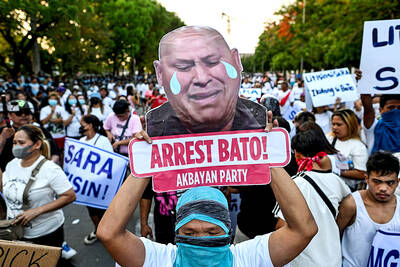
The Philippines said it has asked the country’s Supreme Court to allow it to arrest former Philippine president Rodrigo Duterte’s chief drug war enforcer to stand trial in an international tribunal. The International Criminal Court (ICC) last week unsealed an arrest warrant against Philippine Senator Ronald dela Rosa, accusing him along with Duterte and other “coperpetrators” of the “crime against humanity of murder.” Dela Rosa briefly sought refuge in the Philippine Senate last week while asking the Philippine Supreme Court to stop an ongoing attempt by government agents to arrest him. “By his own conduct, he has placed himself outside the protection of

The researchers in Ireland looked at their computer screen, marveling at a medieval book tracked down in a Roman library. They flipped through its digitized pages and found their sought-after treasure: the oldest surviving English poem. “We were extremely surprised. We were speechless. We couldn’t believe our eyes when we first saw that,” said Elisabetta Magnanti, a visiting research fellow at Trinity College Dublin’s school of English. The poem was also within the main body of Latin text, she said, calling it “extraordinary.” Composed in Old English by a Northumbrian agricultural worker in the 7th century, Caedmon’s Hymn appears within some copies of


 RSS
RSS