


Egyptian mother of three Menna said she was caught off-guard when a bulldozer clearing space for a controversial highway flattened much of a mausoleum that doubled as her home in a sprawling cemetery.
“The earth mover suddenly hit the wall and we found ourselves throwing our things in a panic” outside, she said.
“They kicked us out on the street,” she said, surrounded by rubble and dust in the UNESCO-listed world heritage site.
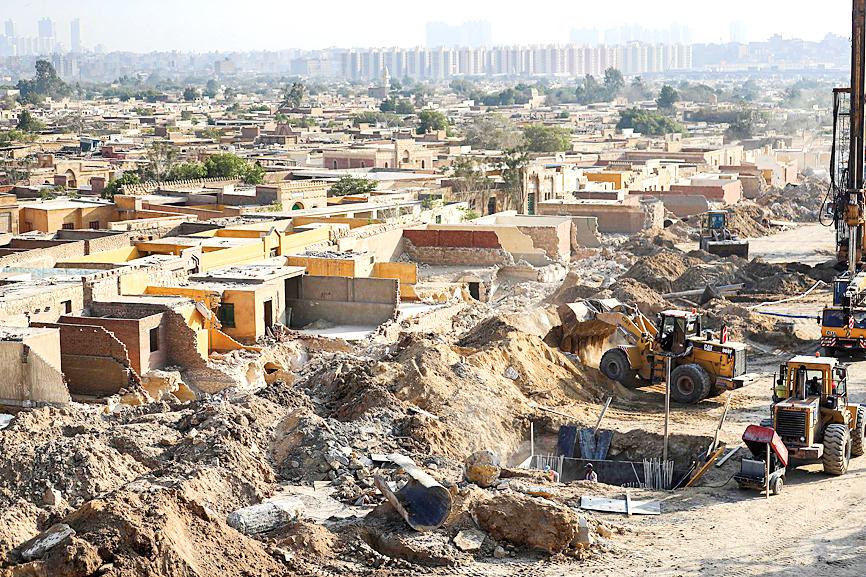
Photo: AFP
Menna’s parents and grandparents had made their home among the graves of the City of the Dead, the oldest necropolis in the Muslim world.
For those unable to afford prohibitively high rents in Egypt’s capital, the burial chambers in the city’s Basatin District provide shelter for thousands like her.
Many built extensions to the original mausoleums, eking out a largely tranquil, if bizarre, existence side-by-side with dead sultans, singers and saints in the sprawling east Cairo cemetery.
However, Menna said her peace — and that of the dead — was shattered by the arrival of workers.
“It was awful. We moved the dead on straw mats,” she said.
She and her husband shifted several bodies, including the remains of her father, to a segment of her home still intact.
Menna is now living with neighbors in part of the cemetery that is not in the demolition area.
Dozens of bodies were displaced by the construction work in the second half of last month, according to local media, to make way for the 17.5km Al-Ferdaous (Paradise) highway.
Ferdaous, connecting major Cairo road arteries, is the latest installment of Egyptian President Abdel-Fattah al-Sisi’s urban vision. He is intent on transferring the center of political power to a new capital, about 45km east of Cairo — a megaproject in the desert overseen by the military’s engineering arm.
Al-Sisi led the army’s overthrow of elected Egyptian president Mohamed Morsi in 2013 following mass protests against the Islamist leader’s rule.
He won his first term as president in 2014 and was re-elected four years later with more than 97 percent of the vote.
It is not just residents of the City of the Dead who are upset by the demolition work undertaken there.
Galila El-Kadi, a veteran architect and urban researcher based in Marseille, France, said the site is “an important component” of the capital’s urban history.
A final resting place for illustrious figures, including singer Farid al-Atrash and writer Ihsan Abdel Kouddous, as well as ordinary Egyptians, the Islamic necropolis founded in the 7th century stretches more than 6.5km.
It is full of ornately designed domes with Koranic verses that have been the object of fascination for orientalist painters and historians.
El-Kadi, who authored a book on the City of the Dead, said the demolition had reached a historic perimeter where luminaries are buried, including Sultan Abu Said Qansuh of the Mamluk Dynasty in the 15th century.
She said the demolitions would result in a loss of Cairo’s “visual identity and its memory.”
They reveal the “blind and arbitrary” character of a haphazard urban planning vision, driven by a “bulldozer policy,” El-Kadi said.
UNESCO said that it was “neither informed nor consulted” about the demolition work.
“The World Heritage Centre is following up with the Egyptian authorities to review the matter and assess any potential impacts on the Outstanding Universal Value, authenticity and integrity of the property,” it added.
On social media, Egyptians have documented the urban destruction with photographs of their family vaults as well as historic ones.
The Egyptian Ministry of Antiquities defended the work undertaken in the cemetery last month and said “there was no destruction of monuments” as only “recent graves” were moved.
However, Menna said she is haunted by the disturbed bodies.
“They abuse the living and the dead, without mercy ... and in the end, no one cares about us,” she said.
ROCKY RELATIONS: The figures on residents come as Chinese tourist numbers drop following Beijing’s warnings to avoid traveling to Japan The number of Chinese residents in Japan has continued to rise, even as ties between the two countries have become increasingly fractious, data released on Friday showed. As of the end of December last year, the number of Chinese residents had increased by 6.5 percent from the previous year to 930,428. Chinese people accounted for 22.6 percent of all foreign residents in Japan, making them by far the largest group, Japanese Ministry of Justice data showed. Beijing has criticized Tokyo in increasingly strident terms since Japanese Prime Minister Sanae Takaichi last year suggested that a military conflict around Taiwan could

A pro-Iran hacking group claimed to breach FBI Director Kash Patel’s personal e-mail inbox and posted some of the contents online. The e-mails provided by the hacking group include travel details, correspondence with leasing agents in Washington and global entry, and loyalty account numbers. The e-mail address the hackers claim to have compromised has been previously tied to Patel’s personal details, and the leaked e-mails contain photos of Patel and others, in addition to correspondence with family members and colleagues. “The FBI is aware of malicious actors targeting Director Patel’s personal email information,” the agency said in a statement on

RIVALRY: ‘We know that these are merely symbolic investigations initiated by China, which is in fact the world’s most profligate disrupter of supply chains,’ a US official said China has started a pair of investigations into US trade practices, retaliating against similar probes by US President Donald Trump’s administration as the superpowers stake out positions before an expected presidential summit in May. The move, announced by the Chinese Ministry of Commerce on Friday, is a direct mirror of steps Trump took to revive his tariff agenda after the US Supreme Court last month struck down some of his duties. “China expresses its strong dissatisfaction and firm opposition to these actions,” a ministry spokesperson said in a statement, referring to the so-called Section 301 investigations initiated on March 11.
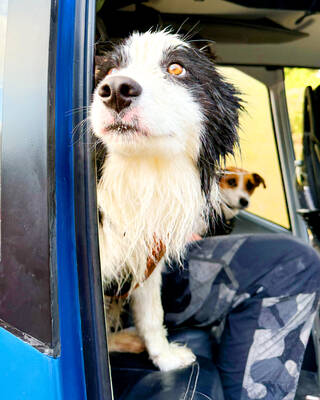
When a hiker fell from a 55m waterfall in wild New Zealand bush, rescuers were forced to evacuate the badly hurt woman without her dog, which could not be found. After strangers raised thousands of dollars for a search, border collie Molly was flown to safety by a helicopter pilot who was determined to reunite the pet and the owner. A week earlier, an emergency rescue helicopter found the woman with bruises and lacerations after a fall at a rocky spot at the waterfall on the South Island’s West Coast. She was airlifted on March 24, but they were forced to


 RSS
RSS