


The operator of a Japanese bulk carrier which ran aground off Mauritius in the Indian Ocean yesterday apologized for a major oil spill, which officials and environmentalists say is creating an ecological disaster, as police prepared to board the ship.
The MV Wakashio, operated by Mitsui OSK Lines, struck the reef on Mauritius’ southeast coast on July 25.
“We apologize profusely and deeply for the great trouble we have caused,” Mitsui OSK Lines executive vice president Akihiko Ono said at a news conference in Tokyo.
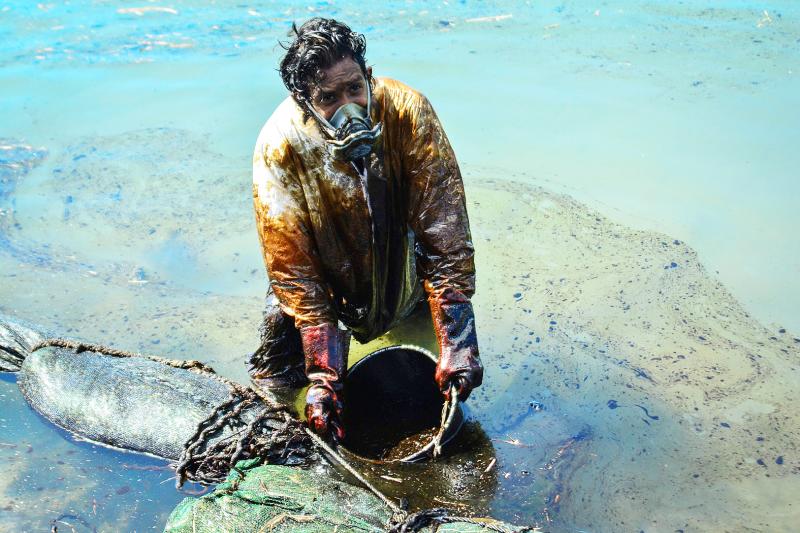
Photo: AFP
The company would “do everything in their power to resolve the issue,” he said.
At least 1,000 tonnes of oil is estimated to have leaked from the ship onto the waters surrounding Mauritius.
About 500 tonnes of oil have been salvaged from the ship, but there are still 2,500 tonnes remaining on the ship.
Neither Mitsui OSK Lines nor Nagashiki Shipping, the ship’s owner, could confirm the cost of damages from the oil spill.
Mauritius on Friday declared a state of “environmental emergency” following the accident, and on Saturday, France said it was sending help from nearby Reunion Island.
“When biodiversity is in peril, there is urgency to act,” French President Emmanuel Macron said on Saturday in a tweet.
A French statement from Reunion said that a military transport aircraft was carrying pollution control equipment to Mauritius and the navy’s Le Champlain has sailed with additional material.
Clean-up crews are battling a growing ecological disaster on the archipelago’s pristine shores.
Satellite images showed a dark slick spreading in the turquoise waters near wetlands that the government called “very sensitive.”
Hundreds of volunteers, many smeared head-to-toe in black sludge, were marshalling along the coastline, stringing together kilometers of makeshift cordons in a desperate attempt to hold back the oily tide.
However, a thick muck has already inundated the island nation’s unspoiled lagoons, marine habitats and white-sand beaches, causing unprecedented damage to the fragile coastal ecosystem upon which Mauritius and its economy relies.
Wildlife workers and volunteers ferried dozens of baby tortoises and rare plants from an island near the spill, Ile aux Aigrettes, to the mainland as fears grew that worsening weather yesterday could tear the ship apart along its cracked hull.
“People have realized that they need to take things into their hands. We are here to protect our fauna and flora,” said Ashok Subron, an environmental activist at Mahebourg, one of the worst-hit areas.
Police said they would execute a search warrant granted by a Mauritius court to board the Wakashio and seize items of interest, including the ship’s log book and communication exchanges, as part of its investigation into the accident.
The ship’s captain, a 58-year-old Indian national, would accompany officers on the search, police officials said.
Twenty crew members evacuated safely from the Japanese-owned but Panamanian-flagged ship when it ran aground are under surveillance.
Residents and environmentalists alike wondered why authorities did not act more quickly after the ship ran aground July 25 on a reef.
“That’s the big question,” Jean Hugues Gardenne with the Mauritian Wildlife Foundation said. “Why that ship has been sitting for long on that coral reef and nothing being done.”
This is the country’s first oil spill, he said, adding that perhaps no one expected the ship to break apart. Cracks in the hull were detected a few days ago and the salvage team was quickly evacuated.
About 400 sea booms were deployed to contain the spill, but they were not enough.
The opposition has called for the resignation of the country’s environment and fisheries ministers, as pressure mounts on the government to explain why more was not done to prepare in the two weeks since the ship ran aground.
Mauritian Prime Minister Pravind Jugnauth said the spill “represents a danger” for the country of 1.3 million people that relies heavily on tourism and has been hit hard by the effects of the coronavirus pandemic.
Jugnauth convened an crisis committee yesterday, and has expressed concern that forecast bad weather could further complicate efforts to stymie the spill, and cause more structural damage to the vessel.
Heavy winds are expected to push the oil slick even farther along the mainland’s shore.
The country also has appealed to the UN for urgent aid, including experts in containing oil spills and environmental protection.
Additional reporting by AP and AFP

Crowds in Bangladesh are flocking to snap photographs with an unlikely social media star — an albino buffalo with flowing blond hair nicknamed “Donald Trump” that is due to be sacrificed within days. Owner Zia Uddin Mridha, 38, said his brother named the 700kg bull over its flowing helmet of hair resembling the signature look of the US president. “My younger brother picked this name because of the buffalo’s extraordinary hair,” he said at his farm in Narayanganj, just outside the capital, Dhaka. Mridha said that a constant stream of curious visitors — social media fans, onlookers and children — have come throughout

It began as a satirical online project. Now millions of young people in India are flocking to it as an outlet for their frustration. A parody political party called the Cockroach Janta Party, with the insect as its symbol, has exploded across India’s social media by turning absurdist humor into protest. Memes and short videos mocking corruption, joblessness and political dysfunction have flooded social media sites, where millions of users are embracing the cockroach — known for its ability to survive harsh conditions — as a tongue-in-cheek symbol of endurance. The online movement’s rise has been unusually rapid. The Cockroach Janta Party (CJP)
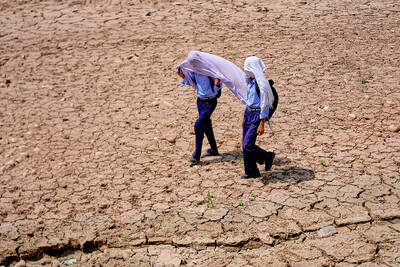
HOTTER: While Indians are accustomed to summer heat, climate change has caused northwestern India to warm faster than other parts of the country, an academic said Roads and markets have emptied during afternoons and some farmers have switched to nighttime work to avoid scorching temperatures as a heat wave grips large parts of India. The India Meteorological Department forecast maximum temperatures for yesterday of about 45°C in the capital, New Delhi, where authorities have opened temporary “cooling zones” to help people cope. The weather department warned that conditions would likely persist across several northern regions in the coming days, with temperatures staying well above seasonal averages. Authorities urged people to stay indoors during the hottest hours and take precautions against heat-related illnesses. India declares a heat wave whenever maximum temperatures

SPEAKING OUT: After Siranudh Scott’s allegations surfaced, celebrities and public figures took to social media to share their own experiences of sexual misconduct and abuse A high-profile alleged sexual abuse case within a wealthy Thai beer brewing family has prompted a wave of painful accounts from survivors of unconnected abuse in the conservative nation. Siranudh Scott, a member of the billionaire Thai family that founded the ubiquitous Singha beer brand, posted an emotional video this month accusing his elder brother Sunit of repeatedly abusing him when he was a teenager. Sunit, who is in his 30s, later denied the allegations in a video posted online, but Singha parent Boonrawd dismissed him from his executive role with the company on Tuesday last week. “I felt I needed to speak


 RSS
RSS