


Indian Prime Minister Narendra Modi yesterday took center stage at a ceremony laying the foundations for a temple at a flashpoint holy site exactly a year after imposing direct rule on Muslim-majority Kashmir — twin triumphs for his Hindu nationalist government.
The site at Ayodhya, and Kashmir, have been two of the most divisive communal issues of the past 30 years in India, and Modi has attempted to draw a line under both.
For his fans, both steps confirm Modi — elected to a second-straight term in a landslide victory last year — as a decisive, visionary and heroic leader, and India’s most important in decades.
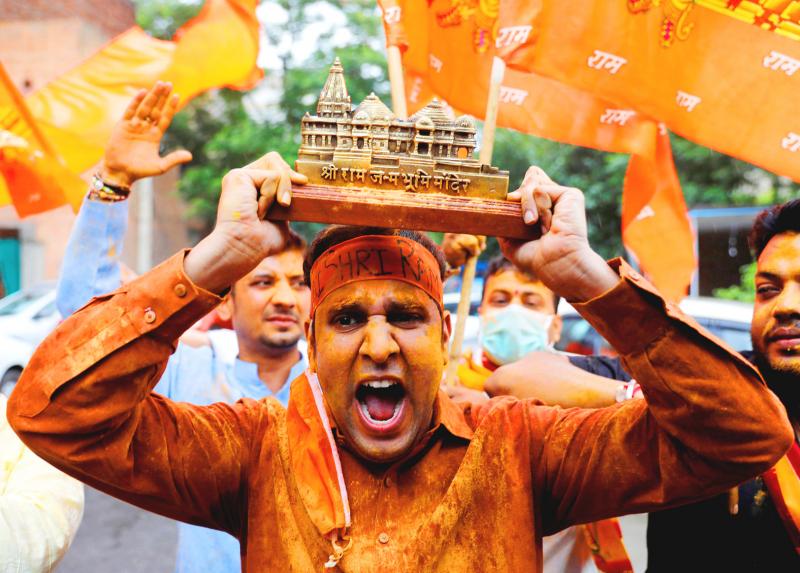
Photo: Reuters
His critics see him as remolding the officially secular country of 1.3 billion as a Hindu nation at the expense of India’s 200 million Muslims.
“Modi has certainly been India’s most transformative leader in recent memory,” making him “wildly popular, but also highly controversial and quite divisive,” said Micheal Kugelman, deputy director and senior associate for South Asia at the Wilson Center.
The holy city of Ayodhya in the state of Uttar Pradesh has long been a religious tinderbox, providing the spark for some of its worst sectarian violence.
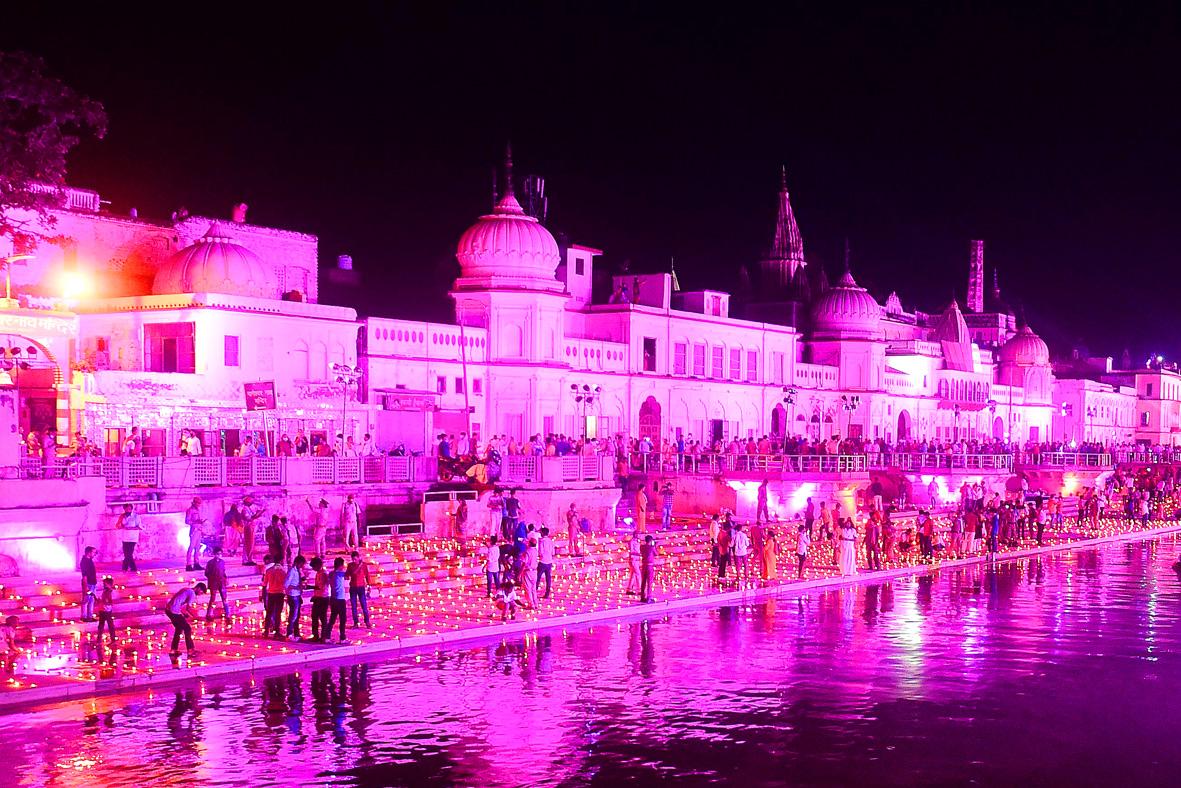
Photo: AFP
In 1992, a Hindu mob destroyed a centuries-old mosque there that they believed had been built on the birthplace of Ram, an important deity. This triggered religious riots that killed 2,000 people, most of them Muslims.
A lengthy legal battle ensued, but in November last year — in a major victory for Modi’s Bharatiya Janata Party (BJP) — India’s top court awarded the site to Hindus, allowing a temple “touching the sky” to be built.
Yesterday’s elaborate religious ceremony was shown live on television and was reportedly set to be beamed in Times Square in New York City. Small celebrations also took place across India.
A masked Modi, 69, shared the stage with the head of the Rashtriya Swayamsevak Sangh, a militaristic hardline Hindu group that is parent to the BJP and which Modi joined as a young man.
“Not only mankind, but the entire universe, all the birds and animals, are enthralled by this golden moment,” the main priest chanted.
Modi “is going to make his position permanently in history purely on the strength of this temple,” his biographer Nilanjan Mukhopadhyay said.
Further cementing Modi’s place in his country’s annals is Kashmir, divided between India and Pakistan since 1947 and the spark for two wars and the source of much bloodshed.
The BJP had long seen the special status enjoyed by the part of Kashmir controlled by India as a historical wrong, and on Aug. 5 last year, Modi abolished it.
An accompanying security operation turned the region into a fortress for weeks, with telecommunications cut and thousands taken into custody.
Even now, India has “maintained stifling restraints on Kashmiris in violation of their basic rights,” Human Rights Watch has said.
Fearing protests ahead of the anniversary, thousands of Indian troops on Tuesday imposed a tight curfew in Kashmir.
In Pakistan-administered Kashmir, Pakistani Prime Minister Imran Khan — who on Tuesday released a new map showing all of Kashmir as part of Pakistan — led a protest march in Muzaffarabad.
“We will never accept, and neither will the Kashmiris, the illegal Indian actions and oppression of the Kashmiri people,” Khan said in a statement.

SPEAKING OUT: After Siranudh Scott’s allegations surfaced, celebrities and public figures took to social media to share their own experiences of sexual misconduct and abuse A high-profile alleged sexual abuse case within a wealthy Thai beer brewing family has prompted a wave of painful accounts from survivors of unconnected abuse in the conservative nation. Siranudh Scott, a member of the billionaire Thai family that founded the ubiquitous Singha beer brand, posted an emotional video this month accusing his elder brother Sunit of repeatedly abusing him when he was a teenager. Sunit, who is in his 30s, later denied the allegations in a video posted online, but Singha parent Boonrawd dismissed him from his executive role with the company on Tuesday last week. “I felt I needed to speak

SEEKING ORDER: Rodrigo Paz said that ‘anyone who wants to destroy the nation will have to deal with this president and the full force of the constitution’ Bolivian President Rodrigo Paz on Wednesday said that the nation was at a “breaking point” after nearly a month of protests that have caused shortages of food, fuel and medicine. Paz, who took office six months ago amid the worst economic crisis there in four decades, is battling a groundswell of fury over his policies. The political capital, La Paz, has been besieged by low-income workers and members of the indigenous majority calling for his resignation. “The country needs order and is reaching breaking point,” the 58-year-old said at a public event in La Paz, renewing his appeal for dialogue. On Tuesday, the Bolivian

‘CROSSING THE LINE’: China’s embassy in Seoul criticized US Forces Korea Commander General Xavier Brunson, asking if his ‘hostile’ remarks were authorized by Washington South Korea and the US are in talks over recent public remarks by the commander of US Forces Korea, Seoul’s presidential office said yesterday, after the comments drew sharp criticism from China. In a recent podcast interview, US Forces Korea Commander General Xavier Brunson described South Korea as “the dagger in the heart of Asia” from China’s east coast, prompting the Chinese embassy in Seoul to say that he had “truly crossed the line.” The interview came amid growing speculation that Washington might seek to expand the role of US Forces Korea in countering the growing regional influence of China, a key

Forecasters in Europe yesterday warned of exceptional heat as record temperatures driven by a “heat dome” push temperatures well above seasonal norms across the continent. The surge follows a record-breaking Monday, with France logging its hottest day in the month of May on record, its weather agency said, and the UK also posting unprecedented highs. A so-called “heat dome” of warm air from northern Africa trapped under a high-pressure system over western Europe is behind the high temperatures not usually seen until high summer. Restrictions on outdoor work were imposed in parts of Italy, beaches in southwest France filled earlier than usual and


 RSS
RSS