


Burmese police said they have seized a huge haul of liquid fentanyl. It is the first time that one of the dangerous synthetic opioids that have ravaged North America has been found in Asia’s Golden Triangle drug-producing region.
In a signal that Asia’s drug syndicates have moved into the lucrative opioid market, more than 3,700 liters of methylfentanyl was discovered by anti-narcotics police near Loikan village in Shan State in northeast Myanmar.
The seizure of the fentanyl derivative was part of Asia’s biggest-ever interception of illicit drugs, precursors and drug-making equipment, including 193 million methamphetamine tablets known as yaba. At 17.5 tonnes, the yaba almost equaled the amount seized in the previous two years in Myanmar.
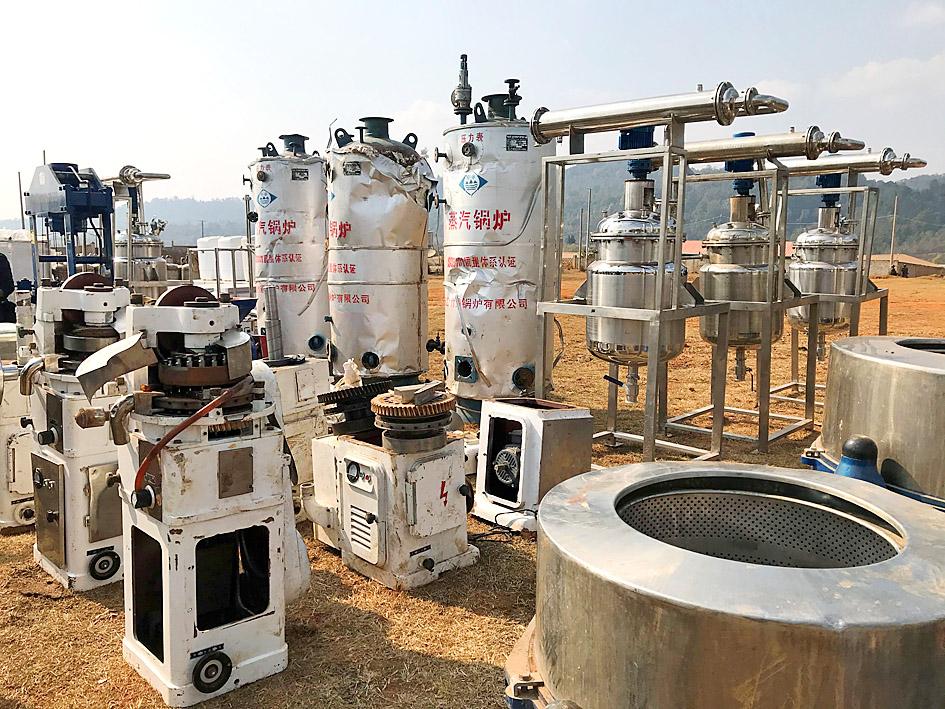
Photo: Myanmar Police/UN Office on Drugs and Crime/handout via Reuters
The UN Office on Drugs and Crime (UNODC) said that the scale of the bust was unprecedented and Myanmar’s anti-drug authorities had “dismantled a significant network” during a two-month operation involving police and military.
Also seized were almost 163,000 liters and 35.5 tonnes of drug precursors, as well as weapons. There were more than 130 arrests.
Even so, the methylfentanyl discovery was an ominous indicator for the region’s illicit drug market, the UN agency and a Western official based in Myanmar told reporters.
“It could be a game changer because fentanyl is so potent that its widespread use would cause a major health concern for Myanmar and the region,” said the official, who declined to be identified.
In an interview, the head of law enforcement for Myanmar’s counter-narcotics agency, Colonel Zaw Lin, said that the methylfentanyl had been verified using state-of-the-art equipment.
The seizure showed that the methods of the drug syndicates were changing, he said.
Fentanyl and its derivatives have caused more than 130,000 overdose deaths in the US and Canada in the past five years, government agencies say.
The opioid epidemic has not swept through Asia, Europe or Australasia, but there are signs it is an emerging threat.
“We have repeatedly warned the region fentanyl could become a problem, but this is off the charts,” said Jeremy Douglas, the UNODC’s representative for Southeast Asia and the Pacific. “It is the shift in the market we have been anticipating, and fearing.”
While Burmese police did not disclose the purity and exact makeup of the methylfentanyl found, it comes in two main variants, both more potent than fentanyl, the European Monitoring Centre for Drugs and Drug Addiction says.
Fentanyl itself is 25 to 50 times stronger than heroin.
Increasingly, drug traffickers have been mixing fentanyl and its derivatives with heroin, meth and cocaine, adding to their potency and lethality.
Half of all heroin and cocaine overdoses in the US included substances with traces of synthetic opioids in 2017, a Rand Corporation analysis found.
A Canadian survey found that 73 percent of those who tested positive for fentanyl did not know they had consumed it.
The methylfentanyl and other drugs and precursors were found in clearings near Loikan village where several drug factories were located, but had been abandoned when the raids took place, Zaw Lin said.
“Upon interrogation, the offenders revealed most of the drugs would be distributed inside Myanmar and distributed around neighboring countries, but we are still conducting interrogations. We haven’t totally got the final destinations yet,” he said.
Liquid fentanyl is usually converted into powder before being sold, often in tablet form, said two analysts, who asked not to be identified.
As well as being easier and cheaper to produce than heroin, strong synthetic opioids such as fentanyl can be readily concealed and transported as only small amounts can deliver thousands of doses.
For decades, Asian crime syndicates in partnership with ethnic minority militias have used the Golden Triangle — centered on northern Myanmar and including parts of Laos and Thailand — to grow opium and refine heroin.
More recently, meth production by groups such as the Sam Gor syndicate has exploded in the region, in part due to a crackdown in China.
Zaw Lin said that the methylfentanyl had come from a neighboring country, but declined to identify it.
Burmese police documents reviewed by Reuters said that most of the seized drugs, precursors and equipment had come from China.
China, along with Mexico, has been a major supplier of fentanyl to North America, but escalating law enforcement efforts have brought a slump in Chinese exports of the synthetic opioid to the US, the US Drug Enforcement Administration says.
Northern Myanmar’s proximity to China makes it an attractive alternative for Asian drug syndicates looking to produce fentanyl and other synthetic opioids, analysts said.

‘CROSSING THE LINE’: China’s embassy in Seoul criticized US Forces Korea Commander General Xavier Brunson, asking if his ‘hostile’ remarks were authorized by Washington South Korea and the US are in talks over recent public remarks by the commander of US Forces Korea, Seoul’s presidential office said yesterday, after the comments drew sharp criticism from China. In a recent podcast interview, US Forces Korea Commander General Xavier Brunson described South Korea as “the dagger in the heart of Asia” from China’s east coast, prompting the Chinese embassy in Seoul to say that he had “truly crossed the line.” The interview came amid growing speculation that Washington might seek to expand the role of US Forces Korea in countering the growing regional influence of China, a key

SEEKING ORDER: Rodrigo Paz said that ‘anyone who wants to destroy the nation will have to deal with this president and the full force of the constitution’ Bolivian President Rodrigo Paz on Wednesday said that the nation was at a “breaking point” after nearly a month of protests that have caused shortages of food, fuel and medicine. Paz, who took office six months ago amid the worst economic crisis there in four decades, is battling a groundswell of fury over his policies. The political capital, La Paz, has been besieged by low-income workers and members of the indigenous majority calling for his resignation. “The country needs order and is reaching breaking point,” the 58-year-old said at a public event in La Paz, renewing his appeal for dialogue. On Tuesday, the Bolivian

Through the noise of rushing papers and whirring belts at a print factory in Kyoto, two creators watch their photo essay come to life in broadsheet form — part of an effort to win new audiences in the age of artificial intelligence (AI). Despite the decline of the publishing industry, self-publication and handmade “zine” magazines are growing in popularity in Japan, reflecting the nation’s enduring love of paper in the digital era. While speaking to Agence France-Presse at the plant, his hands black with ink, one of the creators, Kazuma Obara, said: “I think [paper] is a medium that engages all five

Australian researchers have trained lab-grown brain cells on a silicon computer chip to play the 1990s shooter game Doom and said they are just scratching the surface of what the neurons could be capable of doing. It is the science-fiction work of biotech boffins at Cortical Labs, who researched and developed the technology that harnesses the workings of the brain’s networking system. Each so-called “biological computer” contains about 200,000 living human brain cells, grown from stem cells that were harvested from blood donations. Having mastered the simple computer game Pong, where a paddle is moved up and down to send a ball


 RSS
RSS