


The 250th anniversary of Captain James Cook’s contentious landing in Australia went largely unmarked yesterday as the coronavirus pandemic forced the cancelation of long-planned commemorative events.
On April 29, 1770, Cook sailed the Endeavour into Botany Bay — called Kamay in the local indigenous language — an event that is increasingly being seen through the eyes of the Aboriginal Australians who were on the shore.
Australian Prime Minister Scott Morrison said that the anniversary represented “a merging of histories,” calling Cook an “extraordinary individual.”
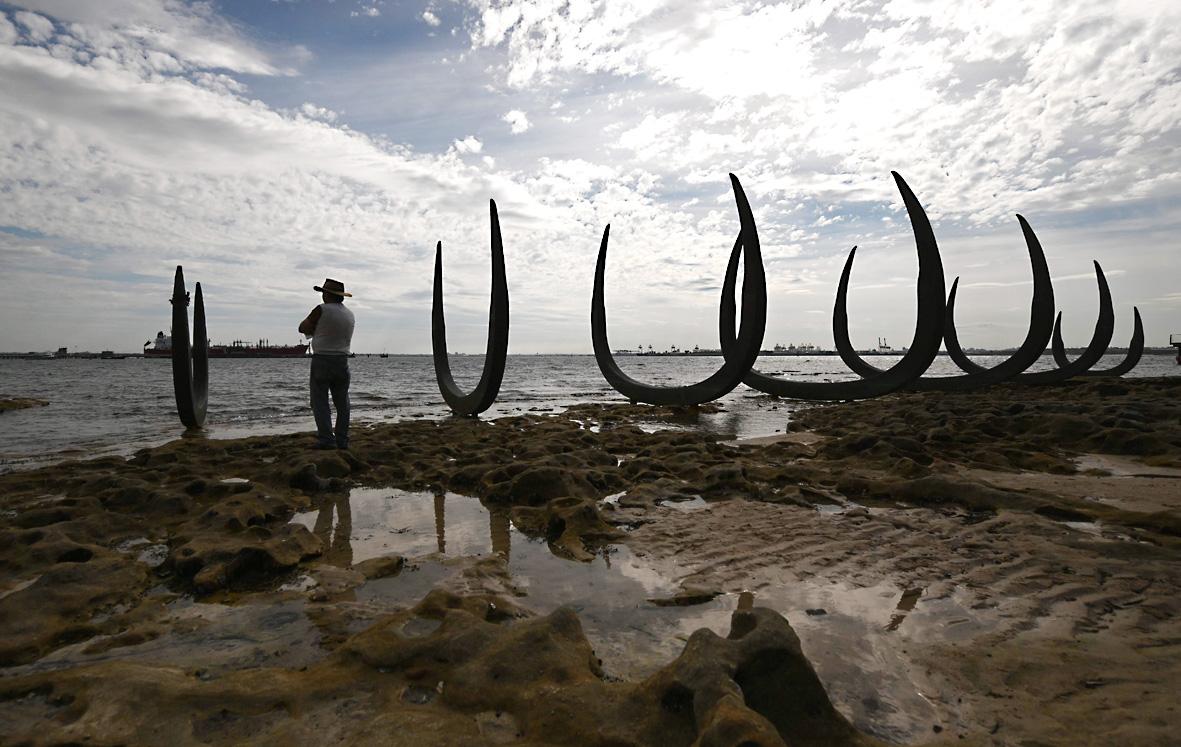
Photo: AFP
“The day Cook and the local indigenous community at Kamay first made contact 250 years ago changed the course of our land forever,” he said.
“It’s a point in time from which we embarked on a shared journey which is realized in the way we live today,” he said.
Australia’s government was forced to cancel events marking 250 years since Cook’s landing due to the COVID-19 pandemic, including the planned A$6.5 million (US$4.24 million) circumnavigation of Australia by a replica of the Endeavour.
The first contact between the British navigator and Aboriginals foreshadowed the colonization of the continent and centuries of dispossession for indigenous Australians.
During his voyage, Cook declared Australia terra nullius — or legally unoccupied land — and claimed it as British territory despite Aboriginal history stretching back more than 60,000 years.
The British later established a penal colony in New South Wales in 1788.
Gujaga Foundation chairperson Ray Ingrey said that the indigenous Dharawal people had been working with the National Museum of Australia for 18 months to showcase their ancestors’ recollections of encountering Cook.
“Australian society has matured quite a lot over the last 50 years since the last anniversary came around, the 200th anniversary,” he said.
“A lot of the messages being received by the National Museum was the broader community saying: ‘We’ve heard about Cook’s side of story, or the story from the ship, and we want to hear more about the story from the shore,’” he said.
An online exhibition features the “largely missing” stories passed down through generations of indigenous Australians of those encounters with Cook and his crew.
Ingrey said that the anniversary was a “significant event for all Australians,” but the indigenous side of the story had long been overlooked or misrepresented.
“It was the first act of violence towards our people by the British, however it is our shared history and we have shared present, so it’s only common sense that we have a shared future,” he said.
“Both stories need to be respected and that’s all that we would hope for, that we have the opportunity to tell our story the way that we want to tell it and be respected to do that,” Ingrey said.

An American scientist convicted of lying to US authorities about payments from China while he was at Harvard University has rebuilt his research lab in Shenzhen, China, to pursue technology the Chinese government has identified as a national priority: embedding electronics into the human brain. Charles Lieber, 67, is among the world’s leading researchers in brain-computer interfaces. The technology has shown promise in treating conditions such as amyotrophic lateral sclerosis and restoring movement in paralyzed people. It also has potential military applications: Scientists at the Chinese People’s Liberation Army have investigated brain interfaces as a way to engineer super soldiers by boosting

Jailed media entrepreneur Jimmy Lai (黎智英) has been awarded Deutsche Welle’s (DW) freedom of speech award for his contribution to Hong Kong’s pro-democracy movement. The German public broadcaster on Thursday said Lai would be presented in absentia with the 12th iteration of the award on June 23 at the DW Global Media Forum in Bonn. Deutsche Welle director-general Barbara Massing praised the 78-year-old founder of the now-shuttered news outlet Apple Daily for standing “unwaveringly for press freedom in Hong Kong at great personal risk.” “With Apple Daily, he gave journalists a platform for free reporting and a voice to the democracy movement in
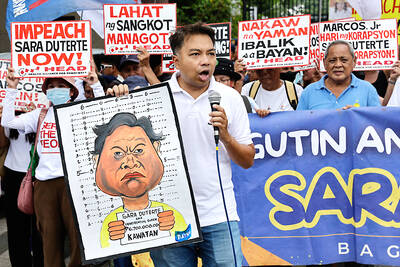
PHILIPPINE COMMITTEE: The head of the committee that made the decision said: ‘If there is nothing to hide, there is no reason to hide, there is no reason to obstruct’ A Philippine congressional committee on Wednesday ruled that there was “probable cause” to impeach Philippine Vice President Sara Duterte after hearing allegations of unexplained wealth, misuse of state funds and threats to have the president assassinated. The unanimous decision of the 53-member committee in the Philippine House of Representatives sends the two impeachment complaints to deliberations and voting by the entire lower chamber, which has more than 300 lawmakers. The complaints centered on Duterte’s alleged illegal use and mishandling of intelligence funds from the vice president’s office, and from her time as education secretary under Philippine President Ferdinand Marcos Jr. Duterte and the

As evening falls in Fiji’s capital, a steady stream of people approaches a makeshift clinic that is a first line of defense against one of the world’s fastest-growing HIV epidemics. In the South Pacific nation — a popular tourist destination of just under a million people — more than 2,000 new HIV cases were recorded last year, a 26 percent increase from 2024. The government has declared an HIV outbreak and described it as a national crisis. “It’s spreading like wildfire,” said Siteri Dinawai, 46, who came to be tested. The Moonlight Clinic, a converted minibus parked in a suburban cul-de-sac in Suva, is


 RSS
RSS