


Hop into an Uber in Miami before the pandemic and it was easy to hear a driver speaking Spanish with an accent from Venezuela — many of its people ended up there after fleeing an economic meltdown back home.
Now, with the US economy largely shut down because of the COVID-19 pandemic, those idle Venezuelan Uber drivers are displaying the coping skills they developed while trying to survive under Venezuelan President Nicolas Maduro.
Some get by as home chefs, cooking up Venezuelan dishes and marketing them on social media for people hunkering down because of the lockdown.
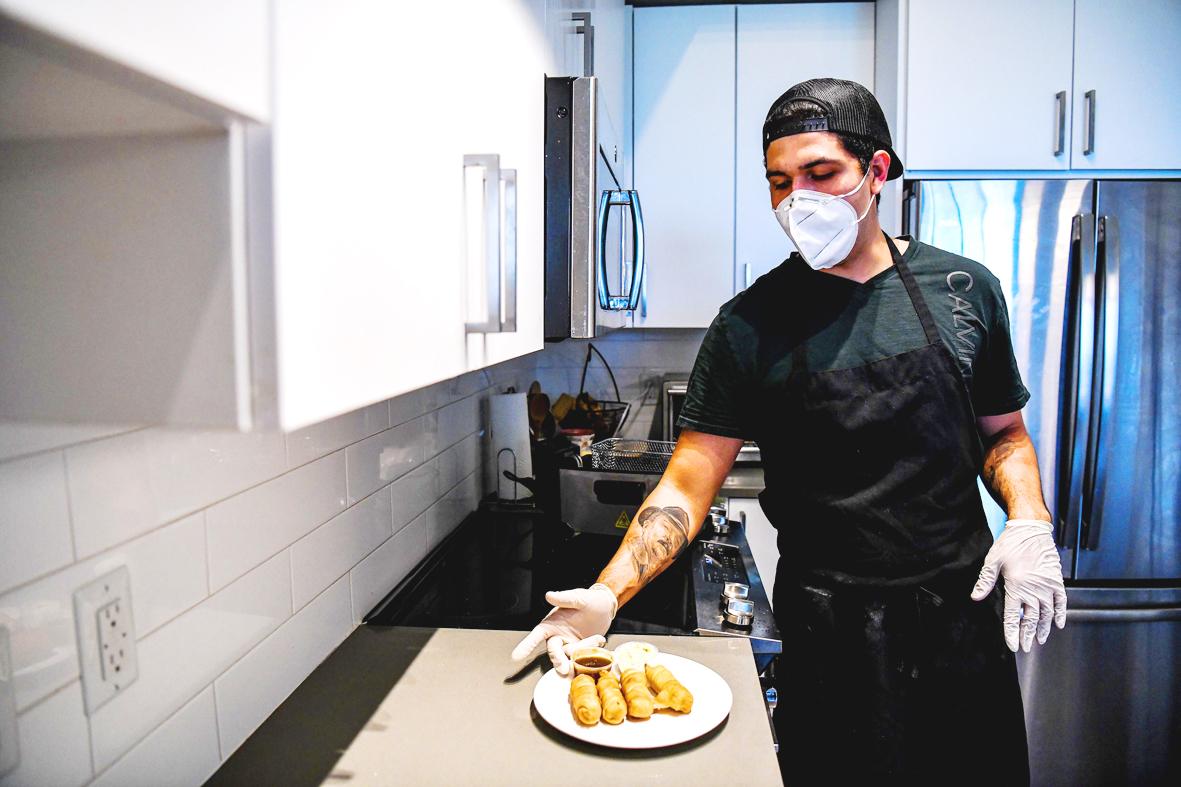
Photo: AFP
They are doing OK, in fact, so well they might keep cooking after the pandemic ends.
Mario Amate, who used to drive for the ride-hailing company, recalled the day in the middle of last month when his smartphone just stopped pinging with alerts to go pick somebody up.
The US was finally beginning to mobilize against the pandemic and Florida had shut down non-essential businesses.
“The phone did not go off once in 10 hours,” said Amate, who is 31 and settled in Miami five years ago after fleeing Venezuela’s economic, political and humanitarian crisis.
Miami, where you hear Spanish just about everywhere and Cuban exiles have contributed much to the city’s development, has become the hub of the Venezuelan diaspora in the US over the past two decades.
There are no clear estimates on how many Venezuelans moved to the US, as many of them are undocumented. According to a Pew Research Center study last year, 421,000 Venezuelans resided in the US in 2017, a 352 percent increase since 2000.
A lawyer back home, Amate has worked at just about everything in Miami. He also cooked, but most of his income came from Uber.
When his wife, an accountant, saw her hours cut in half, they started to panic.
“We were worried, because we had money for a week and thought: ‘Then what?’” he said.
Amate’s neighbor, Rafael Delgado, also a Venezuelan and a part-time Uber driver, was laid off from the hotel where he worked. So he proposed to Amate they start cooking and selling a Venezuelan appetizer called a tequeno — small cheese sticks wrapped in fried dough.
“We felt a lot of anxiety, but you cannot just sit back and do nothing,” said Delgado, 29.
His wife was also furloughed, so the two couples are now churning out 1,000 tequenos a week.
An Uber official told reporters that the company has no figures on how many of its associates are Latin American immigrants, but confirmed that most of its drivers in Miami speak Spanish.
The official did not give figures for Miami, but reported last month that ridership nationwide was down 60 to 70 percent.
With times hard — once again, for these Venezuelans — others are cooking up dishes from back home, too.
Jesus Escalona, for instance, makes pastichos, a sort of Venezuelan lasagna.
Manuel Freitez drives around the city delivering Venezuelan cinnamon rolls. They are the work of his wife, a furloughed hotel chef named Natasha Echevarreneta, 30, and her father, a musician who used to earn all his income from Uber.
They sounded hopeful about their new way of surviving in exile.
“Times of crisis are times for opportunity,” Amate said.

An American scientist convicted of lying to US authorities about payments from China while he was at Harvard University has rebuilt his research lab in Shenzhen, China, to pursue technology the Chinese government has identified as a national priority: embedding electronics into the human brain. Charles Lieber, 67, is among the world’s leading researchers in brain-computer interfaces. The technology has shown promise in treating conditions such as amyotrophic lateral sclerosis and restoring movement in paralyzed people. It also has potential military applications: Scientists at the Chinese People’s Liberation Army have investigated brain interfaces as a way to engineer super soldiers by boosting
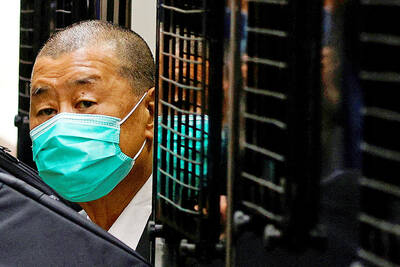
Jailed media entrepreneur Jimmy Lai (黎智英) has been awarded Deutsche Welle’s (DW) freedom of speech award for his contribution to Hong Kong’s pro-democracy movement. The German public broadcaster on Thursday said Lai would be presented in absentia with the 12th iteration of the award on June 23 at the DW Global Media Forum in Bonn. Deutsche Welle director-general Barbara Massing praised the 78-year-old founder of the now-shuttered news outlet Apple Daily for standing “unwaveringly for press freedom in Hong Kong at great personal risk.” “With Apple Daily, he gave journalists a platform for free reporting and a voice to the democracy movement in
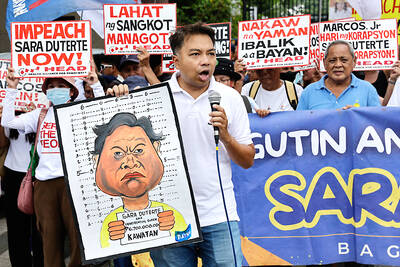
PHILIPPINE COMMITTEE: The head of the committee that made the decision said: ‘If there is nothing to hide, there is no reason to hide, there is no reason to obstruct’ A Philippine congressional committee on Wednesday ruled that there was “probable cause” to impeach Philippine Vice President Sara Duterte after hearing allegations of unexplained wealth, misuse of state funds and threats to have the president assassinated. The unanimous decision of the 53-member committee in the Philippine House of Representatives sends the two impeachment complaints to deliberations and voting by the entire lower chamber, which has more than 300 lawmakers. The complaints centered on Duterte’s alleged illegal use and mishandling of intelligence funds from the vice president’s office, and from her time as education secretary under Philippine President Ferdinand Marcos Jr. Duterte and the
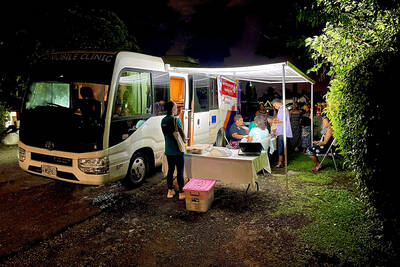
As evening falls in Fiji’s capital, a steady stream of people approaches a makeshift clinic that is a first line of defense against one of the world’s fastest-growing HIV epidemics. In the South Pacific nation — a popular tourist destination of just under a million people — more than 2,000 new HIV cases were recorded last year, a 26 percent increase from 2024. The government has declared an HIV outbreak and described it as a national crisis. “It’s spreading like wildfire,” said Siteri Dinawai, 46, who came to be tested. The Moonlight Clinic, a converted minibus parked in a suburban cul-de-sac in Suva, is


 RSS
RSS