


Latin American countries on Wednesday stepped up measures to slow the advance of COVID-19, announcing a slew of restrictions on travelers from the worst-affected nations and shutting down major sports events.
Argentina, Colombia and Peru said that travelers from China, Italy, Spain and France would be isolated on arrival.
El Salvador went further, with Salvadorean President Nayib Bukele announcing late on Wednesday that it was banning entry to foreigners for a period of 21 days.
Photo: AFP
The move would affect “any foreigner who is not a resident or diplomat” posted in the country, Bukele said, adding that Salvadoreans arriving from countries hit by the virus would face a 30-day quarantine.
El Salvador — which previously banned entry of those traveling from the worst-affected countries — is among a handful of states in the region yet to declare a confirmed COVID-19 case.
Argentina was on Saturday the first Latin American nation to register a COVID-19-related death, with Panama announcing another on Tuesday.
Cuba registered its first three cases on Wednesday. Three Italian tourists, who had arrived on Monday in Havana, all tested positive for the virus and have been quarantined.
The Cuban Ministry of Public Health said they were “progressing well and none of them is in danger of death.”
The continent still has only about 150 registered cases and two deaths.
Though it pales with soaring global figures of about 128,000 infections and more than 4,700 deaths, the new measures reflect the region’s growing disquiet — particularly given its close links with former colonial power Spain, one of the nations worst hit by the crisis.
Buenos Aires announced a two-week isolation period for people arriving from China, Italy, France, Germany, Spain, Japan, South Korea and the US.
“If you don’t comply, you’ll be committing a crime, which is putting the public health at risk,” Argentine President Alberto Fernandez said on radio.
He said Argentina was considering barring travelers from Italy, the worst-affected European country and one from which many Argentines are descended.
Panama has suspended school classes until April 7, while Bukele said El Salvador would suspend university classes as well until the end of the month.
Colombia has seen only three cases so far, but also announced measures against travelers arriving from affected countries.
“Given the implications of the quarantine by China, Italy, Spain and France, the national government is adopting the preventive isolation of people coming from those countries,” Colombian President Ivan Duque tweeted.
Peru followed suit by declaring a two-week “home isolation” for people coming from those same four countries, while also announcing the start of the new school year would be pushed back two weeks to March 30.
On Tuesday, Chile was the first Latin American country to announce a quarantine on arrivals from Spain and Italy. With 23 cases, Chile’s total is surpassed regionally only by Brazil’s 37.
Bolivia has asked people arriving from affected countries to place themselves in isolation for two weeks.
Costa Rica has called off large-scale events, including soccer matches, concerts and festivals.
Guatemala has banned entry to people from China and migrants from Honduras displaying signs of the virus, while also imposing a week-long hospital stay on those coming from Europe.
Paraguay has suspended school classes and large public events for two weeks, and the Dominican Republic has suspended flights arriving from Milan, Italy.

An American scientist convicted of lying to US authorities about payments from China while he was at Harvard University has rebuilt his research lab in Shenzhen, China, to pursue technology the Chinese government has identified as a national priority: embedding electronics into the human brain. Charles Lieber, 67, is among the world’s leading researchers in brain-computer interfaces. The technology has shown promise in treating conditions such as amyotrophic lateral sclerosis and restoring movement in paralyzed people. It also has potential military applications: Scientists at the Chinese People’s Liberation Army have investigated brain interfaces as a way to engineer super soldiers by boosting
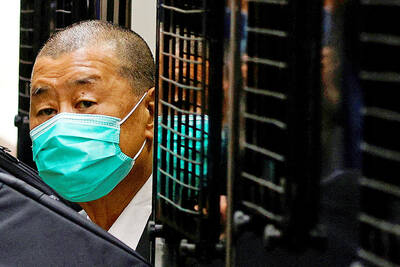
Jailed media entrepreneur Jimmy Lai (黎智英) has been awarded Deutsche Welle’s (DW) freedom of speech award for his contribution to Hong Kong’s pro-democracy movement. The German public broadcaster on Thursday said Lai would be presented in absentia with the 12th iteration of the award on June 23 at the DW Global Media Forum in Bonn. Deutsche Welle director-general Barbara Massing praised the 78-year-old founder of the now-shuttered news outlet Apple Daily for standing “unwaveringly for press freedom in Hong Kong at great personal risk.” “With Apple Daily, he gave journalists a platform for free reporting and a voice to the democracy movement in
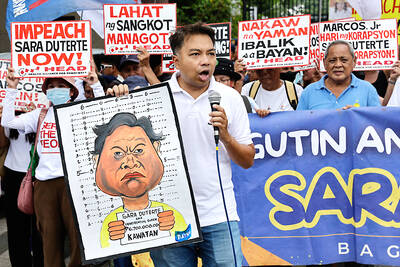
PHILIPPINE COMMITTEE: The head of the committee that made the decision said: ‘If there is nothing to hide, there is no reason to hide, there is no reason to obstruct’ A Philippine congressional committee on Wednesday ruled that there was “probable cause” to impeach Philippine Vice President Sara Duterte after hearing allegations of unexplained wealth, misuse of state funds and threats to have the president assassinated. The unanimous decision of the 53-member committee in the Philippine House of Representatives sends the two impeachment complaints to deliberations and voting by the entire lower chamber, which has more than 300 lawmakers. The complaints centered on Duterte’s alleged illegal use and mishandling of intelligence funds from the vice president’s office, and from her time as education secretary under Philippine President Ferdinand Marcos Jr. Duterte and the
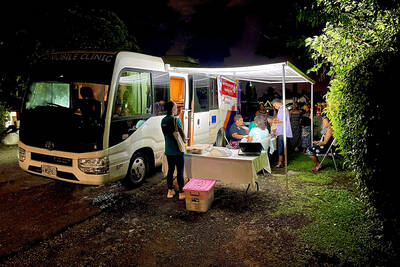
As evening falls in Fiji’s capital, a steady stream of people approaches a makeshift clinic that is a first line of defense against one of the world’s fastest-growing HIV epidemics. In the South Pacific nation — a popular tourist destination of just under a million people — more than 2,000 new HIV cases were recorded last year, a 26 percent increase from 2024. The government has declared an HIV outbreak and described it as a national crisis. “It’s spreading like wildfire,” said Siteri Dinawai, 46, who came to be tested. The Moonlight Clinic, a converted minibus parked in a suburban cul-de-sac in Suva, is


 RSS
RSS