


Government worker Iorliam Shija sits in one of the ramshackle bars along the banks of the Benue River in central Nigeria sipping from a gourd filled with frothy burukutu.
The vinegary alcoholic beverage has been made here for generations from the fermented grains of sorghum and millet, and consumed as a traditional alternative to beer.
Now, as Nigeria’s economy struggles to grow, the local brew is enjoying a boom from clients looking for a cheaper option.
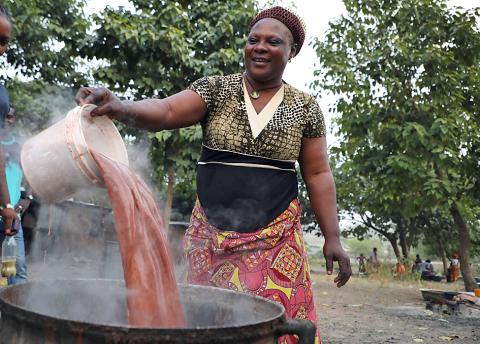
Photo: AFP
“If you have beer or burukutu, I will go with burukutu,” Shija said. “It is natural and it is what our people are used to drinking.”
Even though it is still early, the makeshift joints are already filled with drinkers young and old, male and female.
Women ladle the brownish liquid — which typically varies in strength from about 4 to 10 percent alcohol — out of large clay pots into dried calabashes for customers to drink alone or in a group.
Typically burukutu — which has its roots with the Jukun people of central and north Nigeria — is consumed by all strata of society and serves as an important focal point for social gatherings. However, those partaking say that as Nigeria’s economy limps along more people in this rural area are turning to it instead of the more expensive mass-produced beers.
Emmanuel Anthony has come to join friends even though he admits he has no money in his pockets.
“The reason why I am taking it is that I want to cut cost,” he said. “The economy is bad for now. I cannot go outside and start living above my means.”
Nigeria’s economy is still struggling to shake off its hangover after emerging from its deepest recession in decades in 2017. The government is predicting that growth would reach 2.93 percent this year, but that is still well below earlier levels and poverty rates are increasing as population numbers surge.
“With just 200 naira [US$0.55] two or three people will take the drink and be satisfied,” Anthony said. “A bottle of beer is from 200 naira to 350 naira.”
Artisan Chris Achochi, who lives close to Nigeria’s capital, Abuja, said the drink was a cheap way of bringing friends together.
“Burukutu is very cheap and it is an advantage to us, the way we are living in the country now,” he said. “With just 1,000 naira, you sit out with friends and drink enough, but with the same amount, you cannot cope with beer.”
Mary Ngoo has been in the business of brewing burukutu for more than 30 years. To keep her thirsty customers satisfied she wakes up in the early hours of the morning each day to begin the cooking process. Production involves steeping the seeds in the water, before washing, grinding, fermentation, filtering, boiling and refiltering. As she stokes firewood to keep the flames high, she insists the brewing process is not too complicated — but it demands time.
“It takes an average of three days to get the liquor ready for consumption,” she said.
The traditional method of production means that burukutu is not to everyone’s tastes — and possibly poses more health risks than beer.
A 2017 study by Nigerian academics comparing “chronic” beer and burukutu drinkers suggested it had a greater impact on the livers of consumers “due to its relatively high alcoholic content obtained by local and unstandardized brewing process.”
It is the lack of hygiene standards or quality control that has put off businessman Hilary Achia.
“I don’t drink burukutu. I am a very conscious hygienic person. I don’t think I agree with the method of processing it, so I am a little cautious and choosy in this aspect,” he said. “I rather go with beer which I have at least a fair idea of the production method and hygienic nature to some extent. I think I will go with bottled beer instead of burukutu.”

‘CROSSING THE LINE’: China’s embassy in Seoul criticized US Forces Korea Commander General Xavier Brunson, asking if his ‘hostile’ remarks were authorized by Washington South Korea and the US are in talks over recent public remarks by the commander of US Forces Korea, Seoul’s presidential office said yesterday, after the comments drew sharp criticism from China. In a recent podcast interview, US Forces Korea Commander General Xavier Brunson described South Korea as “the dagger in the heart of Asia” from China’s east coast, prompting the Chinese embassy in Seoul to say that he had “truly crossed the line.” The interview came amid growing speculation that Washington might seek to expand the role of US Forces Korea in countering the growing regional influence of China, a key

SEEKING ORDER: Rodrigo Paz said that ‘anyone who wants to destroy the nation will have to deal with this president and the full force of the constitution’ Bolivian President Rodrigo Paz on Wednesday said that the nation was at a “breaking point” after nearly a month of protests that have caused shortages of food, fuel and medicine. Paz, who took office six months ago amid the worst economic crisis there in four decades, is battling a groundswell of fury over his policies. The political capital, La Paz, has been besieged by low-income workers and members of the indigenous majority calling for his resignation. “The country needs order and is reaching breaking point,” the 58-year-old said at a public event in La Paz, renewing his appeal for dialogue. On Tuesday, the Bolivian

Through the noise of rushing papers and whirring belts at a print factory in Kyoto, two creators watch their photo essay come to life in broadsheet form — part of an effort to win new audiences in the age of artificial intelligence (AI). Despite the decline of the publishing industry, self-publication and handmade “zine” magazines are growing in popularity in Japan, reflecting the nation’s enduring love of paper in the digital era. While speaking to Agence France-Presse at the plant, his hands black with ink, one of the creators, Kazuma Obara, said: “I think [paper] is a medium that engages all five

Australian researchers have trained lab-grown brain cells on a silicon computer chip to play the 1990s shooter game Doom and said they are just scratching the surface of what the neurons could be capable of doing. It is the science-fiction work of biotech boffins at Cortical Labs, who researched and developed the technology that harnesses the workings of the brain’s networking system. Each so-called “biological computer” contains about 200,000 living human brain cells, grown from stem cells that were harvested from blood donations. Having mastered the simple computer game Pong, where a paddle is moved up and down to send a ball


 RSS
RSS