


The hum of millions of locusts on the move is broken by the screams of farmers and the clanging of pots and pans, but their noise-making does little to stop the voracious insects from feasting on their crops in the Kenyan village of Katitika.
The worst outbreak of desert locusts in Kenya in 70 years has seen hundreds of millions of the bugs swarm into the east African nation from Somalia and Ethiopia. Those two countries have not had an infestation like this in a quarter-century, destroying farmland and threatening an already vulnerable region with devastating hunger.
“Even cows are wondering what is happening,” said Ndunda Makanga, who spent hours on Friday trying to chase the locusts from his farm. “Corn, sorghum, cowpeas, they have eaten everything.”
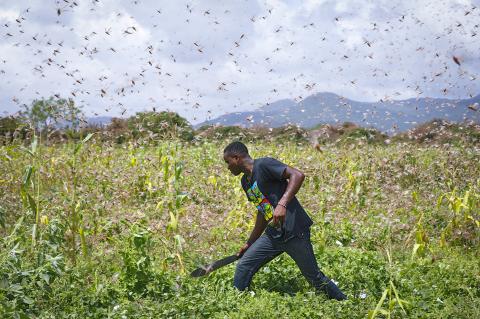
Photo: EPA-EFE
When rains arrive in March and bring new vegetation across much of the region, the numbers of the fast-breeding locusts could grow 500 times before drier weather in June curbs their spread, the UN said.
“We must act immediately,” said David Phiri of the UN Food and Agricultural Organization (FAO), as donors huddled in Kenya’s capital, Nairobi, a three-hour drive away.
About US$70 million is needed to step up aerial pesticide spraying, the only effective way to combat them, the UN said. That would not be easy, especially in Somalia, where parts of the country are in the grip of the al-Qaeda-linked al-Shabaab group.
The rose-colored locusts turn whole trees pink, clinging to branches like quivering ornaments before taking off in hungry, rustling clouds.
Astonished by the finger-length insects, children dash here and there, waving blankets or plucking at branches to shake the locusts free. One woman, Kanini Ndunda, batted them with a shovel.
Even a small swarm of the insects can consume enough food for 35,000 people in a single day, said Jens Laerke of the UN humanitarian office in Geneva, Switzerland.
Farmers are afraid to let their cattle out for grazing, and their crops of millet, sorghum and corn are vulnerable, but there is little they can do.
About 70,000 hectares of land in Kenya are already infested.
“This one, ai! This is huge,” said Kipkoech Tale, a migratory pest control specialist with the Kenyan Ministry of Agriculture. “I’m talking about over 20 swarms that we have sprayed. We still have more. And more are coming.”
A single swarm can contain up to 150 million locusts per square kilometer of farmland, an area the size of almost 250 football fields, regional authorities say.
One especially large swarm in northeastern Kenya measured 60km by 40km wide.
Kenya needs more spraying equipment to supplement the four planes now flying, Tale said.
Ethiopia also has four.
They also need a steady supply of pesticides, said Francis Kitoo, deputy director of agriculture in southeastern Kenya’s Kitui County.
“The locals are really scared, because they can consume everything,” Kitoo said. “I’ve never seen such a big number.”
The locusts eat the fodder for animals, a crucial source of livelihood for families who now worry how they will pay for expenses like school fees, he said.
His own concern about the locusts?
“They will lay eggs and start another generation,” he said.
A changing climate has contributed to “exceptional” breeding conditions, Nairobi-based climate scientist Abubakr Salih Babiker said.
Migrating with the wind, the locusts can cover up to 150km in a single day. They look like tiny aircraft lazily crisscrossing the sky.
They are now heading toward Uganda and fragile South Sudan, where almost half the country faces hunger as it emerges from civil war. Uganda has not had such an outbreak since the 1960s and is already on alert.
The locusts are also moving steadily toward Ethiopia’s Rift Valley, the breadbasket for Africa’s second-most populous country, the UN said.
“The situation is very bad, but farmers are fighting it in the traditional way,” said Buni Orissa, a resident of Ethiopia’s Sidama region. “The locusts love cabbage and beans. This may threaten the shaky food security in the region.”
Even before this outbreak, nearly 20 million people faced high levels of food insecurity across the east African region long challenged by periodic droughts and floods.
As exasperated farmers look for more help in fighting one of history’s most persistent pests, the FAO’s Locust Watch offers little consolation.
“Although giant nets, flamethrowers, lasers and huge vacuums have been proposed in the past, these are not in use for locust control,” the UN agency said. “People and birds often eat locusts, but usually not enough to significantly reduce population levels over large areas.”
Still, it offered recipes. One suggested seasoning in Uganda is chopped onion and curry powder. Then fry.

Four contenders are squaring up to succeed Antonio Guterres as secretary-general of the UN, which faces unprecedented global instability, wars and its own crushing budget crisis. Chile’s Michelle Bachelet, Argentina’s Rafael Grossi, Costa Rica’s Rebeca Grynspan and Senegal’s Macky Sall are each to face grillings by 193 member states and non-governmental organizations for three hours today and tomorrow. It is only the second time the UN has held a public question-and-answer, a format created in 2016 to boost transparency. Ultimately the five permanent members of the UN’s top body, the Security Council, hold the power, wielding vetoes over who leads the

South Korea’s air force yesterday apologized for a 2021 midair collision involving two fighter jets, a day after auditors said the pilots were taking selfies and filming during the flight and held them responsible for the accident. “We sincerely apologize to the public for the concern caused by the accident that occurred in 2021,” an air force spokesman told a news conference, adding that one of the pilots involved had been suspended from flying duties, received severe disciplinary action and has since left the military. The apology followed a report released on Wednesday by the South Korean Board of Audit and Inspection,

An earthquake registering a preliminary magnitude of 7.7 off northern Japan on Monday prompted a short-lived tsunami alert and the advisory of a higher risk of a possible mega-quake for coastal areas there. The Cabinet Office and the Japan Meteorological Agency said there was a 1% chance for a mega-quake, compared to a 0.1% chance during normal times, in the next week or so following the powerful quake near the Chishima and Japan trenches. Officials said the advisory was not a quake prediction but urged residents in 182 towns along the northeastern coasts to raise their preparedness while continuing their daily lives. Prime

About 240 Indians claiming descent from a Biblical tribe landed at Tel Aviv airport on Thursday as part of a government operation to relocate them to Israel. The newcomers passed under a balloon arch in blue and white, the colors of the Israeli flag, as dozens of well-wishers welcomed them with a traditional Jewish song. They were the first “bnei Menashe” (“sons of Manasseh”) to arrive in Israel since the government in November last year announced funding for the immigration of about 6,000 members of the community from the states of Manipur and Mizoram in northeast India. The community claims to descend from


 RSS
RSS