


Beijing has said that anyone seeking to keep Taiwan separate from China would “leave a stink for 10,000 years” in its strongest remarks since the re-election of President Tsai Ing-wen (蔡英文), who opposes unification with China.
On Monday, while on a tour in Africa, Chinese Minister of Foreign Affairs Wang Yi (王毅) said: “The unification of the two sides of the [Taiwan] Strait is a historical inevitability,” the official Xinhua news agency reported.
He described those going against this trend as bound to “stink for 10,000 years,” an idiom to say one will “go down in infamy.”
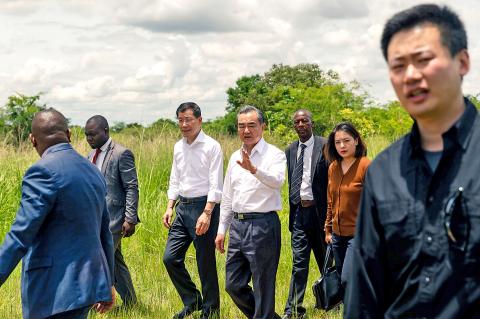
Photo: AFP
Tsai’s landslide electoral victory on Saturday has been embarrassing for China, where state media spent most of the past year isolating Taiwan on the diplomatic stage, deriding Tsai and highlighting the popularity of her opponent, Kaohsiung Mayor Han Kuo-yu (韓國瑜), of the Chinese Nationalist Party (KMT), which is pro-China.
Her win, after a campaign that leaned heavily on Hong Kong as a cautionary tale for Taiwan, is widely seen as a repudiation of Beijing’s attempts to draw Taiwan into its fold through military intimidation, economic incentives, cultural exchanges and other means.
Beijing has sought to downplay the election results, which also saw the Democratic Progressive Party maintain its majority in the legislature, giving Tsai’s administration a stronger mandate over the next four years.
In an editorial on Sunday, Xinhua said Tsai’s party had used “dirty tactics,” including fake news, repression and intimidation.
Chinese commentators said Tsai had “won by fear,” while the Global Times blamed infighting within the KMT.
“Yet no matter how much uncertainty there is across the Strait, the fact that the Chinese mainland is getting increasingly stronger and the Taiwan island is getting weaker is an inevitable reality,” an editorial late on Saturday said.
This week, authorities have tried to highlight the struggles Taiwanese would suffer under the DPP.
Yesterday, the international version of the People’s Daily, the mouthpiece of the Chinese Communist Party (CCP), criticized the DPP for focusing on politics rather than Taiwan’s struggling economy, a common argument made by Beijing and pro-China groups in Taiwan that closer ties would help wage and job growth.
“The people of Taiwan must tighten their belts and continue to live a hard life,” the paper said.
State media have also accused “external dark forces,” such as the US, an ally of Taiwan’s, of having a hand in the election.
Experts have said China is likely to double down on its strategy of punishing Taiwan.
During Tsai’s first term, Beijing cut off a dialogue mechanism, independent travel to Taiwan, and persuaded several of Taiwan’s few remaining allies to switch diplomatic recognition.
In her victory speech on Saturday, Tsai said that she was committed to maintaining peaceful cross-strait relations, but said it was a responsibility to be borne by “both sides.”
“China must abandon threats of force against Taiwan,” she said. “Democratic Taiwan and our democratically elected government will not concede to threats and intimidation.”

‘CROSSING THE LINE’: China’s embassy in Seoul criticized US Forces Korea Commander General Xavier Brunson, asking if his ‘hostile’ remarks were authorized by Washington South Korea and the US are in talks over recent public remarks by the commander of US Forces Korea, Seoul’s presidential office said yesterday, after the comments drew sharp criticism from China. In a recent podcast interview, US Forces Korea Commander General Xavier Brunson described South Korea as “the dagger in the heart of Asia” from China’s east coast, prompting the Chinese embassy in Seoul to say that he had “truly crossed the line.” The interview came amid growing speculation that Washington might seek to expand the role of US Forces Korea in countering the growing regional influence of China, a key

Through the noise of rushing papers and whirring belts at a print factory in Kyoto, two creators watch their photo essay come to life in broadsheet form — part of an effort to win new audiences in the age of artificial intelligence (AI). Despite the decline of the publishing industry, self-publication and handmade “zine” magazines are growing in popularity in Japan, reflecting the nation’s enduring love of paper in the digital era. While speaking to Agence France-Presse at the plant, his hands black with ink, one of the creators, Kazuma Obara, said: “I think [paper] is a medium that engages all five

Australian researchers have trained lab-grown brain cells on a silicon computer chip to play the 1990s shooter game Doom and said they are just scratching the surface of what the neurons could be capable of doing. It is the science-fiction work of biotech boffins at Cortical Labs, who researched and developed the technology that harnesses the workings of the brain’s networking system. Each so-called “biological computer” contains about 200,000 living human brain cells, grown from stem cells that were harvested from blood donations. Having mastered the simple computer game Pong, where a paddle is moved up and down to send a ball

France experienced its hottest spring on record, the French weather service said on Tuesday, after an exceptional early heat wave that also broke highs for the season in England and Wales. Meteo-France said the average nationwide temperature over March to May was 13.8°C — about 1.7°C above the norm, and surpassing records set in 2011 and 2020. “The warmest spring since records began in 1900,” it said in a bulletin. All three months were warmer than average, but the onset of an “unprecedented heatwave” late last month pushed the mercury to highs typically seen at the height of the summer. “Our country had never


 RSS
RSS