


“Do you want a piece?” beekeeper Ma Gongzuo asked, looking into the camera of a friend’s smartphone before biting into the dripping comb of amber-colored honey.
The clip goes out to his 737,000 followers on Douyin, the Chinese version of popular video sharing app TikTok that has 400 million users and has turned Ma into something of a celebrity.
Creating videos has become a popular sales tactic for Chinese farmers — the clips show increasingly discerning consumers the origins of the product and provide a window into rural life that captures audience imagination.
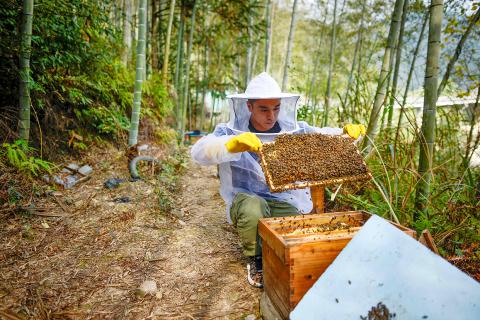
Photo: AFP
For some it has helped them find a way out of poverty, which the Chinese Communist Party hopes to eradicate by this year.
“Everyone said I was good for nothing when they saw I’d come back,” the 31-year-old said of his return to his village after a failed attempt at running an online clothing business. “They tell us that we can only get out of poverty if we study and get a job in a city.”
Today, Ma drives an expensive BMW and has already earned enough to buy property, and help his parents and fellow villagers with their homes and businesses.
Ma in 2015 took on the family honey-producing business in the verdant hills of Zhejiang Province and thanks to e-commerce apps, managed to turn an annual revenue of 1 million yuan (US$144,204).
However, sales stagnated.
So in November 2018, with help from his friends in the village, he began posting videos about his life on the farm. They showed him opening up a hive surrounded by a swarm of bees, swimming bare-chested in a river and chopping wood.
“I never advertise my products. I show my daily life, the landscapes of the countryside. That’s what interests people,” Ma said. “Of course, people suspect that I’m selling honey, but they decide to get in touch with me to say they want to buy some.”
Like most transactions in China, where hard cash is becoming less popular, the orders are paid for through apps such as WeChat and AliPay.
Ma now sells between 2 million and 3 million yuan of honey each year, as well as dried sweet potato and brown sugar.
“When I was young we were poor,” he said. “At school, I used to admire other kids who had pocket money, because I never had any.”
Now he drives a 4x4 BMW that costs about 760,000 yuan and has also invested in building a bed-and-breakfast.
“Using Douyin, that was the turning point,” he said. “Today, I can buy my family what they need. I help the other villagers to sell their products, too. All of the local economy benefits.”
In China, about 847 million people access the Internet via their smartphone, so online apps have played a vital role in Ma’s success.
“It’s progress,” said Ma Gongzuo’s father, Ma Jianchun. “We old people are overwhelmed. With the money, we’ve been able to renovate our house.”
China is home to the world’s largest market for live video broadcasting, according to US audit firm Deloitte.
Getting in on the trend, Douyin’s parent company ByteDance says it has organized training for 26,000 farmers on how to master the art of making videos.
There are other similar platforms such as Kuaishou and Yizhibo.
Taobao, the most popular e-commerce app in the nation owned by technology giant Alibaba, last year launched a project showing farmers how to become livestreaming hosts in a bid to help them earn more.
The number of people living under the poverty line in rural China has reduced dramatically — from 700 million in 1978 to 16.6 million in 2018, government data show.
However, the depopulation of the countryside continues, as many Chinese head to cities in search of better-paid jobs.
“We want to be an example, to show young people that it is entirely possible to set up a business and earn money in rural areas,” university-educated Ma Gongzuo said. “We hope that more will return, so that life and the economy can resume in the villages.”
With his newfound fame, Ma Gongzuo said that he has already received many proposals — and not just from those interested in his honey.

An American scientist convicted of lying to US authorities about payments from China while he was at Harvard University has rebuilt his research lab in Shenzhen, China, to pursue technology the Chinese government has identified as a national priority: embedding electronics into the human brain. Charles Lieber, 67, is among the world’s leading researchers in brain-computer interfaces. The technology has shown promise in treating conditions such as amyotrophic lateral sclerosis and restoring movement in paralyzed people. It also has potential military applications: Scientists at the Chinese People’s Liberation Army have investigated brain interfaces as a way to engineer super soldiers by boosting

Jailed media entrepreneur Jimmy Lai (黎智英) has been awarded Deutsche Welle’s (DW) freedom of speech award for his contribution to Hong Kong’s pro-democracy movement. The German public broadcaster on Thursday said Lai would be presented in absentia with the 12th iteration of the award on June 23 at the DW Global Media Forum in Bonn. Deutsche Welle director-general Barbara Massing praised the 78-year-old founder of the now-shuttered news outlet Apple Daily for standing “unwaveringly for press freedom in Hong Kong at great personal risk.” “With Apple Daily, he gave journalists a platform for free reporting and a voice to the democracy movement in

PHILIPPINE COMMITTEE: The head of the committee that made the decision said: ‘If there is nothing to hide, there is no reason to hide, there is no reason to obstruct’ A Philippine congressional committee on Wednesday ruled that there was “probable cause” to impeach Philippine Vice President Sara Duterte after hearing allegations of unexplained wealth, misuse of state funds and threats to have the president assassinated. The unanimous decision of the 53-member committee in the Philippine House of Representatives sends the two impeachment complaints to deliberations and voting by the entire lower chamber, which has more than 300 lawmakers. The complaints centered on Duterte’s alleged illegal use and mishandling of intelligence funds from the vice president’s office, and from her time as education secretary under Philippine President Ferdinand Marcos Jr. Duterte and the

As evening falls in Fiji’s capital, a steady stream of people approaches a makeshift clinic that is a first line of defense against one of the world’s fastest-growing HIV epidemics. In the South Pacific nation — a popular tourist destination of just under a million people — more than 2,000 new HIV cases were recorded last year, a 26 percent increase from 2024. The government has declared an HIV outbreak and described it as a national crisis. “It’s spreading like wildfire,” said Siteri Dinawai, 46, who came to be tested. The Moonlight Clinic, a converted minibus parked in a suburban cul-de-sac in Suva, is


 RSS
RSS