


A powerful typhoon that battered Tokyo overnight with ferocious winds killed one person, police said yesterday, as halted trains caused commuter chaos and more than 100 flights were canceled.
Typhoon Faxai, packing record winds of up to 207kph, made landfall in Chiba just east of the capital before dawn, after barrelling through Tokyo Bay.
The transport disruptions unleashed by the storm came less than two weeks before the start of the Rugby World Cup and delayed the arrival of the Australia team.
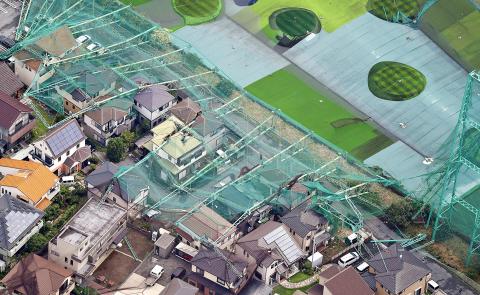
Photo: Kyodo / via Reuters
Police confirmed that one person was killed in the storm, a woman in her 50s who was found dead in Tokyo.
Security camera footage showed that she was pushed across a street and into a wall by high winds, a police spokesman said.
Another woman in her 20s was rescued from her house in Ichihara, east of Tokyo, after it was partly crushed when a perimeter fence from a golf driving range fell on it. She was seriously injured.
“There was a huge grinding noise, I couldn’t figure out what it was. Then I looked out the window,” a neighbor told NHK.
More than 30 people were injured in the storm, the Kyodo news agency said, while authorities said that more than 2,000 people had taken refuge in shelters.
The strong winds downed trees and power lines, which left 910,000 people without electricity in the Tokyo area yesterday morning, including the entire city of Kamogawa, NHK said.
“I’ve never seen a situation like this, the whole city without power,” an official told NHK.
At least 10 homes were damaged in Shizuoka, with windows shattered and cars flipped on their sides, local media reported.
Elsewhere, scaffolding was ripped from buildings and protective sheeting hung to keep construction debris off the streets was crumpled and torn by the storm.
While the damage was relatively light given the wind speeds, it was enough to cause chaos in the capital’s notoriously busy morning commute.
The overland East Japan Railway train system was largely halted in the early hours of operation while tracks were checked for fallen trees and other debris.
The storm also caused delays and stoppages on subway lines, leading to massive crowds at some stations in the busy metropolitan area that is home to 36 million people.
The usually congested trains and major stations were even more crowded than usual once services resumed, with trains stopping temporarily and running erratically.
“I can’t go to work now, and I also had to contact my customers,” said Tsubasa Kikuchi, a 23-year-old real-estate worker, who had been waiting at Shimbashi Station for more than two hours. “This is troublesome.”
Trains and shuttle buses running to and from Narita International Airport were halted, with taxis the only options left to those arriving or hoping to fly out. More than 5,000 passengers were stranded at the airport.
By mid-Monday morning, the storm had moved offshore and was headed northeast away from Japan, back into the Pacific.
Additional reporting by Reuters and Bloomberg

Through the noise of rushing papers and whirring belts at a print factory in Kyoto, two creators watch their photo essay come to life in broadsheet form — part of an effort to win new audiences in the age of artificial intelligence (AI). Despite the decline of the publishing industry, self-publication and handmade “zine” magazines are growing in popularity in Japan, reflecting the nation’s enduring love of paper in the digital era. While speaking to Agence France-Presse at the plant, his hands black with ink, one of the creators, Kazuma Obara, said: “I think [paper] is a medium that engages all five

‘CROSSING THE LINE’: China’s embassy in Seoul criticized US Forces Korea Commander General Xavier Brunson, asking if his ‘hostile’ remarks were authorized by Washington South Korea and the US are in talks over recent public remarks by the commander of US Forces Korea, Seoul’s presidential office said yesterday, after the comments drew sharp criticism from China. In a recent podcast interview, US Forces Korea Commander General Xavier Brunson described South Korea as “the dagger in the heart of Asia” from China’s east coast, prompting the Chinese embassy in Seoul to say that he had “truly crossed the line.” The interview came amid growing speculation that Washington might seek to expand the role of US Forces Korea in countering the growing regional influence of China, a key

Australian researchers have trained lab-grown brain cells on a silicon computer chip to play the 1990s shooter game Doom and said they are just scratching the surface of what the neurons could be capable of doing. It is the science-fiction work of biotech boffins at Cortical Labs, who researched and developed the technology that harnesses the workings of the brain’s networking system. Each so-called “biological computer” contains about 200,000 living human brain cells, grown from stem cells that were harvested from blood donations. Having mastered the simple computer game Pong, where a paddle is moved up and down to send a ball

France experienced its hottest spring on record, the French weather service said on Tuesday, after an exceptional early heat wave that also broke highs for the season in England and Wales. Meteo-France said the average nationwide temperature over March to May was 13.8°C — about 1.7°C above the norm, and surpassing records set in 2011 and 2020. “The warmest spring since records began in 1900,” it said in a bulletin. All three months were warmer than average, but the onset of an “unprecedented heatwave” late last month pushed the mercury to highs typically seen at the height of the summer. “Our country had never


 RSS
RSS