


Holidaymakers splash in the turquoise waters of the Rosignano Solvay beach in Tuscany and laze on its pristine white sands — most of them fully aware that the picture-perfect swimming spot owes its allure to a nearby factory.
“I discovered it on Google Maps,” said Dutch tourist Lieuya, who travelled to the beach with his family to enjoy a setting more reminiscent of the Caribbean than of northern Italy.
“I was told it’s not dangerous, that the color comes from the soda factory next door,” he said.
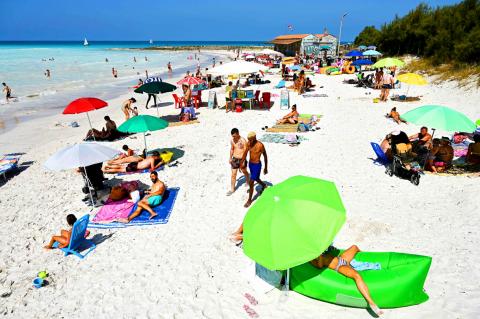
Photo: AFP
Questions have lingered for decades over why the sea and sand are such startling colors — with some environmentalists suggesting the phenomenon is caused by heavy metals emitted by the plant.
The beach, about 4km long, is named after the Solvay factory, which produces soda ash for making glass as well as sodium bicarbonate, or baking soda.
The plant strenuously denies polluting the surrounding coastline.
Tourists taking a dip or settling down in beach chairs for a light pasta lunch are not worried about the striking contrast between the waters off Rosignano Solvay and those of the nearby Monte alla Rena beach.
“Every time I come here, I think that if swimming is allowed by local, regional and national authorities, we can believe them when they say that the water is clean,” said Italian teacher Marina, who declined to give her last name.
A notice from the regional environmental protection agency Arpat at the beach entrance says the water quality is “excellent.”
Swimming is banned along a small stretch of the beach, but that is because of a strong current in the area.
The plant, about 25km south of the port city Livorno, opened at the start of the last century and a new town — Rosignano Solvay — sprang up to house workers and their families.
Today, the global chemical giant operates in 61 countries and boasts about 24,500 employees.
“Solvay was like a mother to this area of Tuscany. We called it ‘mamma,’” said Leonardo Martinelli, a journalist born in the town and whose mother worked at Solvay for half a century.
Belgian industrialist Ernest Solvay, the plant’s founder, “guaranteed well-being by opening a school, a hospital and a theatre,” he said.
The factory has ensured “the unemployment rate has always been low,” he added.
Davide Papavero, the group’s industrial director, said it “respects all the rules of a high-risk site.”
“The plant ... only discharges powdery deposits of limestone, a harmless substance that is safe for the environment, but explains the white color of the sand,” he said.
The startling blue of the water is caused by the reflection of the sky against the white sea floor, Papavero said.
Rosignano Solvay Mayor Daniele Donati also said the plant’s activities “do not pose any health problems.”
However, Maurizio Marchi, from Italy’s Medicina Democratica health association, said the plant is a blight.
“The reality is that for a century, this place has been a Solvay landfill, an industrial landfill,” he said.
Environmentalists have also deplored the gutting of limestone hills near San Vincenzo and mass extraction of rock salt.
Manolo Morandini, a journalist with local daily Il Tirreno who has written extensively on the subject, said Marchi’s concerns would once have been valid, but no longer.
“In the 1980s it was indeed a toxic beach, but the production cycle that used mercury and heavy metals has been changed,” he said.
He says the famous white beach is nothing more than an “artificial” construct — one which nonetheless offers holidaymakers a slice of paradise.

Through the noise of rushing papers and whirring belts at a print factory in Kyoto, two creators watch their photo essay come to life in broadsheet form — part of an effort to win new audiences in the age of artificial intelligence (AI). Despite the decline of the publishing industry, self-publication and handmade “zine” magazines are growing in popularity in Japan, reflecting the nation’s enduring love of paper in the digital era. While speaking to Agence France-Presse at the plant, his hands black with ink, one of the creators, Kazuma Obara, said: “I think [paper] is a medium that engages all five
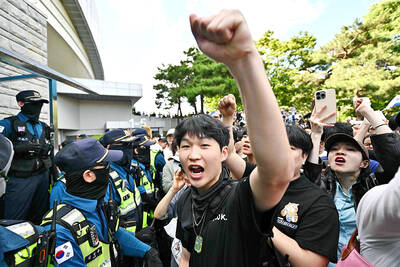
‘ABSURD MISTAKE’: The election commission said that there had been a failure to anticipate turnout after 14 polling stations ran short of ballot papers South Korean riot police yesterday cleared protesters from a Seoul polling station after a 35-hour blockade sparked by a shortage of ballot papers during local elections earlier this week. Wednesday’s election was the first nationwide vote since South Korean President Lee Jae-myung took office following the ouster of Yoon Suk-yeol over his short-lived martial law declaration. Lee’s ruling Democratic Party swept most races, but failed to flip the crucial Seoul mayoral seat. The South Korean National Election Commission apologized, blaming a failure to anticipate turnout after 14 polling stations in Seoul ran short of ballot papers. Some polling stations stayed open until 10pm to

Australian researchers have trained lab-grown brain cells on a silicon computer chip to play the 1990s shooter game Doom and said they are just scratching the surface of what the neurons could be capable of doing. It is the science-fiction work of biotech boffins at Cortical Labs, who researched and developed the technology that harnesses the workings of the brain’s networking system. Each so-called “biological computer” contains about 200,000 living human brain cells, grown from stem cells that were harvested from blood donations. Having mastered the simple computer game Pong, where a paddle is moved up and down to send a ball

France experienced its hottest spring on record, the French weather service said on Tuesday, after an exceptional early heat wave that also broke highs for the season in England and Wales. Meteo-France said the average nationwide temperature over March to May was 13.8°C — about 1.7°C above the norm, and surpassing records set in 2011 and 2020. “The warmest spring since records began in 1900,” it said in a bulletin. All three months were warmer than average, but the onset of an “unprecedented heatwave” late last month pushed the mercury to highs typically seen at the height of the summer. “Our country had never


 RSS
RSS