


As protesters blocked roads in Hong Kong’s central business district this week, something unusual happened: Tear gas canisters began raining down from the sky.
It was unclear where they were coming from, but police officers wearing gas masks were seen on the roof of a nearby building.
A video of the incident appeared to show aluminum canisters trailing smoke as they fell at least 10 stories, landing in the middle of hundreds of demonstrators.
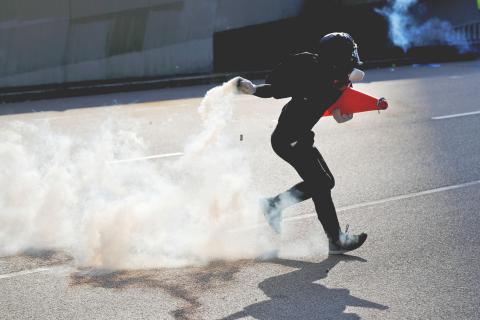
Photo: AP
The incident marked one of the more dangerous uses of tear gas in nine weeks of rallies that have rocked the financial hub and underscored the growing risks of a fatality as police and protesters become more aggressive.
The more that police fire tear gas, the better protesters become at countering it — leading authorities to deploy even harsher measures.
Any deaths would add more fuel to the biggest challenge to Beijing’s rule since it took control in 1997.
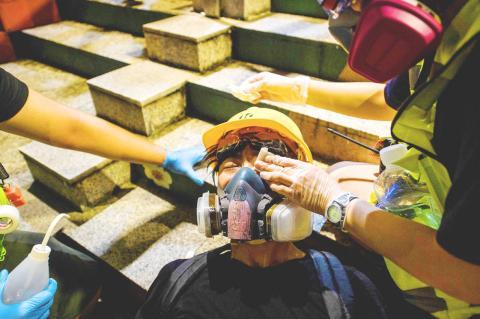
Photo: AFP
China has encouraged the police to use greater force to subdue protesters rather than meet their demands, which include an investigation into police violence and the resignation of Hong Kong Chief Executive Carrie Lam (林鄭月娥).
“Nonlethal weapons are nonlethal only if they are appropriately used,” said Lawrence Ka-ki Ho (何家騏), an assistant professor at the Education University of Hong Kong, who is an expert in policing and public order management. “If you fear more, you may uncontrollably use more force.”
Police have already used far more tear gas than at any point in Hong Kong’s history and it is affecting more than just protesters. It has been used sometimes without warning in shopping districts, central neighborhoods packed with residential highrises and suburbs popular with young families.
Journalists covering the demonstrations have reported skin rashes and other health issues.
For the Beijing-backed local government, tear gas is an effective way to quell protesters who have become increasingly violent, brandishing iron poles, surrounding police stations and lobbing bricks and Molotov cocktails in clashes with police.
Lam’s administration has defended officers from the opposition’s allegations of excessive force and abuse, saying that police are using reasonable means to deal with extreme circumstances.
“All over the world, police always use tear smoke as a riot-control agent,” Hong Kong Executive Council member Regina Ip (葉劉淑儀) told Bloomberg News on Tuesday. “It’s actually a better instrument than using police batons or rubber bullets.”
The use of smoke looks dramatic, but is a relatively safer type of crowd control that prevents injuries that might come via other methods, said Steve Vickers, chief executive officer of risk consultancy Steve Vickers and Associates, and a former head of the Royal Hong Kong Police Criminal Intelligence Bureau.
“The escalation of force is smoke before batons,” Vickers said. “It looks terrible on TV. You get big flashes and bangs, and it looks gruesome, but it’s the first level of force and the next is batons and bean bags and rubber bullets.”
Protesters are becoming more adept at developing tactics to neutralize the effects of tear gas, from wearing gas masks to clamping traffic cones and cooking pots over fizzing canisters. They have even affixed gas masks on older passersby.
A representative from Hings Group of Companies, which sells gas masks and other items in Hong Kong, said it has run out over the past two months amid a surge in demand.
“I’m not afraid of dying,” said a 25-year-old electrician surnamed Poon, who declined to give his full name as he marched last week into the streets toward the Chinese Liaison Office of the Central People’s Government in the Hong Kong Special Administrative Region, where riot cops shot several volleys of tear gas. “If I get injured or killed, it’s the responsibility of the police.”
The police response to the demonstrations had drawn international condemnation even before the barrage of tear gas.
Then-British secretary of state for foreign and commonwealth affairs Jeremy Hunt in June announced a ban on export licenses for crowd control equipment, pending a “robust, independent investigation into the violent scenes that we saw.”
US House of Representatives Speaker Nancy Pelosi this week reiterated a call for the US government to “suspend future sales of munitions and crowd control equipment to the Hong Kong police force,” a statement that drew a harsh rebuke from China.
At least some of the tear gas used comes from Pennsylvania-based NonLethal Technologies, which has warned that firing canisters directly at people risks “serious injury or death.”
Hong Kong Secretary for Security John Lee (李家超) has also defended the force, saying that police have ensured a safe distance from protesters when firing the gas — and that it was deployed in addition to other tactics, including arrests.
“I believe these considerations are in line with that of other police forces internationally,” he said on Tuesday.
Over the past couple of months, the weekly use of tear gas — which is banned in warfare, along with other chemical and biological weapons, but remains legal as a crowd-control measure — stands out in Hong Kong’s modern history, where its use has been rare to nonexistent.
During the “Umbrella movement” that shut down parts of the territory’s business district in 2014, the surprise use of tear gas against a local crowd for what was arguably the first time brought hundreds of thousands of people into the streets in outrage.
In total, police launched 87 rounds during 79 days of unrest.
By contrast, police have fired more than 1,820 rounds since June 9 and lobbed more than 150 canisters on June 12 alone, the day protesters tried to storm Hong Kong’s Legislative Council building.
“No matter what legal justification they can provide, the use of nonlethal weapons still may need to be restrained,” Ho said. “It’s not just about dispersing the crowd, but they could actually harm or destroy the police-citizen relationship.”

Auschwitz survivor Eva Schloss, the stepsister of teenage diarist Anne Frank and a tireless educator about the horrors of the Holocaust, has died. She was 96. The Anne Frank Trust UK, of which Schloss was honorary president, said she died on Saturday in London, where she lived. Britain’s King Charles III said he was “privileged and proud” to have known Schloss, who cofounded the charitable trust to help young people challenge prejudice. “The horrors that she endured as a young woman are impossible to comprehend and yet she devoted the rest of her life to overcoming hatred and prejudice, promoting kindness, courage, understanding

‘DISRESPECTFUL’: Katie Miller, the wife of Trump’s most influential adviser, drew ire by posting an image of Greenland in the colors of the US flag, captioning it ‘SOON’ US President Donald Trump on Sunday doubled down on his claim that Greenland should become part of the US, despite calls by the Danish prime minister to stop “threatening” the territory. Washington’s military intervention in Venezuela has reignited fears for Greenland, which Trump has repeatedly said he wants to annex, given its strategic location in the arctic. While aboard Air Force One en route to Washington, Trump reiterated the goal. “We need Greenland from the standpoint of national security, and Denmark is not going to be able to do it,” he said in response to a reporter’s question. “We’ll worry about Greenland in
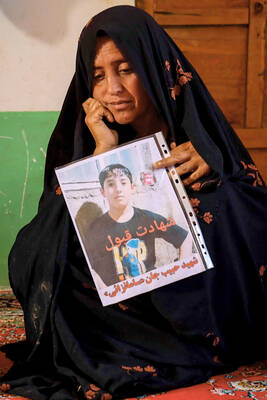
PERILOUS JOURNEY: Over just a matter of days last month, about 1,600 Afghans who were at risk of perishing due to the cold weather were rescued in the mountains Habibullah set off from his home in western Afghanistan determined to find work in Iran, only for the 15-year-old to freeze to death while walking across the mountainous frontier. “He was forced to go, to bring food for the family,” his mother, Mah Jan, said at her mud home in Ghunjan village. “We have no food to eat, we have no clothes to wear. The house in which I live has no electricity, no water. I have no proper window, nothing to burn for heating,” she added, clutching a photograph of her son. Habibullah was one of at least 18 migrants who died
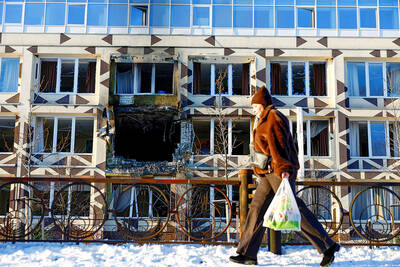
Russia early yesterday bombarded Ukraine, killing two people in the Kyiv region, authorities said on the eve of a diplomatic summit in France. A nationwide siren was issued just after midnight, while Ukraine’s military said air defenses were operating in several places. In the capital, a private medical facility caught fire as a result of the Russian strikes, killing one person and wounding three others, the State Emergency Service of Kyiv said. It released images of rescuers removing people on stretchers from a gutted building. Another pre-dawn attack on the neighboring city of Fastiv killed one man in his 70s, Kyiv Governor Mykola


 RSS
RSS