


A Belgian diplomat was on Tuesday expected to travel to China’s Xinjiang region to confirm the whereabouts of a Uighur family that was escorted from Belgium’s embassy in Beijing by police last month.
The disappearance of the woman and her four children has alarmed her husband, as an estimated 1 million ethnic Uighurs and other mostly Muslim minorities are believed to be held in internment camps in Xinjiang.
Abdulhamid Tursun, a political refugee in Belgium, said he has not heard from his family since May 31, a few days after they left the embassy under murky circumstances.
“I am worried about their safety,” he said. “I hope they can safely come be at my side as soon as possible, and our family can reunite.”
Belgium’s decision to dispatch a diplomat to Xinjiang comes as the embassy faces criticism for allegedly enabling Chinese police to take the family back to Xinjiang — where they could face detention.
“The case exposes the additional risk Uighurs in China face even if they want to seek help from foreign governments,” said Patrick Poon (潘嘉偉), China researcher at Amnesty International.
“The Belgian embassy set an extremely bad example of how governments put economic interests above human rights,” he said.
The Chinese Ministry of Foreign Affairs and the Xinjiang government did not immediately respond to requests for comment.
Horiyat Abdulla, and her four children traveled to Beijing at the end of last month to complete missing paperwork for their family reunification visas.
Tursun said that his wife and children panicked upon learning it would take “at least three months” for their visas to be approved and refused to leave the embassy.
They were afraid to return to their hotel because police had visited them multiple times since they arrived in Beijing, he said.
“The police came in the middle of the night, asking why they came to Beijing, when they would return,” he said. “They were very scared, they didn’t sleep all night.”
The embassy offered to accompany Abdulla and her four children back to their hotel, but they “refused to leave the embassy in a kind of sit-in,” a Belgian Ministry of Foreign Affairs spokesman said.
Belgian Minister of Foreign Affairs Didier Reynders told Le Soir newspaper that the diplomatic police “asked the family to leave the premises” and the situation was explained to the father the next day.
An embassy is not intended to “lodge people” applying for visas, he said.
In the end, Chinese police “escorted them away,” the ministry spokesman said.
A few days later, Abdulla and her children were taken away by Xinjiang police, her husband said, and he has not heard from her since.
Reynders on Monday told the Belga news agency that the diplomat would go to the address given by the father to check if “everything is going well” with them.
“My only concern here is that we can reunite the family,” he said.
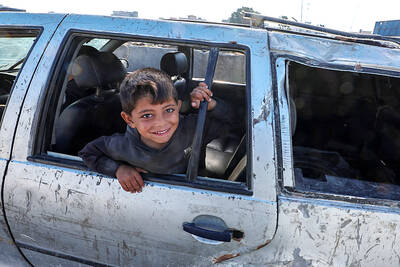
Gaza is rapidly running out of its limited fuel supply and stocks of food staples might become tight, officials said, after Israel blocked the entry of fuel and goods into the war-shattered territory, citing fighting with Iran. The Israeli military closed all Gaza border crossings on Saturday after announcing airstrikes on Iran carried out jointly with the US. Israeli authorities late on Monday night said that they would reopen the Kerem Shalom crossing from Israel to Gaza yesterday, for “gradual entry of humanitarian aid” into the strip, without saying how much. Israeli authorities previously said the crossings could not be operated safely during

Hungarian authorities temporarily detained seven Ukrainian citizens and seized two armored cars carrying tens of millions of euros in cash across Hungary on suspicion of money laundering, officials said on Friday. The Ukrainians were released on Friday, following their detention on Thursday, but Hungarian officials held onto the cash, prompting Ukraine to accuse Hungary’s Russia-friendly government of illegally seizing the money. “We will not tolerate this state banditism,” Ukrainian Minister of Foreign Affairs Andrii Sybiha said. The seven detained Ukrainians were employees of the Ukrainian state-owned Oschadbank, who were traveling in the two armored cars that were carrying the money between Austria and
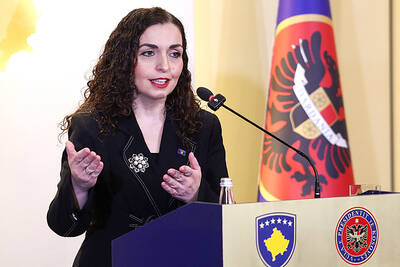
Kosovar President Vjosa Osmani on Friday after dissolving the Kosovar parliament said a snap election should be held as soon as possible to avoid another prolonged political crisis in the Balkan country at a time of global turmoil. Osmani said it is important for Kosovo to wrap up the upcoming election process and form functional institutions for political stability as the war rages in the Middle East. “Precisely because the geopolitical situation is that complex, it is important to finish this electoral process which is coming up,” she said. “It is very hard now to imagine what will happen next.” Kosovo, which declared

MORE BANS: Australia last year required sites to remove accounts held by under-16s, with a few countries pushing for similar action at an EU level and India considering its own ban Indonesia on Friday said it would ban social media access for children under 16, citing threats from online pornography, cyberbullying, online fraud and Internet addiction. “Accounts belonging to children under 16 on high-risk platforms will start to be deactivated, beginning with YouTube, TikTok, Facebook, Instagram, Threads, X, Bigo Live and Roblox,” Indonesian Minister of Communications and Digital Meutya Hafid said. “The government is stepping in so that parents no longer have to fight alone against the giants of the algorithm. Implementation will begin on March 28, 2026,” she said. The social media ban would be introduced in stages “until all platforms fulfill their


 RSS
RSS