


Thailand is advancing same-sex partnership legislation — and one of the nation’s biggest industries, tourism, is paying close attention.
Amid an election campaign, a measure that would give gay and lesbian couples more rights — yet does not legalize same-sex marriage — was approved by the Cabinet and was headed to parliament.
Although the session ended before the bill became law, the tourism industry is using the occasion to actively promote Thailand as an LGBT-friendly destination.
“Thailand already has products and offerings catered to this market, and now our focus will be how we can better serve them,” Tourism Authority of Thailand Deputy Governor Srisuda Wanapinyosak said in an interview.
This year, the Tourism Authority will host an LGBT travel symposium and plans more participation in pride parades in such cities as New York and Tel Aviv.
Last month, it released a promotional video featuring LGBT travelers, including well-known lesbian bloggers Roxanne Weijer and Maartje Hensen. At a Madrid tourism event in January, the industry had a booth for the first time promoting Thailand specifically to gay and lesbian travelers.
The Thai tourism industry represents about one-fifth of the economy and is growing at a faster pace than other sectors. The LGBT market has become key to the industry’s fortunes.
According to the investment firm LGBT Capital, tourism revenue from that community contributes 1.15 percent to Thailand’s economy, a greater share than any other destination.
Although Thailand is one of Asia’s most significant LGBT destinations, it is still legally and in some respects culturally behind other countries like the US, Spain and the UK, which received more revenue than Thailand from LGBT visitors.
The proposed civil union law stops short of allowing same-sex couples to marry: It would grant such partners legal rights to jointly manage assets and liabilities and to give or receive inheritances.
Activists have criticized the measure for not giving same-sex couples the same rights as heterosexual couples, though proponents hail the bill as one of the first steps toward equality in Thailand.
Although the bill has not become law, the government is expected to revisit the measure after the election.
The measure would represent an advancement for LGBT rights in Asia. Vietnam and Taiwan have taken some steps toward recognizing same-sex unions in recent years, with the latter drafting a bill to legalize same-sex marriage that could go into effect this year.
In recent years Thailand has become known for its welcoming attitude toward LGBT visitors, although the local gay and lesbian community complains that they face some barriers in employment outside of entertainment and service industries. Bangkok was ranked Asia’s best city for LGBT visitors, ahead of Tokyo, Hong Kong and Shanghai, according to apartment rental site Nestpick.
Foreign visitors generated about US$63 billion to the Thai economy last year.
According to LGBT Capital, the revenue from the LGBT inbound tourism market is estimated to be about US$5.3 billion, which accounts for about 8.4 percent of the tourism industry. The Thai Ministry of Tourism and Sports expects more than 41 million tourists this year, generating nearly US$70 billion.
Several studies have shown that people in the LGBT community have higher disposable income than the general population and tend to travel internationally. LGBT visitors could boost Thai tourism revenue at a time when tourism from some European and Middle Eastern countries has slowed down.
Robert Sharp, founder of Out Adventures, a Toronto-based travel company focusing on the gay community, has sent thousands of US and Canadian travelers to Thailand over the past decade.
He said the majority of his clients take at least three international trips annually and some only consider destinations that are welcoming to the LGBT community.
“I think Thailand sees this segment as an opportunity to promote the country, and this bill will only help that initiative,” Sharp said. “Thailand could really be an example that there’s a fiscal benefit to recognizing the community and other countries could learn from it.”

A humanoid robot that won a half-marathon race for robots in Beijing on Sunday ran faster than the human world record in a show of China’s technological leaps. The winner from Honor, a Chinese smartphone maker, completed the 21km race in 50 minutes and 26 seconds, said a WeChat post by the Beijing Economic-Technological Development Area, also known as Beijing E-Town, where the race began. That was faster than the human world record holder, Ugandan Jacob Kiplimo, who finished the same distance in about 57 minutes in March at the Lisbon road race. The performance by the robot marked a significant step forward
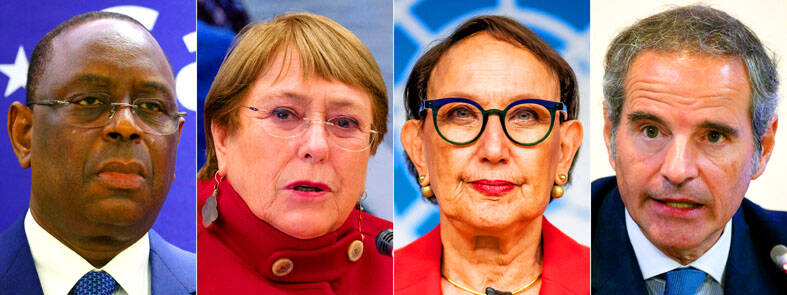
Four contenders are squaring up to succeed Antonio Guterres as secretary-general of the UN, which faces unprecedented global instability, wars and its own crushing budget crisis. Chile’s Michelle Bachelet, Argentina’s Rafael Grossi, Costa Rica’s Rebeca Grynspan and Senegal’s Macky Sall are each to face grillings by 193 member states and non-governmental organizations for three hours today and tomorrow. It is only the second time the UN has held a public question-and-answer, a format created in 2016 to boost transparency. Ultimately the five permanent members of the UN’s top body, the Security Council, hold the power, wielding vetoes over who leads the

South Korea’s air force yesterday apologized for a 2021 midair collision involving two fighter jets, a day after auditors said the pilots were taking selfies and filming during the flight and held them responsible for the accident. “We sincerely apologize to the public for the concern caused by the accident that occurred in 2021,” an air force spokesman told a news conference, adding that one of the pilots involved had been suspended from flying duties, received severe disciplinary action and has since left the military. The apology followed a report released on Wednesday by the South Korean Board of Audit and Inspection,
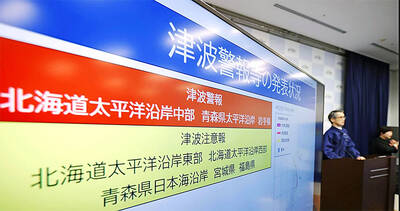
An earthquake registering a preliminary magnitude of 7.7 off northern Japan on Monday prompted a short-lived tsunami alert and the advisory of a higher risk of a possible mega-quake for coastal areas there. The Cabinet Office and the Japan Meteorological Agency said there was a 1% chance for a mega-quake, compared to a 0.1% chance during normal times, in the next week or so following the powerful quake near the Chishima and Japan trenches. Officials said the advisory was not a quake prediction but urged residents in 182 towns along the northeastern coasts to raise their preparedness while continuing their daily lives. Prime


 RSS
RSS