


About half of 451 North Korean defectors questioned in a survey endured physical violence at the hands of North Korean authorities, a rights group said yesterday, as North Korean leader Kim Jong-un prepared to meet US President Donald Trump for a summit.
On Sunday, US lawmakers called Kim the “leader of perhaps the world’s most repressive regime,” but analysts say that as in the leaders’ first summit, human rights are unlikely to be addressed in their second.
Trump and Kim are due to meet in the Vietnamese capital, Hanoi, today and tomorrow, eight months after their historic Singapore summit.
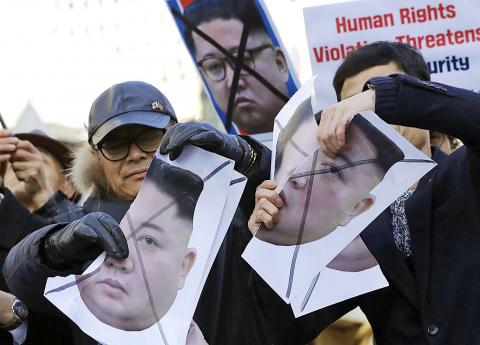
Photo: AP
On the top of their agenda is the denuclearization of the Korean Peninsula, and what concessions the US might offer in return for North Korea giving up its weapons.
North Korea’s poor human rights record is not likely to figure prominently, if at all.
The survey, conducted between 2015 and 2018 and released by Seoul-based Transitional Justice Working Group, found that three out of four North Korean defectors had, before they fled North Korea, experienced physical violence or the death of close family members, by execution or starvation, forced repatriation, arrest or detention.
About 48 percent of the respondents said that they had personally experienced violence perpetrated by the North Korean authorities, including beating, torture, rape and other sexual assault.
There has been dismay that rights seem to have been relegated down the agenda in dealing with North Korea.
In Seoul, protesters yesterday tore up photographs of Kim and threw them to the ground.
“We are skeptical of the US-North Korea summit without discussing human right issues,” said Ihn Ji-yeon, a leader of the anti-North rally and a spokeswoman for the Korean Patriots Party.
British Minister of State for the Commonwealth and United Nations Tariq Ahmad on Monday told the UN Human Rights Council in Geneva, Switzerland, that human rights in North Korea had not improved.
“Despite some welcome signs on the political track, there has been no improvement in the human rights situation,” he said.
“Meeting the challenge of North Korea’s nuclear weapons and missile programs, as well as addressing other issues such as North Korea’s systemic, gross violations of human rights, is of concern to all Americans and to our allies and partners,” US senators said in a letter to Trump on Sunday.
However, South Korean Minister of Foreign Affairs Kang Kyung-wha told the Geneva council that “human rights cannot thrive in the absence of peace.”
She said that progress toward a “nuclear-free Korean Peninsula,” which had started, would have enormous rewards, including an improvement in human rights.

North Korea blew up sections of roads in its own territory that are part of links once used to connect the southern part of the peninsula with the north, in a show of defiance after it accused Seoul of flying drones over Pyongyang. North Korea detonated bombs north of its eastern and western borders at around noon yesterday, South Korea’s Joint Chiefs of Staff (JCS) said. South Korea’s military later fired off warning shots within its border, said the JCS, which also confirmed there were no reports of damage in South Korea from the detonations. A video released by the South Korean

It is usually a serene two-and-a-half-hour ride on Japan’s famously efficient bullet train, but on Saturday, the journey quickly descended into a zombie apocalypse, with passengers screaming in terror. Organizers of the adrenaline-filled trip, less than two weeks before Halloween, touted it as the world’s first haunted house experience on a running Shinkansen. On board one chartered car of the Shinkansen, about 40 thrill-seekers were ready to brave an encounter with the living dead between Tokyo and the western metropolis of Osaka. The eerie experience was inspired by the hit 2016 South Korean action-horror movie Train to Busan, in which a father and

A member of chart-topping K-pop group NewJeans yesterday tearfully testified to South Korean lawmakers as part of an inquiry into workplace harassment, amid a boardroom drama over her super producer. In recent years, South Korea’s K-pop industry has become a global juggernaut powered by the success of groups like BTS, but domestically it is known for imposing strict standards and controls on fledgling stars. Rising K-pop idols are expected to adhere to their powerful agency’s behavior and appearance guidelines, with many stars describing receiving extreme backlash from fans over perceived mistakes in their personal lives, for example dating. Hanni, 20, who is

IRANIAN THREATS: Revolutionary Guards chief Hossein Salami said that it would be a ‘mistake’ for Israel to attack Iran and if it did ‘we will strike you again painfully’ Israel yesterday bombed a Syrian coastal city, while the US conducted multiple strikes on targets in Yemen nearly a month into Israel’s war with Hezbollah in Lebanon. Syria, the Houthi rebels in Yemen, Hezbollah and Hamas in Gaza all belong to the so-called “axis of resistance” led by Iran, which on Oct. 1 conducted a missile strike on Israel. Israel has vowed to retaliate for the strike. Iran’s Revolutionary Guards chief Hossein Salami yesterday said in a speech that Tehran would hit Israel “painfully” if it attacks Iranian targets. “If you make a mistake and attack our targets, whether in the region or in


 RSS
RSS