


A Chinese-Australian billionaire businessman yesterday won a high-profile defamation case against a newspaper that alleged he was a coconspirator in a plot to bribe a top UN official, amid fears of Beijing meddling in domestic politics.
Fairfax Media, publisher of the Sydney Morning Herald, was ordered to pay Chau Chak Wing (周澤榮) A$280,000 (US$199,073) in damages after a judge at the Federal Court of Australia ruled that the 2015 article was defamatory.
“The natural and ordinary meaning of the words employed in the article, and the overall impression conveyed by the article considered as a whole, was not merely one of suspicion, but one of guilt,” Justice Michael Wigney said in his judgement. “I consider their [Fairfax and its reporter] conduct to have been unreasonable in many respects.”
New Fairfax owner Nine Publishing said that it would appeal the decision.
The decision came as tensions between Canberra and Beijing rise over fears of Chinese influence in Australian politics.
An Australian citizen who made his money in property development, Chau has consistently denied any links to the Chinese Communist Party or the UN scandal, and yesterday said that his faith in the Australian legal system “has been vindicated.”
Chau added that he would donate the damages to charities supporting Australian military veterans and their families.
The ruling came almost a year after Australian Parliamentary Joint Committee on Intelligence and Security Chair Andrew Hastie used the legal protection of parliamentary privilege to identify Chau as a previously unnamed figure in a US FBI case.
That case related to former UN General Assembly president John Ashe, who was accused of accepting bribes from Chinese businesspeople seeking to influence the world body.
Ashe was arrested in 2015 and died a year later. The scandal was a major blow to the UN.
Australia’s defamation laws have been criticized for being too biased toward plaintiffs and impinging on public-interest journalism.
Hastie yesterday said that he was “concerned about the impact that defamation laws in Australia are having on responsible journalism that informs Australians about important national security issues.”

A new online voting system aimed at boosting turnout among the Philippines’ millions of overseas workers ahead of Monday’s mid-term elections has been marked by confusion and fears of disenfranchisement. Thousands of overseas Filipino workers have already cast their ballots in the race dominated by a bitter feud between President Ferdinand Marcos Jr and his impeached vice president, Sara Duterte. While official turnout figures are not yet publicly available, data from the Philippine Commission on Elections (COMELEC) showed that at least 134,000 of the 1.22 million registered overseas voters have signed up for the new online system, which opened on April 13. However,

EUROPEAN FUTURE? Albanian Prime Minister Edi Rama says only he could secure EU membership, but challenges remain in dealing with corruption and a brain drain Albanian Prime Minister Edi Rama seeks to win an unprecedented fourth term, pledging to finally take the country into the EU and turn it into a hot tourist destination with some help from the Trump family. The artist-turned-politician has been pitching Albania as a trendy coastal destination, which has helped to drive up tourism arrivals to a record 11 million last year. US President Donald Trump’s son-in-law, Jared Kushner, also joined in the rush, pledging to invest US$1.4 billion to turn a largely deserted island into a luxurious getaway. Rama is expected to win another term after yesterday’s vote. The vote would
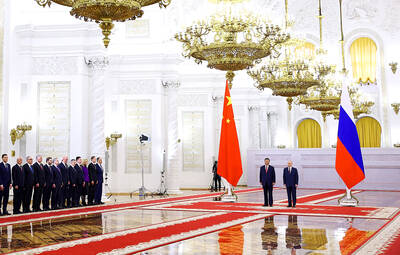
ALLIES: Calling Putin his ‘old friend,’ Xi said Beijing stood alongside Russia ‘in the face of the international counter-current of unilateralism and hegemonic bullying’ Chinese President Xi Jinping (習近平) yesterday was in Moscow for a state visit ahead of the Kremlin’s grand Victory Day celebrations, as Ukraine accused Russia’s army of launching air strikes just hours into a supposed truce. More than 20 foreign leaders were in Russia to attend a vast military parade today marking 80 years since the defeat of Nazi Germany in World War II, taking place three years into Russia’s offensive in Ukraine. Putin ordered troops into Ukraine in February 2022 and has marshaled the memory of Soviet victory against Nazi Germany to justify his campaign and rally society behind the offensive,

FRAUD ALLEGED: The leader of an opposition alliance made allegations of electoral irregularities and called for a protest in Tirana as European leaders are to meet Albanian Prime Minister Edi Rama’s Socialist Party scored a large victory in parliamentary elections, securing him his fourth term, official results showed late on Tuesday. The Socialist Party won 52.1 percent of the vote on Sunday compared with 34.2 percent for an alliance of opposition parties led by his main rival Sali Berisha, according to results released by the Albanian Central Election Commission. Diaspora votes have yet to be counted, but according to initial results, Rama was also leading there. According to projections, the Socialist Party could have more lawmakers than in 2021 elections. At the time, it won 74 seats in the


 RSS
RSS