


Through the cacophony of the UN’s global climate talks, an Australian farmer is quietly spreading his plan to reforest the world.
Over more than 30 years in west Africa, Tony Rinaudo has regenerated more than 6 million hectares — an area nearly as large as Tasmania.
His farmer-managed natural regeneration technique is responsible for 240 million trees regrowing across the parched continent — but it nearly never happened.
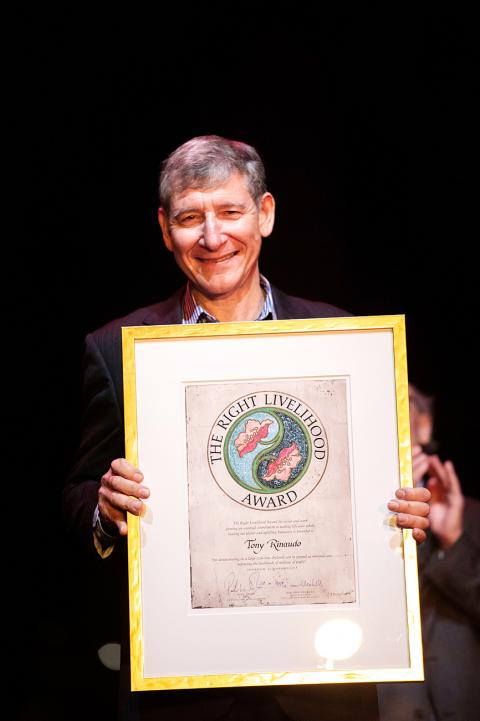
Photo: AFP
Having grown up in Victoria’s Myrtleford, Rinaudo in 1981 moved to Niger, one of the world’s poorest countries, inspired by his Christian faith and a desire “somewhere, somehow to make a difference.”
However, after two years of intense tree planting and trying to coax some life from the arid landscape regularly devastated by severe drought, he despaired.
“I was in charge of a reforestation project that was failing miserably. It wasn’t that I was particularly dumb, it was the same story all over west Africa. And I remember the frustration that just hit me: north, south, east, west, was a barren landscape, and I knew perfectly well that 80 or 90 percent of the trees I was carrying [in my car] for planting would die,” Rinaudo said.
Crouching in the sand to reduce his tires’ air pressure, he looked more closely at the few low desert bushes scattered around the landscape, the only thing that would grow there.
Rinaudo knew they were not small bushes, but trees that had been hacked down. Looking more closely, he realized that, if pruned and allowed to grow, they stood a chance of flourishing.
“In that moment, everything changed. We didn’t need to plant trees, it wasn’t a question of having a multi-million dollar budget and years to do it, everything you needed was in the ground,” he said.
The root system of the chopped-down trees remained alive under the ground — Rinaudo describes it as an “underground forest” — it just needed to be pruned and allowed to grow.
“Nature would heal itself, you just needed to stop hammering it,” Rinaudo said.
Thirty years later, his technique has a name: farmer-managed natural regeneration.
It is an “embarrassingly simple solution” to what appeared to be an intractable problem, he said.
However, it involved overturning generations of accepted wisdom and a resistance to giving some land back to nature.
“When you’ve got people who are on the edge of starvation every year, not just in famine years, you’ve got this perception that you need every square inch of farmland to grow food crops, and here’s this nut telling people they should sacrifice some of their land for trees,” he said.
Rinaudo — known then as “the crazy white farmer” — managed to convince 10 farmers in as many villages to back his plan to allow trees to regrow.
A drought was the catalyst for a work-for-food program, which brought reluctant farmers into the fold, but when the farming yields were at first no worse, then better, then dramatically so, the technique took off.
The reforestation can be seen on satellite images.
At the UN’s global climate talks in Katowice, Poland, this week, Rinaudo quietly took his farming message from meeting room to meeting room, delegation to delegation.
The trees improve farming yields, reduce ground temperatures and hold water in the soil, he said.
They provide firewood and make farming, in places where the temperature regularly reaches 40°C, more comfortable, but the trees also act as a powerful carbon sink, and with the potential to draw in billions more tonnes of carbon, Rinaudo said.
For his work on regeneration, Rinaudo was recognized this year in the Right Livelihood Awards, often described as the alternative Nobel, and focused on fields such as environmental protection, human rights, sustainability and peace.
Working with World Vision, Rinaudo has taken his technique across the world, from arid Somaliland to tropical East Timor.
There are 2 billion hectares of degraded land in the world and much of it can be restored to help pull carbon from the atmosphere, he said.
Regeneration is not the silver bullet for climate change — no such thing exists — but it could be a powerful tool to assist.
“We can do this very cheaply, we can do this very quickly and we can do this at scale,” he said.


Through the noise of rushing papers and whirring belts at a print factory in Kyoto, two creators watch their photo essay come to life in broadsheet form — part of an effort to win new audiences in the age of artificial intelligence (AI). Despite the decline of the publishing industry, self-publication and handmade “zine” magazines are growing in popularity in Japan, reflecting the nation’s enduring love of paper in the digital era. While speaking to Agence France-Presse at the plant, his hands black with ink, one of the creators, Kazuma Obara, said: “I think [paper] is a medium that engages all five
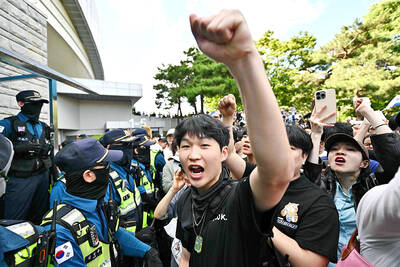
‘ABSURD MISTAKE’: The election commission said that there had been a failure to anticipate turnout after 14 polling stations ran short of ballot papers South Korean riot police yesterday cleared protesters from a Seoul polling station after a 35-hour blockade sparked by a shortage of ballot papers during local elections earlier this week. Wednesday’s election was the first nationwide vote since South Korean President Lee Jae-myung took office following the ouster of Yoon Suk-yeol over his short-lived martial law declaration. Lee’s ruling Democratic Party swept most races, but failed to flip the crucial Seoul mayoral seat. The South Korean National Election Commission apologized, blaming a failure to anticipate turnout after 14 polling stations in Seoul ran short of ballot papers. Some polling stations stayed open until 10pm to

France experienced its hottest spring on record, the French weather service said on Tuesday, after an exceptional early heat wave that also broke highs for the season in England and Wales. Meteo-France said the average nationwide temperature over March to May was 13.8°C — about 1.7°C above the norm, and surpassing records set in 2011 and 2020. “The warmest spring since records began in 1900,” it said in a bulletin. All three months were warmer than average, but the onset of an “unprecedented heatwave” late last month pushed the mercury to highs typically seen at the height of the summer. “Our country had never
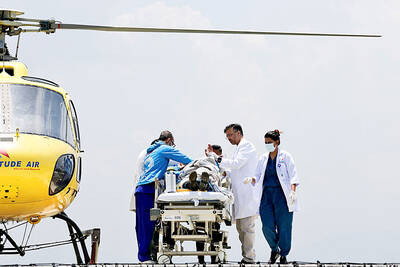
A Sherpa guide was found crawling to base camp on Mount Everest a week after he went missing and was reunited with his family, who had given up hope he would return. Dawa Sherpa was last seen on Friday last week descending the mountain, but he did not reach base camp even though his client did. The pair were among the last climbers on the mountain as the climbing season came to an end and the route was dismantled. Dawa was located by a cleaning crew on Thursday morning as he was crawling down the snowy slopes around the Khumbu Icefall, just above


 RSS
RSS