


Chinese officials urged Hong Kong media to help prevent “external forces” from challenging Beijing’s authority, in the latest sign that the Chinese Communist Party is laying the ground for a tough new security law.
Hong Kong media executives received the warning during a visit to Beijing in the wake of the territory’s decision not to renew the visa of a Financial Times editor who hosted a Foreign Correspondents’ Club speech by a pro-independence activist.
Huang Kunming (黃坤明), the party’s Propaganda Department minister and a member of the Politburo, on Tuesday said that he hoped the media would help “prevent external forces from turning the city into a base for interfering with the mainland.”
The comments were relayed by Siu Sai-wo (蕭世和), a Hong Kong newspaper publisher who led the media delegation to the Chinese capital.
China’s Hong Kong Liaison Office Director Zhang Xiaoming (張曉明) defended the comments during a meeting on Thursday, Siu said.
“It is nothing unusual for state leaders to send out kind reminders that Hong Kong should not be used as an anti-China and anti-Communist Party base,” Siu cited Zhang as saying.
The comments highlighted the growing pressure on Hong Kong’s media in Beijing’s widening campaign to limit dissent in the territory.
While pro-Beijing officials have long complained about the influence of “external forces” — presumably US and UK organizations — the warnings carry greater weight after the territory’s rare decision not to renew Financial Times journalist Victor Mallet’s work visa.
Underscoring such concerns was a controversy over Siu’s account of Huang’s remarks.
The newspaper executive initially said that Huang had warned the media against becoming a base itself for foreign interference, only to later retract and revise the comment.
The Hong Kong Journalists’ Association on Wednesday released a statement demanding that participants explain what Huang had said.
Still, the remarks fanned concerns that Chinese President Xi Jinping (習近平) intends to use the controversy to pressure Hong Kong to enact security legislation that could put new limits on freedom of speech guaranteed before the territory’s return to China.
The legislation, known as Article 23, requires the administration to enact laws that “prohibit foreign political organizations or bodies from conducting political activities in the region.”
In his meeting with media executives, Zhang noted Hong Kong’s failure to pass Article 23, as required by the territory’s Basic Law.
He also expressed support for Hong Kong’s visa decision, which the territory has so far declined to explain.
“They are laying the framework for Article 23,” Chinese University of Hong Kong adjunct professor Willy Lam (林和立) said.
Hong Kong Chief Executive Carrie Lam (林鄭月娥) last week said she wants “to create a favorable social environment” before advancing the legislation.
The government abandoned plans to enact the laws in 2003 after half a million people took to the streets in protest.

Through the noise of rushing papers and whirring belts at a print factory in Kyoto, two creators watch their photo essay come to life in broadsheet form — part of an effort to win new audiences in the age of artificial intelligence (AI). Despite the decline of the publishing industry, self-publication and handmade “zine” magazines are growing in popularity in Japan, reflecting the nation’s enduring love of paper in the digital era. While speaking to Agence France-Presse at the plant, his hands black with ink, one of the creators, Kazuma Obara, said: “I think [paper] is a medium that engages all five
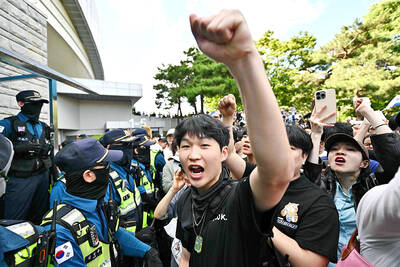
‘ABSURD MISTAKE’: The election commission said that there had been a failure to anticipate turnout after 14 polling stations ran short of ballot papers South Korean riot police yesterday cleared protesters from a Seoul polling station after a 35-hour blockade sparked by a shortage of ballot papers during local elections earlier this week. Wednesday’s election was the first nationwide vote since South Korean President Lee Jae-myung took office following the ouster of Yoon Suk-yeol over his short-lived martial law declaration. Lee’s ruling Democratic Party swept most races, but failed to flip the crucial Seoul mayoral seat. The South Korean National Election Commission apologized, blaming a failure to anticipate turnout after 14 polling stations in Seoul ran short of ballot papers. Some polling stations stayed open until 10pm to

Australian researchers have trained lab-grown brain cells on a silicon computer chip to play the 1990s shooter game Doom and said they are just scratching the surface of what the neurons could be capable of doing. It is the science-fiction work of biotech boffins at Cortical Labs, who researched and developed the technology that harnesses the workings of the brain’s networking system. Each so-called “biological computer” contains about 200,000 living human brain cells, grown from stem cells that were harvested from blood donations. Having mastered the simple computer game Pong, where a paddle is moved up and down to send a ball

France experienced its hottest spring on record, the French weather service said on Tuesday, after an exceptional early heat wave that also broke highs for the season in England and Wales. Meteo-France said the average nationwide temperature over March to May was 13.8°C — about 1.7°C above the norm, and surpassing records set in 2011 and 2020. “The warmest spring since records began in 1900,” it said in a bulletin. All three months were warmer than average, but the onset of an “unprecedented heatwave” late last month pushed the mercury to highs typically seen at the height of the summer. “Our country had never


 RSS
RSS