


Chinese officials pulled a tour by the German theater star Thomas Ostermeier earlier this month when audience members in Beijing shouted slogans demanding free speech, the director said.
Ostermeier, director of Berlin’s famed Schaubuhne theater, said the Chinese tour of Henrik Ibsen’s An Enemy of the People — in which a local doctor fights political corruption — was abruptly cut short by the authorities “because of technical problems.”
His acclaimed version of the 19th-century classic by the Norwegian playwright, which played at the Opera House of the National Center for the Performing Arts near Tiananmen Square, includes a scene where the actors and audience interact.
“When the authorities realized [after the first of three planned performances in Beijing] that it included an interaction, they did everything they could so there would be no scandal,” Ostermeier said. “But the news had spread like wildfire on social media.”
State control of the Internet has been drastically increased under Chinese President Xi Jinping (習近平), with the Web regularly purged of criticism or content judged politically sensitive.
The authorities moved quickly to censor all mention of the scene, “erasing everything that had been said on social media”, said Ostermeier, who is in Paris to premiere his new staging of Shakespeare’s Twelfth Night at the Comedie Francaise.
Ostermeier said he was told to cut the scene, but instead replaced it with an announcement saying that “we would have liked to have a discussion with you, but the actor who was to do it has lost his voice. Has that ever happened to you?”
“Then the whole troupe came on stage and there was two minutes of silence. The audience understood immediately,” Ostermeier said.
“Some started shouting out their support of free speech and individual liberty,” he added.
Ostermeier, who has toured China with his troupe many times before, said he had been told by fellow directors that it “wouldn’t be possible” to stage An Enemy of the People in the country.
The play tells the story of a provincial doctor who discovers that the waters of a spa are contaminated, but when he reveals the scandal he is forced out of his home after being accused of trying to ruin the village.
Ostermeier said he thought that by inviting him to stage the play in China, the authorities wanted to show their openness.
It was only later that “we realized that they had not seen the play in advance, and that from their point of view, there had been an error,” he said.
Further performances in Nanjing were canceled “because of technical problems.”
Ostermeier has shown his adaptation in about 40 countries after it was the hit of the Avignon festival in France in 2012.
Since then he has filmed the scene where the public are invited to speak in every city that it plays for a documentary he is making called Mapping Democracy.
The Beijing show was also filmed although the recording was later confiscated by officials.
However, Ostermeier said that he still has a copy.
“It’s delicate,” he said. “They wanted to watch it to see who had spoken out.”

Through the noise of rushing papers and whirring belts at a print factory in Kyoto, two creators watch their photo essay come to life in broadsheet form — part of an effort to win new audiences in the age of artificial intelligence (AI). Despite the decline of the publishing industry, self-publication and handmade “zine” magazines are growing in popularity in Japan, reflecting the nation’s enduring love of paper in the digital era. While speaking to Agence France-Presse at the plant, his hands black with ink, one of the creators, Kazuma Obara, said: “I think [paper] is a medium that engages all five
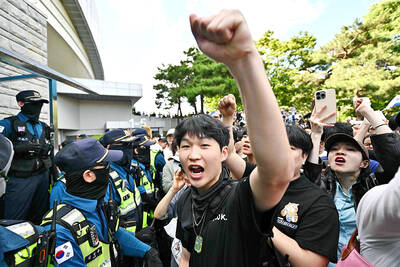
‘ABSURD MISTAKE’: The election commission said that there had been a failure to anticipate turnout after 14 polling stations ran short of ballot papers South Korean riot police yesterday cleared protesters from a Seoul polling station after a 35-hour blockade sparked by a shortage of ballot papers during local elections earlier this week. Wednesday’s election was the first nationwide vote since South Korean President Lee Jae-myung took office following the ouster of Yoon Suk-yeol over his short-lived martial law declaration. Lee’s ruling Democratic Party swept most races, but failed to flip the crucial Seoul mayoral seat. The South Korean National Election Commission apologized, blaming a failure to anticipate turnout after 14 polling stations in Seoul ran short of ballot papers. Some polling stations stayed open until 10pm to

Australian researchers have trained lab-grown brain cells on a silicon computer chip to play the 1990s shooter game Doom and said they are just scratching the surface of what the neurons could be capable of doing. It is the science-fiction work of biotech boffins at Cortical Labs, who researched and developed the technology that harnesses the workings of the brain’s networking system. Each so-called “biological computer” contains about 200,000 living human brain cells, grown from stem cells that were harvested from blood donations. Having mastered the simple computer game Pong, where a paddle is moved up and down to send a ball

France experienced its hottest spring on record, the French weather service said on Tuesday, after an exceptional early heat wave that also broke highs for the season in England and Wales. Meteo-France said the average nationwide temperature over March to May was 13.8°C — about 1.7°C above the norm, and surpassing records set in 2011 and 2020. “The warmest spring since records began in 1900,” it said in a bulletin. All three months were warmer than average, but the onset of an “unprecedented heatwave” late last month pushed the mercury to highs typically seen at the height of the summer. “Our country had never


 RSS
RSS