


Japan yesterday executed six more members of the cult behind the deadly 1995 sarin attack on the Tokyo subway, weeks after the group’s leader was hanged.
Japanese Minister of Justice Yoko Kamikawa confirmed that the six Aum Shinrikyo cult members remaining on death row had been executed yesterday morning.
The executions come after authorities hanged “guru” Shoko Asahara and six of his one-time followers earlier this month, after years on death row.
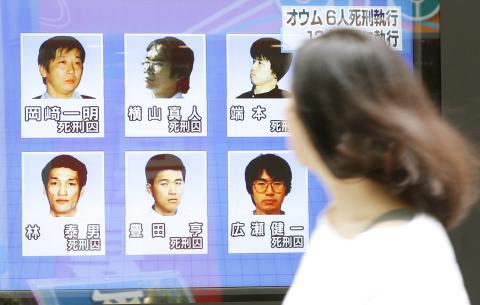
Photo: AP / Kyodo News
“With the 13 members executed, perhaps the case is closed from the point of view of criminal justice,” said Shizue Takahashi, whose husband was killed in the subway attack. “[But] the damage done to the victims continues even after the executions. I find it very hard.”
The additional executions had been widely expected.
In Japan, one of the few developed nations to retain the death penalty, public support remains high, despite international criticism.
“I think we can’t avoid capital punishment for those who have committed extremely heinous crimes,” Kamikawa said.
Local media said authorities wanted to execute all Aum members on death row before the nation’s emperor abdicates next year.
As the group’s crimes were committed within the Heisei era of the current emperor, authorities wanted the executions to be carried out before the new era begins, local media said.
The Aum gained international infamy with the 1995 sarin attack on the Tokyo subway during rush hour, which killed 13 people and injured thousands more.
Members of the group released the chemical in liquid form at five points through the subway network, and soon commuters began struggling to breathe.
Others keeled over, foaming at the mouth, with blood streaming from their noses.
The attack prompted a crackdown on the cult’s headquarters in the foothills of Mount Fuji, where authorities discovered a plant capable of producing enough sarin to kill millions.
Aum members the year before the Tokyo attack were also convicted of an additional sarin attack in the town of Matsumoto, as well as for the murder of an anti-cult lawyer and his family.
The 13 cult members spent years on death row as prosecutors investigated their crimes, while some activists opposed the executions, fearing that the members would be elevated to the status of martyrs.
However, victims of the group’s attacks welcomed the July 6 execution of Asahara and six other Aum members.
One man who was injured in the subway sarin attack told reporters he felt “the world had become slightly brighter” when he heard news of the executions.
Asahara developed his cult in the 1980s, and at one point, the wild-haired “guru” had at least 10,000 followers.
Despite the crackdown on the Aum, it was never formally banned.
It officially disowned Asahara in 2000 and renamed itself Aleph, but experts say the former guru retained a strong influence.
Asahara’s execution set off a battle among his surviving family members for his remains, with his wife and several children who are in successor cults to the Aum seeking to obtain them.
He was cremated days after his execution, and his youngest daughter, who has broken with the Aum’s successor cults, said she would receive his ashes.
Local media reported that the ashes would be scattered at sea to avoid creating a pilgrimage site for Asahara’s followers.
The hanging of Asahara and six other Aum members was Japan’s largest simultaneous execution since 1911, when 11 people were put to death for plotting to assassinate the emperor.

‘CROSSING THE LINE’: China’s embassy in Seoul criticized US Forces Korea Commander General Xavier Brunson, asking if his ‘hostile’ remarks were authorized by Washington South Korea and the US are in talks over recent public remarks by the commander of US Forces Korea, Seoul’s presidential office said yesterday, after the comments drew sharp criticism from China. In a recent podcast interview, US Forces Korea Commander General Xavier Brunson described South Korea as “the dagger in the heart of Asia” from China’s east coast, prompting the Chinese embassy in Seoul to say that he had “truly crossed the line.” The interview came amid growing speculation that Washington might seek to expand the role of US Forces Korea in countering the growing regional influence of China, a key

SEEKING ORDER: Rodrigo Paz said that ‘anyone who wants to destroy the nation will have to deal with this president and the full force of the constitution’ Bolivian President Rodrigo Paz on Wednesday said that the nation was at a “breaking point” after nearly a month of protests that have caused shortages of food, fuel and medicine. Paz, who took office six months ago amid the worst economic crisis there in four decades, is battling a groundswell of fury over his policies. The political capital, La Paz, has been besieged by low-income workers and members of the indigenous majority calling for his resignation. “The country needs order and is reaching breaking point,” the 58-year-old said at a public event in La Paz, renewing his appeal for dialogue. On Tuesday, the Bolivian

Australian researchers have trained lab-grown brain cells on a silicon computer chip to play the 1990s shooter game Doom and said they are just scratching the surface of what the neurons could be capable of doing. It is the science-fiction work of biotech boffins at Cortical Labs, who researched and developed the technology that harnesses the workings of the brain’s networking system. Each so-called “biological computer” contains about 200,000 living human brain cells, grown from stem cells that were harvested from blood donations. Having mastered the simple computer game Pong, where a paddle is moved up and down to send a ball

Through the noise of rushing papers and whirring belts at a print factory in Kyoto, two creators watch their photo essay come to life in broadsheet form — part of an effort to win new audiences in the age of artificial intelligence (AI). Despite the decline of the publishing industry, self-publication and handmade “zine” magazines are growing in popularity in Japan, reflecting the nation’s enduring love of paper in the digital era. While speaking to Agence France-Presse at the plant, his hands black with ink, one of the creators, Kazuma Obara, said: “I think [paper] is a medium that engages all five


 RSS
RSS