


One place China’s Earth-bound and out-of-control space lab, Tiangong-1, will probably not hit today is the forlorn spot in the southern Pacific Ocean where it was supposed to crash.
Officially called an “oceanic pole of inaccessibility,” the watery graveyard for titanium fuel tanks and other high-tech space debris is better known to space junkies as Point Nemo, in honor of Jules Verne’s fictional submarine captain.
Point Nemo is further from land than any other spot on the globe: 2,688km from the Pitcairn Islands to the north, one of the Easter Islands to the northwest, and Maher Island — part of Antarctica — to the south.
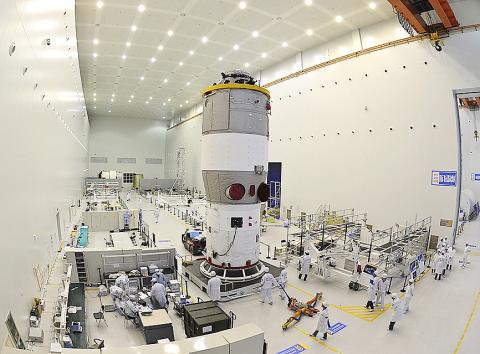
Photo: AP
“Nemo” means “no one” in Latin.
“Its most attractive feature for controlled re-entries is that nobody is living there,” said Stijn Lemmens, a space debris expert at the European Space Agency (ESA) in Darmstadt, Germany.
“Coincidentally, it is also biologically not very diverse. So it gets used as a dumping ground — ‘space graveyard’ would be a more polite term — mainly for cargo spacecraft,” he told reporters.
About 250 to 300 spacecraft — which have mostly burned up as they carved a path through Earth’s atmosphere — have been laid to rest there, he said.
By far the largest object descending from the heavens to splash down at Point Nemo, in 2001, was Russia’s Mir space lab, which weighed 120 tonnes.
“It is routinely used nowadays by the [Russian] Progress capsules, which go back-and-forth to the International Space Station [ISS],” Lemmens said.
The massive, 420-tonne ISS also has a rendezvous with destiny at Point Nemo, in 2024.
Most spacecraft are “designed for demise” with materials that melt at lower temperatures, making them far less likely to survive re-entry and hit Earth’s surface.
NASA and the ESA, for example, are switching from titanium to aluminum in the manufacturing of fuel tanks.
China launched Tiangong-1, its first manned space lab, into space in 2011. It was slated for a controlled re-entry, but ground engineers in March 2016 lost control of the 8-tonne craft, which then began its descent toward a fiery end.
The chances of anyone getting hit by debris from Tiangong-1 are vanishingly small, less than one in 12 trillion, the ESA said.

FRAUD ALLEGED: The leader of an opposition alliance made allegations of electoral irregularities and called for a protest in Tirana as European leaders are to meet Albanian Prime Minister Edi Rama’s Socialist Party scored a large victory in parliamentary elections, securing him his fourth term, official results showed late on Tuesday. The Socialist Party won 52.1 percent of the vote on Sunday compared with 34.2 percent for an alliance of opposition parties led by his main rival Sali Berisha, according to results released by the Albanian Central Election Commission. Diaspora votes have yet to be counted, but according to initial results, Rama was also leading there. According to projections, the Socialist Party could have more lawmakers than in 2021 elections. At the time, it won 74 seats in the

EUROPEAN FUTURE? Albanian Prime Minister Edi Rama says only he could secure EU membership, but challenges remain in dealing with corruption and a brain drain Albanian Prime Minister Edi Rama seeks to win an unprecedented fourth term, pledging to finally take the country into the EU and turn it into a hot tourist destination with some help from the Trump family. The artist-turned-politician has been pitching Albania as a trendy coastal destination, which has helped to drive up tourism arrivals to a record 11 million last year. US President Donald Trump’s son-in-law, Jared Kushner, also joined in the rush, pledging to invest US$1.4 billion to turn a largely deserted island into a luxurious getaway. Rama is expected to win another term after yesterday’s vote. The vote would

CANCER: Jose Mujica earned the moniker ‘world’s poorest president’ for giving away much of his salary and living a simple life on his farm, with his wife and dog Tributes poured in on Tuesday from across Latin America following the death of former Uruguayan president Jose “Pepe” Mujica, an ex-guerrilla fighter revered by the left for his humility and progressive politics. He was 89. Mujica, who spent a dozen years behind bars for revolutionary activity, lost his battle against cancer after announcing in January that the disease had spread and he would stop treatment. “With deep sorrow, we announce the passing of our comrade Pepe Mujica. President, activist, guide and leader. We will miss you greatly, old friend,” Uruguayan President Yamandu Orsi wrote on X. “Pepe, eternal,” a cyclist shouted out minutes later,

Myanmar’s junta chief met Chinese President Xi Jinping (習近平) for the first time since seizing power, state media reported yesterday, the highest-level meeting with a key ally for the internationally sanctioned military leader. Senior General Min Aung Hlaing led a military coup in 2021, overthrowing Myanmar’s brief experiment with democracy and plunging the nation into civil war. In the four years since, his armed forces have battled dozens of ethnic armed groups and rebel militias — some with close links to China — opposed to its rule. The conflict has seen Min Aung Hlaing draw condemnation from rights groups and pursued by the


 RSS
RSS