


Reforms to China’s constitution to remove term limits for the presidency does not mean life-long terms, the ruling Chinese Communist Party’s (CCP) People’s Daily said yesterday, after a surge of concern that Chinese President Xi Jinping (習近平) might stay in power for life.
The party made the announcement on Sunday, setting the stage for Xi to stay in office indefinitely should he wish, prompting accusations from some in the nation that China is set to become another North Korea.
The amendment is to be approved at this month’s annual meeting of the Chinese National People’s Congress, the nation’s largely rubber-stamp parliament, which is stacked with delegates loyal to the party who are not likely to challenge the proposal.
In a lengthy commentary, the People’s Daily said the idea was an “important move” to cement the party’s leadership in every aspect.
“This amendment does not mean changing the retirement system for party and national leaders, and does not mean a life-long term system for leading officials,” the newspaper wrote.
It said that the party’s constitution, which is different from the nation’s constitution, clearly states that leaders cannot keep their offices forever and that if their health does not hold up they should retire.
The regulations for who heads the party, the military and the state — all positions Xi currently holds — are all the same, the newspaper added.
“It is a system designed to accord with the national condition, and ensure long-term peace and stability for the party and the country,” it wrote.
The party has had an unwritten rule that senior officials cannot be promoted once they reach the age of 68, though the party has said that this rule is exactly that — unwritten.
There has been heated speculation since the end of the once-every-five-years CCP National Congress in October last year about the fate of a close Xi ally, former top graft buster Wang Qishan (王岐山), who stepped down from the CCP’s Politburo Standing Committee at the congress, having reached the age of 69.
He is expected to be appointed vice president of the National People’s Congress with a specific role dealing with the administration of US President Donald Trump.
The move is significant because if Wang does not retire, that would set a precedent for Xi, now 64, to stay in power after he reaches what is normally considered retirement age.
Xi is to be formally elected to his second term as president at the National People’s Congress, which opens on Monday next week.
He began his second term as Chinese Communist Party secretary-general in October last year.

PARLIAMENT CHAOS: Police forcibly removed Brazilian Deputy Glauber Braga after he called the legislation part of a ‘coup offensive’ and occupied the speaker’s chair Brazil’s lower house of Congress early yesterday approved a bill that could slash former Brazilian president Jair Bolsonaro’s prison sentence for plotting a coup, after efforts by a lawmaker to disrupt the proceedings sparked chaos in parliament. Bolsonaro has been serving a 27-year term since last month after his conviction for a scheme to stop Brazilian President Luiz Inacio Lula da Silva from taking office after the 2022 election. Lawmakers had been discussing a bill that would significantly reduce sentences for several crimes, including attempting a coup d’etat — opening up the prospect that Bolsonaro, 70, could have his sentence cut to

A powerful magnitude 7.6 earthquake shook Japan’s northeast region late on Monday, prompting tsunami warnings and orders for residents to evacuate. A tsunami as high as three metres (10 feet) could hit Japan’s northeastern coast after an earthquake with an estimated magnitude of 7.6 occurred offshore at 11:15 p.m. (1415 GMT), the Japan Meteorological Agency (JMA) said. Tsunami warnings were issued for the prefectures of Hokkaido, Aomori and Iwate, and a tsunami of 40cm had been observed at Aomori’s Mutsu Ogawara and Hokkaido’s Urakawa ports before midnight, JMA said. The epicentre of the quake was 80 km (50 miles) off the coast of
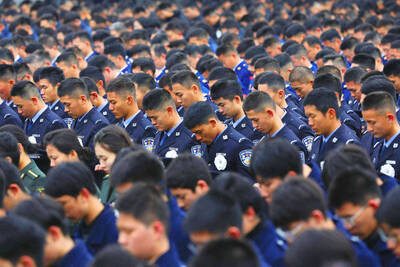
China yesterday held a low-key memorial ceremony for the 1937 Nanjing Massacre, with Chinese President Xi Jinping (習近平) not attending, despite a diplomatic crisis between Beijing and Tokyo over Taiwan. Beijing has raged at Tokyo since Japanese Prime Minister Sanae Takaichi last month said that a hypothetical Chinese attack on Taiwan could trigger a military response from Japan. China and Japan have long sparred over their painful history. China consistently reminds its people of the 1937 Nanjing Massacre, in which it says Japanese troops killed 300,000 people in what was then its capital. A post-World War II Allied tribunal put the death toll

A passerby could hear the cacophony from miles away in the Argentine capital, the unmistakable sound of 2,397 dogs barking — and breaking the unofficial world record for the largest-ever gathering of golden retrievers. Excitement pulsed through Bosques de Palermo, a sprawling park in Buenos Aires, as golden retriever-owners from all over Argentina transformed the park’s grassy expanse into a sea of bright yellow fur. Dog owners of all ages, their clothes covered in dog hair and stained with slobber, plopped down on picnic blankets with their beloved goldens to take in the surreal sight of so many other, exceptionally similar-looking ones.


 RSS
RSS