


Spray can in hand perched halfway up a ladder, Neequaye Dreph Dsane applied the final touches of color to his latest mural enlivening an otherwise drab side street in east London.
The once-dingy area is now a hipster hangout and home to the second in a series of new portraits by the British-Ghanaian artist, known as Dreph.
His mission: To paint a positive picture — literally — of immigrants in Britain, in an era when he feels they are increasingly maligned by gentrification, Brexit and the rise of nationalism.
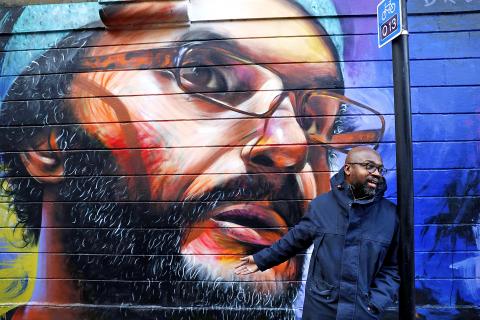
Photo: AFP
The muralist, who rose to prominence last year with a striking street portrait series celebrating black female empowerment, wants to use his rising profile to showcase these “community champions.”
“With Brexit and seeing the effects of gentrification that’s happening across the city, I’ve been inspired to tell the human stories of the people who are the soul of some of the communities that make London such a culturally rich, cosmopolitan city,” Dreph told reporters between bursts of spray paint. “I don’t think we hear enough about the people who have come from different parts of the world and just done some absolutely amazing stuff for their communities, which is essential for this country.”
Dreph’s latest mural depicts Hassan Hajjaj, a British-Moroccan artist who divides his time between the two countries and has had an office-showroom-shop in Shoreditch since 2005.
Hajjaj mines various contemporary cultures in his works — which include photographs, video, sculpture and design — earning him the moniker the “Andy Warhol of Marrakesh.”
He exhibited at London’s Somerset House galleries late last year.
Dreph, 43, was inspired to paint his friend Hajjaj because “he has managed to fuse his native Marrakesh with things that are popular to the West.”
“That’s what his work is about and... exactly what I’m trying to do with this series,” Dreph said.
In the mural — nearly 3m high and more than 6m wide — Hajjaj poses intensely, his graying beard intricately captured with speckles of white spray paint, framed by an eye-catching purple background.
“I still feel a bit strange seeing myself that big,” Hajjaj said, staring up at the wall. “I feel very proud to be a part of Dreph’s body of work... He’s trying to present people of color, people from a different background coming here.”
“We don’t have that many people present, people like us in London in music, fashion, art, food,” Hajjaj added.
Dreph, a father of one and former graffiti artist and school art teacher, has produced his work on streets around the world.
In London, he gets informal agreement to convert walls into canvases, often just knocking on people’s doors to ask permission.
His “You Are Enough” portraits project, completed last year, went viral across platforms such as Instagram and Twitter, and was covered by British media.
Dreph said he conceived the 10-mural series to champion oft-overlooked everyday black women, from lawyers to writers to campaigners.
He did not stage any formal publicity and was surprised by the widespread attention.
“It was all organic and that’s something that I hold dear... The integrity is absolutely paramount to what I do,” Dreph said.
In his follow-up series, the artist plans to produce another 10 portraits around the British capital on the theme of immigration.
He aims to paint his subjects where they live or work, in an effort to celebrate the local and confront issues around gentrification stoked by “You Are Enough.”
“People are actually seeing the artwork as another sign of gentrification,” he said, admitting initial surprise at the reaction. “This series is a response to that... My work is about presenting alternative narratives.”
Dreph completed the first piece of the new project last year: A 6.7m mural towering over central Brixton, a fast-gentrifying south London neighborhood long home to British-Caribbean and British-African communities.
It features local legend Michael Johns, a facilities manager who emigrated from Grenada in the 1970s and was awarded the keys to Brixton Market last year in honor of his years of service.
The mural showcases Dreph’s signature style: larger-than-life subjects emblazoned in bright, bold colors, exuding pride and optimism.
He paints from his own photographs, and credits his vibrant and joyful style to something in his subconscious — and background.
“My portraiture is born out of years and years of doing graffiti... I’ve translated it into what I’m doing now,” Dreph said.
‘CROSSING THE LINE’: China’s embassy in Seoul criticized US Forces Korea Commander General Xavier Brunson, asking if his ‘hostile’ remarks were authorized by Washington South Korea and the US are in talks over recent public remarks by the commander of US Forces Korea, Seoul’s presidential office said yesterday, after the comments drew sharp criticism from China. In a recent podcast interview, US Forces Korea Commander General Xavier Brunson described South Korea as “the dagger in the heart of Asia” from China’s east coast, prompting the Chinese embassy in Seoul to say that he had “truly crossed the line.” The interview came amid growing speculation that Washington might seek to expand the role of US Forces Korea in countering the growing regional influence of China, a key

SEEKING ORDER: Rodrigo Paz said that ‘anyone who wants to destroy the nation will have to deal with this president and the full force of the constitution’ Bolivian President Rodrigo Paz on Wednesday said that the nation was at a “breaking point” after nearly a month of protests that have caused shortages of food, fuel and medicine. Paz, who took office six months ago amid the worst economic crisis there in four decades, is battling a groundswell of fury over his policies. The political capital, La Paz, has been besieged by low-income workers and members of the indigenous majority calling for his resignation. “The country needs order and is reaching breaking point,” the 58-year-old said at a public event in La Paz, renewing his appeal for dialogue. On Tuesday, the Bolivian

Through the noise of rushing papers and whirring belts at a print factory in Kyoto, two creators watch their photo essay come to life in broadsheet form — part of an effort to win new audiences in the age of artificial intelligence (AI). Despite the decline of the publishing industry, self-publication and handmade “zine” magazines are growing in popularity in Japan, reflecting the nation’s enduring love of paper in the digital era. While speaking to Agence France-Presse at the plant, his hands black with ink, one of the creators, Kazuma Obara, said: “I think [paper] is a medium that engages all five

Australian researchers have trained lab-grown brain cells on a silicon computer chip to play the 1990s shooter game Doom and said they are just scratching the surface of what the neurons could be capable of doing. It is the science-fiction work of biotech boffins at Cortical Labs, who researched and developed the technology that harnesses the workings of the brain’s networking system. Each so-called “biological computer” contains about 200,000 living human brain cells, grown from stem cells that were harvested from blood donations. Having mastered the simple computer game Pong, where a paddle is moved up and down to send a ball


 RSS
RSS